Introduction
Reactive oxygen species are frequently described as harmful molecules that should be eliminated. However, the reality is more complex.
Every day, our cells produce reactive molecules as part of normal energy production, immune defence, exercise and cellular communication. In controlled amounts, some of these molecules perform essential functions. Problems can arise when their production becomes excessive or the body can no longer regulate them effectively.
This imbalance is known as oxidative stress.
Molecular hydrogen therapy is being studied because it appears to influence excessive oxidative stress without indiscriminately removing the reactive molecules our cells need. But why do our cells require some ROS, which reactive molecules are potentially harmful, and how might molecular hydrogen interact with them?
Understanding hydrogen therapy and redox signalling begins with recognising one essential principle:
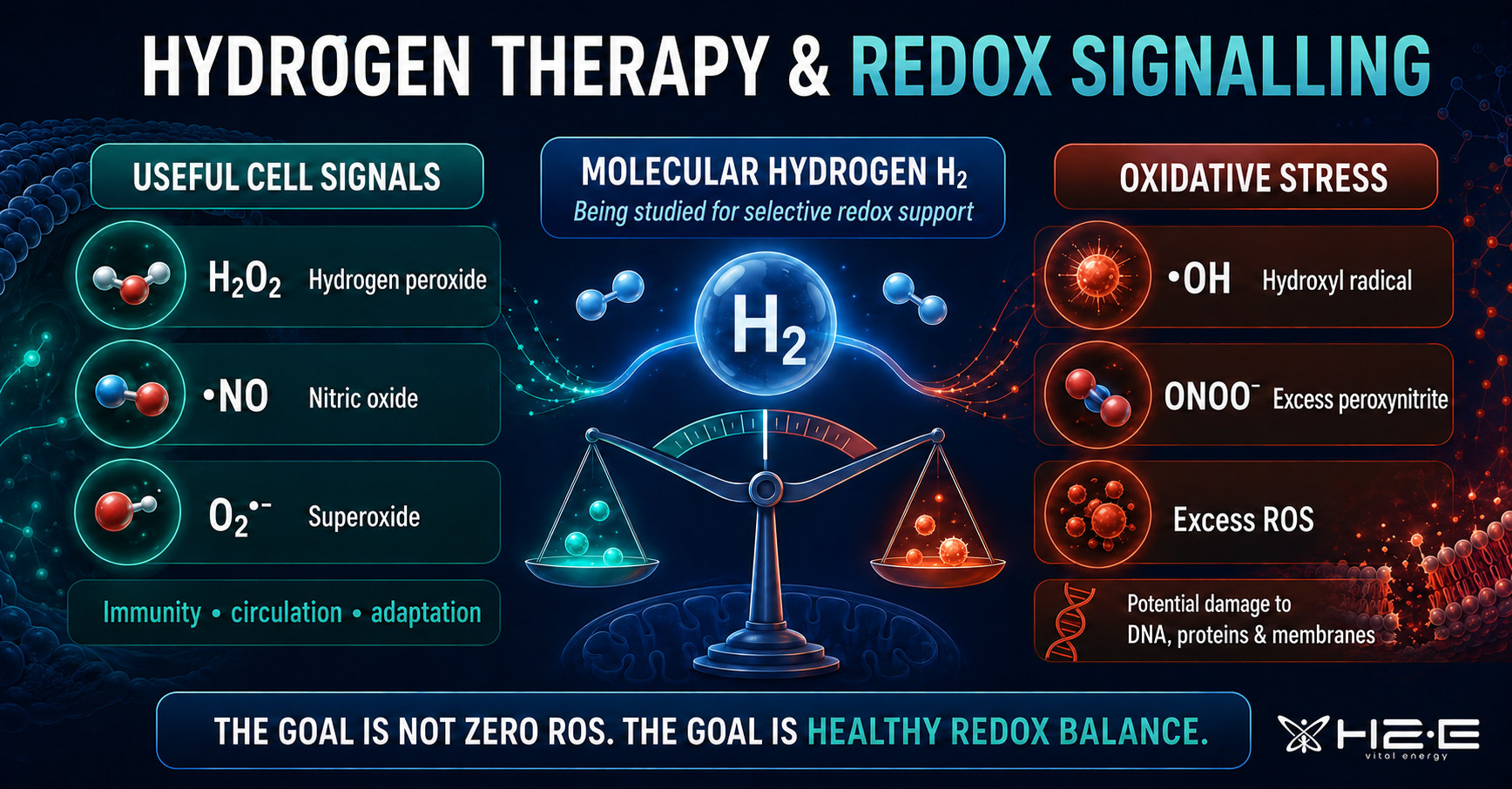
The goal is not to eliminate every reactive molecule. The goal is to maintain a healthy redox balance.
What is redox signalling?
Redox signalling is one of the communication systems cells use to monitor their environment and control their activity.
The word “redox” comes from two chemical processes:
- Reduction
- Oxidation
These processes involve the movement of electrons between molecules. During normal metabolism, cells produce reactive oxygen species and related molecules that can temporarily modify proteins and activate cellular pathways.
In appropriate amounts, these reactive molecules act like short-lived messages. They can tell cells when to:
- Respond to exercise
- Produce antioxidant enzymes
- Manage inflammation
- Fight microorganisms
- Repair cellular damage
- Adapt to environmental stress
- Regulate blood vessels
- Remove cells that are no longer functioning properly
A useful way to understand this is to imagine ROS as cellular alarm signals.
A controlled alarm can alert the body to a problem and initiate an appropriate response. Too many alarms, however, can create confusion and damage. Removing every alarm would also be undesirable because the body could lose part of its ability to recognise and respond to danger.
Are all free radicals and ROS harmful?
No. The term “free radical” is often used as though it describes one harmful substance, but it includes a variety of chemically different molecules.
Their effects depend on:
- The particular molecule involved
- How much is produced
- Where it is produced
- How long it remains present
- What other molecules are nearby
- Whether the body can control it effectively
Some reactive molecules participate in normal cellular signalling. Others are highly reactive and have no established controlled signalling role.
For example, hydrogen peroxide can help transmit messages inside cells. Nitric oxide helps regulate blood flow. The hydroxyl radical, by contrast, reacts almost immediately with nearby cellular structures and is strongly associated with molecular damage.
Therefore, dividing all reactive molecules into simply “good” or “bad” can be misleading. Their chemistry, concentration, location and biological context all matter.
The important reactive molecules
Not every reactive molecule is produced in the same way or performs the same function.
| Reactive molecule | Classification | How is it formed? | Useful physiological roles | Potential harm | Does H₂ directly target it? |
|---|---|---|---|---|---|
| Superoxide (O₂•−) | Reactive oxygen species | Produced when oxygen receives an extra electron. Common sources include mitochondrial energy production, NADPH oxidase activity in immune cells and enzymes such as xanthine oxidase. | Helps immune cells attack microorganisms and contributes to redox signalling. It is also used to produce other signalling molecules. | Excess superoxide can contribute to oxidative damage and react with nitric oxide to produce peroxynitrite. | Molecular hydrogen has not been shown to react efficiently with superoxide under normal biological conditions. |
| Hydrogen peroxide (H₂O₂) | Reactive oxygen species | Primarily formed when superoxide dismutase converts superoxide into hydrogen peroxide. It can also be produced by oxidase enzymes and activated immune cells. | Participates in cellular communication, immune defence, wound responses, exercise adaptation and activation of antioxidant defences. | Excessive concentrations can oxidise cellular components and contribute to hydroxyl-radical formation. | H₂ does not appear to neutralise hydrogen peroxide directly under normal physiological conditions. |
| Hydroxyl radical (•OH) | Reactive oxygen species | Commonly formed when hydrogen peroxide reacts with available reduced iron through the Fenton reaction. It may also arise through radiation, severe inflammation and other reactions involving oxygen-derived molecules and transition metals. | It has no established controlled signalling role because it reacts almost immediately with nearby molecules. | It can damage DNA, proteins, cell membranes and mitochondria. | Foundational laboratory research found that H₂ could reduce hydroxyl radicals. The significance of direct scavenging inside humans is still being investigated. |
| Nitric oxide (•NO) | Reactive nitrogen species | Produced from the amino acid L-arginine by nitric oxide synthase enzymes in blood vessels, nerves and immune cells. | Helps regulate blood-vessel relaxation, circulation, nerve communication and immune responses. | Excessive or poorly regulated production may contribute to nitrosative stress, especially when superoxide is elevated. | H₂ has not been shown to directly neutralise nitric oxide under normal biological conditions. |
| Peroxynitrite (ONOO−) | Reactive nitrogen species | Formed when nitric oxide reacts rapidly with superoxide. | Low concentrations may participate in certain signalling processes, although its normal role is less clearly defined than those of nitric oxide and hydrogen peroxide. | Elevated levels can modify proteins, fats, mitochondria and DNA. | Hydrogen has been proposed to reduce damage associated with peroxynitrite, but the direct reaction and its importance in humans remain uncertain. |
Nitric oxide and peroxynitrite are technically reactive nitrogen species rather than reactive oxygen species. However, they are frequently discussed alongside ROS because oxygen- and nitrogen-derived molecules interact closely within redox biology.
Why do cells need hydrogen peroxide?
Hydrogen peroxide is often associated with bleaching agents and disinfectants, but cells also produce it naturally in extremely small, controlled amounts.
At physiological concentrations, hydrogen peroxide can act as a cellular messenger. It temporarily modifies particular proteins and helps regulate pathways involved in:
- Metabolism
- Immune responses
- Tissue repair
- Adaptation to exercise
- Antioxidant-enzyme production
- Cell growth and survival
Exercise provides a helpful example. Physical activity temporarily increases the production of reactive molecules. This controlled stress helps signal the body to adapt by strengthening its protective systems.
Attempting to eliminate every molecule of hydrogen peroxide could therefore interfere with some of these beneficial adaptations. The objective is regulation, not complete removal.
Why is nitric oxide beneficial?
Nitric oxide is not technically an ROS, but it is an important part of the wider redox-signalling network.
Cells lining the blood vessels produce nitric oxide to help the vessels relax and widen. This supports circulation and helps regulate blood pressure.
Nitric oxide also participates in:
- Nerve communication
- Immune defence
- Delivery of blood and oxygen to tissues
- Exercise responses
- Regulation of platelet activity
Nevertheless, nitric oxide is not always beneficial in every amount or location. When nitric oxide encounters excessive superoxide, the two can react to produce peroxynitrite.
This illustrates why redox biology is about balance. A useful signalling molecule can contribute to a damaging reaction when the surrounding chemical environment changes.
Why is the hydroxyl radical particularly harmful?
The hydroxyl radical is considered one of the most reactive oxygen-derived radicals found in biological systems.
One way it can be produced is through the Fenton reaction, when hydrogen peroxide encounters available reduced iron:
Fe²⁺ + H₂O₂ → Fe³⁺ + OH⁻ + •OH
The resulting hydroxyl radical is exceptionally reactive and extremely short-lived. It does not travel around the body searching for a target. Instead, it reacts almost immediately with a suitable molecule close to where it was formed.
Depending on its location, that reaction may damage:
- DNA
- Proteins
- Cell membranes
- Lipids
- Mitochondrial structures
Unlike hydrogen peroxide, the hydroxyl radical has no established controlled signalling function. The body also has no enzyme that can simply remove it after it has formed because it reacts too rapidly.
Preventing excessive hydroxyl-radical formation and limiting the resulting damage are therefore important aspects of redox protection.
Where does molecular hydrogen fit?
Molecular hydrogen, written as H₂, is a colourless and odourless gas composed of two hydrogen atoms.
Because it is exceptionally small, H₂ can diffuse rapidly through biological membranes and enter cellular compartments. Researchers are studying whether it may influence oxidative stress, inflammatory signalling, mitochondrial function and the body’s natural protective systems.
Scientific interest increased substantially after a foundational 2007 study reported that molecular hydrogen reduced highly damaging hydroxyl radicals while not directly reacting with several reactive molecules involved in physiological processes.
This led to molecular hydrogen being widely described as a “selective antioxidant.”
That description is useful, but it can also oversimplify the science. Molecular hydrogen may not work only by directly neutralising radicals. Its biological effects may also involve changes in redox-related signalling and the activation of the body’s endogenous defence systems.
How is molecular hydrogen different from conventional antioxidants?
Conventional dietary antioxidants—including vitamin C, vitamin E and many plant compounds—are essential parts of normal nutrition and help protect the body against oxidative damage.
However, antioxidants do not all work in the same way.
Vitamin C can donate electrons to several different reactive molecules and can also help regenerate vitamin E. This broad antioxidant activity is normally beneficial and vitamin C remains an essential nutrient. However, when taken in large supplemental doses, it may sometimes reduce reactive signals that the body uses for adaptation.
This has been studied particularly in exercise. Physical activity produces a temporary increase in ROS that helps activate mitochondrial development and the body’s own antioxidant defences. Some studies suggest that high-dose vitamin C, especially when combined with vitamin E, may dampen certain exercise-induced redox signals. Other studies have found little or no meaningful interference, so the effect appears to depend on the dose, timing, individual and type of exercise.
Molecular hydrogen appears to behave differently. Foundational laboratory research found that H₂ could reduce highly damaging hydroxyl radicals while not directly reacting efficiently with signalling molecules such as hydrogen peroxide, superoxide or nitric oxide under the tested conditions.
This does not mean that vitamin C is harmful or that hydrogen is always superior. Vitamin C is an essential nutrient with many important biological functions, whereas molecular hydrogen remains an emerging intervention under scientific investigation.
The key distinction is that H₂ appears to influence redox balance without acting as a broad antioxidant against every reactive molecule it encounters. Its reported effects may also involve modulation of the body’s own protective pathways rather than direct radical scavenging alone.
Molecular hydrogen should not be viewed as a replacement for dietary antioxidants. It represents a different and still-developing approach to redox regulation.
Why doesn’t hydrogen remove beneficial ROS?
Molecular hydrogen does not possess biological intelligence. It cannot consciously recognise whether a molecule is beneficial or harmful.
Its apparent selectivity comes from chemistry.
H₂ is a relatively stable molecule. It does not readily react with every oxidising substance it encounters. Important signalling molecules such as hydrogen peroxide, superoxide and nitric oxide are not efficiently neutralised through a simple direct reaction with molecular hydrogen under normal biological conditions.
The hydroxyl radical is chemically different. It is exceptionally reactive, damaging and has no established controlled signalling role.
Foundational laboratory research found that molecular hydrogen could reduce hydroxyl radicals while leaving hydrogen peroxide, superoxide and nitric oxide comparatively unaffected.
This is why molecular hydrogen may be different from an indiscriminate antioxidant that suppresses a wide range of oxidants.
However, saying that H₂ “only targets harmful ROS” would be too absolute. Scientists continue to investigate which reactions occur directly inside the human body and which effects are produced indirectly through changes in cellular signalling.
A more scientifically accurate explanation is:
Molecular hydrogen appears to influence excessive oxidative stress without indiscriminately neutralising the reactive molecules required for normal cellular signalling.
Molecular hydrogen may do more than neutralise radicals
The original selective-antioxidant explanation focused primarily on direct reactions with highly damaging radicals.
Newer research suggests the mechanism may be more complex.
Hydroxyl radicals react almost instantly with many nearby biological molecules. Because of this extremely rapid reaction rate, some researchers question whether direct scavenging alone can explain all the reported biological effects of molecular hydrogen.
Researchers are now investigating whether H₂ may also influence:
- Nrf2 and the body’s antioxidant-response system
- Mitochondrial stress responses
- Inflammatory pathways
- Gene expression
- Cellular survival pathways
- Production of endogenous antioxidant enzymes
- Adaptation to temporary cellular stress
These possible mechanisms could help explain why the biological effects attributed to hydrogen sometimes continue beyond the brief period during which measurable H₂ remains inside the body.
Molecular hydrogen may therefore be better understood as a potential redox-modulating molecule rather than simply a conventional antioxidant.
Could hydrogen reduce ROS too much?
This is an important and reasonable safety question.
Current research has not shown that molecular hydrogen inhalation eliminates all ROS or switches off normal redox signalling. H₂ also does not appear to accumulate permanently in the body. After administration stops, it diffuses out relatively quickly, mainly through the lungs.
Small human studies have generally reported good short-term tolerance. Some research has included regular inhalation over several weeks without identifying evidence that beneficial ROS signalling was eliminated.
However, long-term human evidence remains limited.
Researchers have not yet established whether unrestricted inhalation for several hours every day over many years could subtly affect:
- Exercise adaptation
- Immune signalling
- Mitochondrial responses
- Normal ROS-dependent communication
- Other long-term biological functions
The absence of a demonstrated problem is reassuring, but it is not the same as conclusive proof that every concentration, session length and pattern of long-term use is risk-free.
For that reason, molecular hydrogen should be discussed responsibly and without claiming that unlimited use has been definitively proven safe.
Supporting redox balance—not eliminating oxidation
The human body already contains sophisticated systems for controlling reactive molecules.
These include:
- Superoxide dismutase
- Catalase
- Glutathione
- Glutathione peroxidase
- Peroxiredoxins
- Thioredoxin systems
Together, these systems help produce, use and remove reactive molecules according to the body’s needs.
The objective of redox health is not to create a body with no oxidation. Oxidation is a normal part of metabolism, immunity and life itself.
The objective is to prevent uncontrolled oxidative stress while preserving the signals required for healthy cellular function.
Molecular hydrogen is scientifically interesting because it may support this balance without behaving like a broad chemical suppressor of every reactive molecule.
Explore the molecular hydrogen research
Research into molecular hydrogen now includes laboratory investigations, animal models and human clinical studies covering several areas of health and cellular function.
The evidence is developing, and not every proposed benefit has been established conclusively in humans.
To explore the studies, proposed mechanisms and potential applications in greater detail, visit our Molecular Hydrogen Scientific Library.
Conclusion
Reactive oxygen species are not automatically harmful. Molecules such as hydrogen peroxide participate in normal cellular communication, while nitric oxide—technically a reactive nitrogen species—supports circulation, nerve signalling and immune function.
Problems can occur when reactive molecules are produced in excessive amounts, appear in the wrong location or overwhelm the body’s protective systems.
The hydroxyl radical is particularly concerning because it is exceptionally reactive, has no established controlled signalling function and may rapidly damage nearby cellular structures.
Current research suggests that molecular hydrogen may influence damaging oxidative stress while preserving important signalling molecules such as hydrogen peroxide and nitric oxide. Its effects may involve selective chemical reactivity as well as modulation of the body’s own protective pathways.
Nevertheless, molecular hydrogen research is still developing. Larger and longer human studies are needed to determine its clinical benefits, optimal applications and long-term effects.
The goal is not zero ROS. The goal is healthy redox balance.