Hydrogen therapy and urolithin A
Mitochondria are often described as the power stations of our cells. They convert nutrients into adenosine triphosphate (ATP), the usable energy required for movement, repair, signalling and nearly every other biological process.
But mitochondria are not permanent structures. Over time, some become damaged or inefficient. Cells therefore need systems that can both protect mitochondria from excessive stress and identify and recycle mitochondria that no longer function properly.
This is where two emerging areas of longevity and mitochondrial research—urolithin A and molecular hydrogen (H₂)—become particularly interesting.
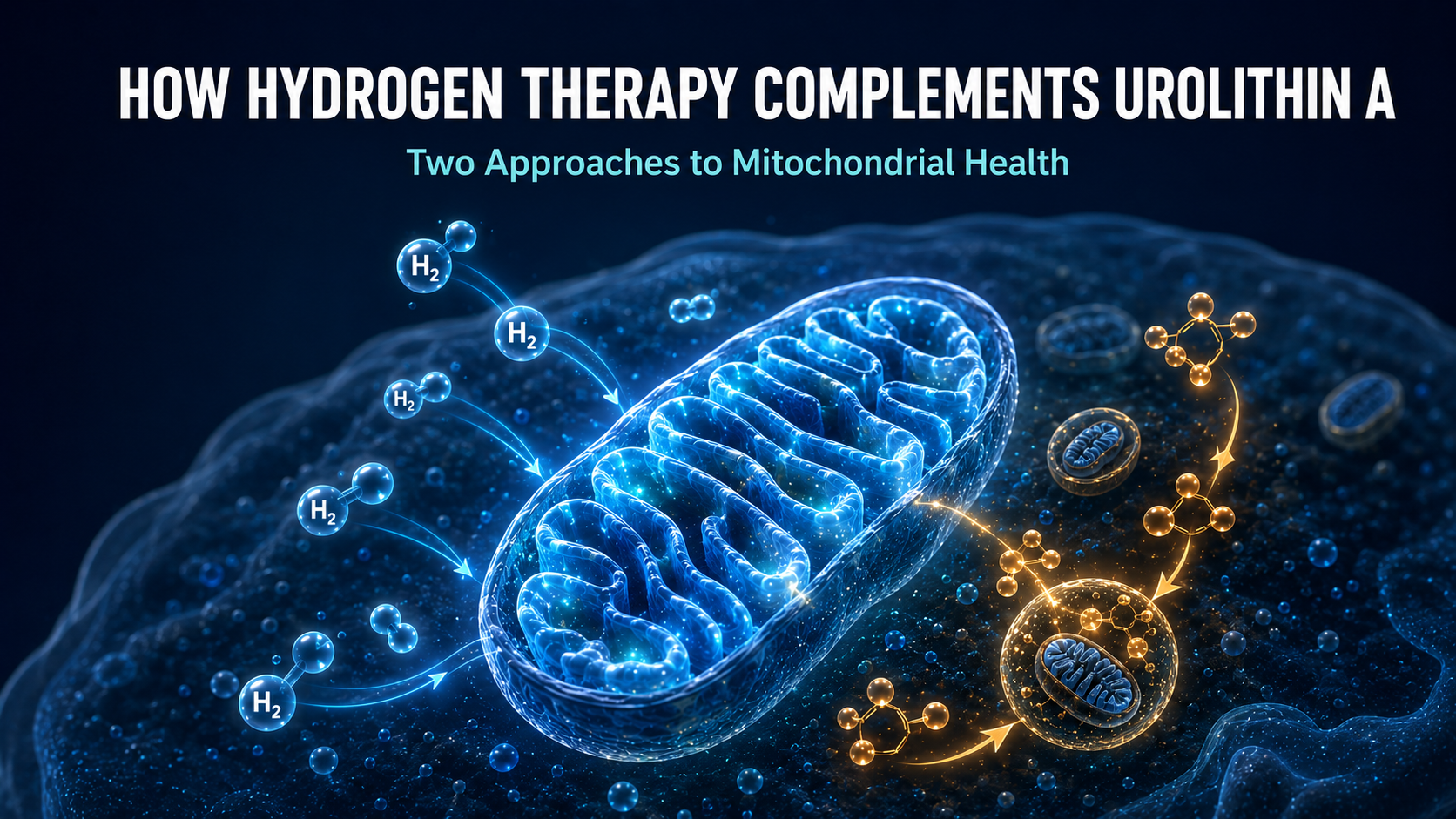
Although they are sometimes discussed for similar goals, they are not interchangeable. Urolithin A is best known for its role in mitophagy, the selective recycling of damaged mitochondria. Molecular hydrogen appears to act more broadly through redox regulation, antioxidant defence, inflammatory signalling and mitochondrial protection.
A useful way to understand the difference is:
Urolithin A may help the cell remove worn-out mitochondria, while molecular hydrogen may help regulate the stressful cellular environment in which mitochondria operate.
This raises an intriguing possibility: could these two approaches complement one another? The cellular rationale is plausible, but direct clinical evidence for using them together is not yet available.
What is urolithin A?
Urolithin A is a postbiotic compound. It can be produced by certain intestinal bacteria after we consume ellagitannins and ellagic acid—plant compounds found in foods such as pomegranates, walnuts and some berries.
However, people differ considerably in their ability to produce urolithin A because their gut microbiomes are different. Consuming pomegranate therefore does not guarantee that someone will generate a meaningful amount of urolithin A. Direct urolithin A supplements are designed to bypass this variability.
Urolithin A attracted scientific interest after researchers found that it could stimulate mitophagy in experimental models.
What is mitophagy?
Mitophagy is the cell’s mitochondrial quality-control system. When a mitochondrion becomes dysfunctional, the cell can identify it, break it down and recycle its components.
Efficient mitophagy helps prevent damaged mitochondria from accumulating. This matters because poorly functioning mitochondria may:
-
Produce energy less efficiently
-
Generate excessive reactive oxygen species
-
Disturb metabolic and inflammatory signalling
-
Contribute to declining muscle function with age
Foundational research showed that urolithin A induced mitophagy in cells and animals, extended lifespan in worms and improved muscle function in rodent models. These findings should not be interpreted as proof that it extends human lifespan, but they established its biological mechanism and supported subsequent human research.
Human trials have since reported changes in mitochondrial biomarkers and some improvements in muscle strength or endurance, particularly in middle-aged and older adults. Results have not been uniformly positive: in one randomised trial, improvements in maximal ATP production and six-minute walking distance were not statistically significant compared with placebo, although certain muscle-endurance measures and biomarkers were more favourable.
The evidence therefore suggests that urolithin A is a promising and relatively targeted mitochondrial-quality intervention—but not a guaranteed treatment for fatigue, ageing or muscle loss.
What does molecular hydrogen do inside the cell?
Molecular hydrogen is the smallest molecule in existence. Its size allows it to diffuse rapidly through biological membranes and enter cellular compartments, including mitochondria.
Early explanations described H₂ principally as a selective antioxidant capable of reducing highly damaging reactive species. Current research suggests that this description is incomplete. Molecular hydrogen may also affect redox-sensitive signalling pathways, helping cells regulate their own protective responses.
Proposed and observed effects in experimental research include:
-
Modulation of oxidative stress
-
Activation of the Nrf2 antioxidant-response pathway
-
Reduced lipid peroxidation
-
Modulation of inflammatory signalling, including NF-κB-related pathways
-
Support for mitochondrial membrane function
-
Regulation of apoptosis and other cell-survival responses
Rather than acting like a conventional antioxidant that attempts to neutralise every reactive molecule, H₂ is increasingly investigated as a possible redox-modulating or hormetic signalling molecule.
This distinction matters because reactive oxygen species are not universally harmful. At controlled levels, they help regulate normal cellular communication, immune responses and adaptation to exercise. The goal is not to remove all oxidation, but to help restore balance when oxidative stress becomes excessive.
Researchers are still investigating the exact primary molecular targets of H₂. Much of the mechanistic evidence comes from cellular and animal research, and human results vary according to the population, condition, dose, delivery method and study design.
Urolithin A and molecular hydrogen: what is the difference?
| Cellular area | Urolithin A | Molecular hydrogen |
|---|---|---|
| Best-known role | Supports mitophagy and mitochondrial quality control | Modulates oxidative stress and cellular signalling |
| Damaged mitochondria | Helps the cell identify and recycle dysfunctional mitochondria | May help limit stress-related mitochondrial damage |
| Antioxidant response | Can influence pathways such as Nrf2 | Reported to activate endogenous antioxidant defences, including Nrf2 |
| Inflammatory signalling | Has shown anti-inflammatory activity in experimental research | May modulate inflammatory pathways such as NF-κB |
| Human evidence | Most developed around muscle function and mitochondrial biomarkers | Studied across many areas, but clinical evidence is heterogeneous |
| Time profile | Regular oral use over weeks or months | Enters tissues quickly but is also rapidly cleared |
In simple terms, urolithin A focuses more directly on mitochondrial housekeeping, whereas molecular hydrogen appears to have a broader role in cellular stress regulation and protection.
How might hydrogen therapy complement urolithin A?
The potential complementarity can be understood as a two-part mitochondrial strategy.
1. Urolithin A may support mitochondrial recycling
By promoting mitophagy, urolithin A may help remove mitochondria that have become inefficient or damaged. This is comparable to a cellular recycling crew clearing machinery that no longer works properly.
2. Molecular hydrogen may support the surrounding cellular environment
Molecular hydrogen may help regulate oxidative and inflammatory stress, potentially reducing pressure on both existing mitochondria and the cellular systems responsible for repair and adaptation.
3. Quality control and cellular protection could be biologically complementary
Removing dysfunctional mitochondria and regulating the conditions that contribute to mitochondrial stress are different—but potentially compatible—goals.
The theoretical sequence would be:
-
Damaged or inefficient mitochondria are identified.
-
Mitophagy removes and recycles them.
-
Mitochondrial renewal and biogenesis help maintain the cellular energy network.
-
Redox and inflammatory regulation help protect mitochondrial function and cellular balance.
Urolithin A is most closely associated with the first part of this process. Molecular hydrogen may influence the fourth and possibly other parts through broader signalling effects.
Some laboratory and animal studies suggest that H₂ can influence autophagy or mitophagy under particular stress conditions. However, hydrogen should not currently be presented as a clinically established mitophagy activator equivalent to urolithin A.
Has the combination been clinically tested?
At present, there is no robust human clinical evidence demonstrating that combining molecular hydrogen therapy with urolithin A produces better health outcomes than using either intervention alone.
That means it would be premature to claim that the combination:
-
Produces more ATP
-
Reverses mitochondrial ageing
-
Prevents age-related muscle loss
-
Treats fatigue or mitochondrial disease
-
Extends human lifespan
The two interventions have overlapping research themes and a plausible complementary rationale, but biological plausibility is not the same as clinical proof.
Future controlled trials would need to compare urolithin A, molecular hydrogen, the combination and placebo while measuring outcomes such as mitophagy markers, mitochondrial respiration, muscle performance, fatigue and safety.
Could they be used as part of the same wellness routine?
Because they use different delivery routes and appear to influence different cellular processes, some people may consider incorporating both into a broader wellness or healthy-ageing routine.
However, there is no validated combined protocol, ideal sequence or proven dose relationship. Product quality and individual health circumstances also matter.
Anyone who is pregnant, breastfeeding, receiving cancer treatment, managing a significant medical condition or taking prescription medication should discuss new supplements and therapies with an appropriately qualified healthcare professional.
Neither approach replaces the foundations of mitochondrial and muscular health:
-
Regular resistance and aerobic exercise
-
Adequate protein and overall nutrition
-
Restorative sleep
-
Appropriate management of metabolic or inflammatory disease
-
Correction of relevant nutrient deficiencies
Supplements and emerging therapies should sit around those foundations—not substitute for them.
The H2=E perspective
Urolithin A and molecular hydrogen illustrate two distinct directions in mitochondrial research.
Urolithin A is being studied as a targeted activator of mitochondrial recycling and quality control. Molecular hydrogen is being studied as a fast-diffusing molecule that may help cells regulate oxidative stress, inflammation and mitochondrial function.
The most scientifically responsible conclusion is not that one is superior, or that combining them is proven. It is that they may address different parts of the same cellular challenge:
Urolithin A may help clear damaged mitochondrial machinery; molecular hydrogen may help regulate the cellular stress that affects how that machinery functions.
That makes the combination scientifically interesting and worthy of further study. For now, however, it remains a complementary hypothesis rather than an established clinical protocol.
Frequently asked questions
Is molecular hydrogen the same as urolithin A?
No. Molecular hydrogen is a gas that rapidly diffuses through tissues and appears to influence redox and inflammatory signalling. Urolithin A is a postbiotic compound taken orally and is best known for stimulating mitophagy.
Does molecular hydrogen activate mitophagy?
Some experimental studies suggest that H₂ can regulate autophagy or mitophagy in particular models of cellular stress. This has not been established as its primary mechanism in humans, so hydrogen should not be described as a proven substitute for urolithin A.
Does urolithin A act as an antioxidant?
Urolithin A has demonstrated antioxidant and anti-inflammatory effects in experimental research, including effects on Nrf2 signalling. Its defining research focus, however, is mitochondrial quality control through mitophagy.
Can hydrogen therapy and urolithin A be used together?
They may be compatible for some individuals, but no robust clinical trials have established the benefits, optimum timing or long-term effects of the combination. Speak to a qualified healthcare professional if you have a medical condition or use medication.
Which one is better for mitochondrial health?
There is no universal answer because they do not perform identical roles. Urolithin A has more targeted evidence around mitophagy and aspects of muscle health. Hydrogen has a broader but less precisely defined research profile involving oxidative stress, inflammation and mitochondrial protection.
References
-
Ryu D, et al. Urolithin A induces mitophagy and prolongs lifespan in C. elegans and increases muscle function in rodents. Nature Medicine. 2016. View study
-
Andreux PA, et al. The mitophagy activator urolithin A is safe and induces a molecular signature of improved mitochondrial and cellular health in humans. Nature Metabolism. 2019. PubMed
-
Liu S, et al. Effect of Urolithin A Supplementation on Muscle Endurance and Mitochondrial Health in Older Adults. JAMA Network Open. 2022. PubMed
-
Singh A, et al. Urolithin A improves muscle strength, exercise performance, and biomarkers of mitochondrial health in a randomized trial in middle-aged adults. Cell Reports Medicine. 2022. PubMed
-
Barancik M, et al. Molecular and Cellular Mechanisms Associated with Effects of Molecular Hydrogen in Cardiovascular and Central Nervous Systems. Antioxidants. 2020. View review
-
Zhang X, et al. Mitochondria: one of the vital hubs for molecular hydrogen’s biological functions. Frontiers in Cell and Developmental Biology. 2023. View review
Medical disclaimer: This article is for educational purposes only. Molecular hydrogen and urolithin A are not established treatments for mitochondrial disease, fatigue, ageing, muscle loss or any other medical condition. The information provided is not a substitute for medical diagnosis, treatment or individual professional advice.