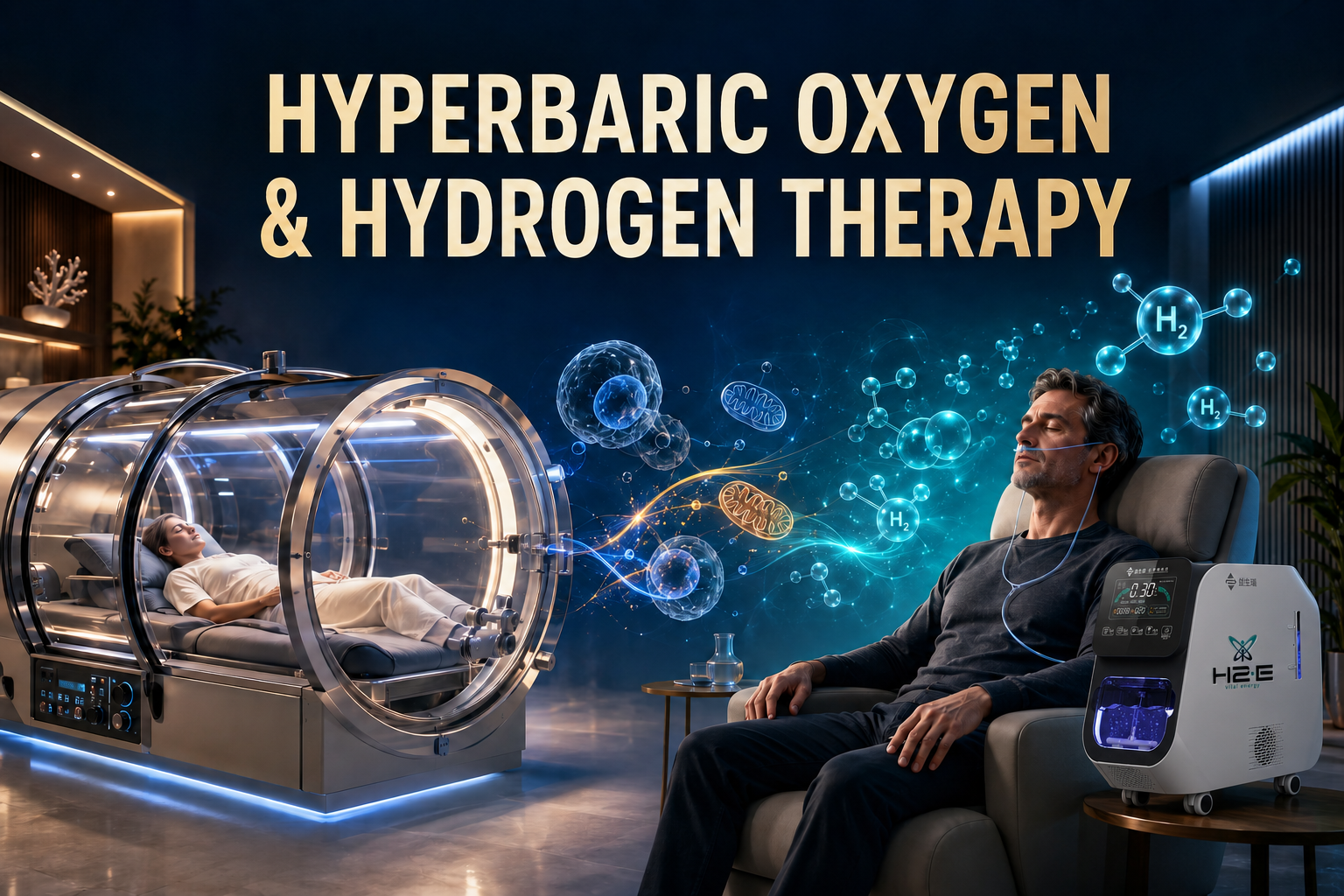
Hyperbaric Oxygen and Hydrogen Therapy: Could They Work Together?
Hyperbaric oxygen therapy and molecular hydrogen therapy involve two very different gases with very different biological roles.
Hyperbaric oxygen therapy—HBOT—is an established medical intervention for selected conditions. It increases the amount of oxygen dissolved in the blood and tissues, supporting oxygen delivery, wound healing and other therapeutic processes.
However, this temporary state of increased oxygen—known as hyperoxia—also increases the production of reactive oxygen species, or ROS. Some of these reactive molecules contribute to HBOT’s beneficial signalling effects. If ROS production becomes excessive, however, it can contribute to oxidative stress and oxygen toxicity.
Molecular hydrogen is being studied for a different reason. Experimental research suggests it may help regulate excessive oxidative stress and may reduce signals associated with highly damaging hydroxyl radicals without acting as a broad antioxidant against every useful reactive molecule.
This raises an important question:
Could molecular hydrogen complement an HBOT session by helping the body manage excessive oxidative stress after the therapeutic oxygen exposure?
The chemistry provides a reasonable scientific hypothesis, but direct clinical evidence remains extremely limited. There is currently no established human protocol confirming whether hydrogen should be used immediately after HBOT, several hours later or on a different day.
This article explains what happens chemically during HBOT, why some hydroxyl radicals may form and what research can—and cannot—currently tell us about using molecular hydrogen afterwards.
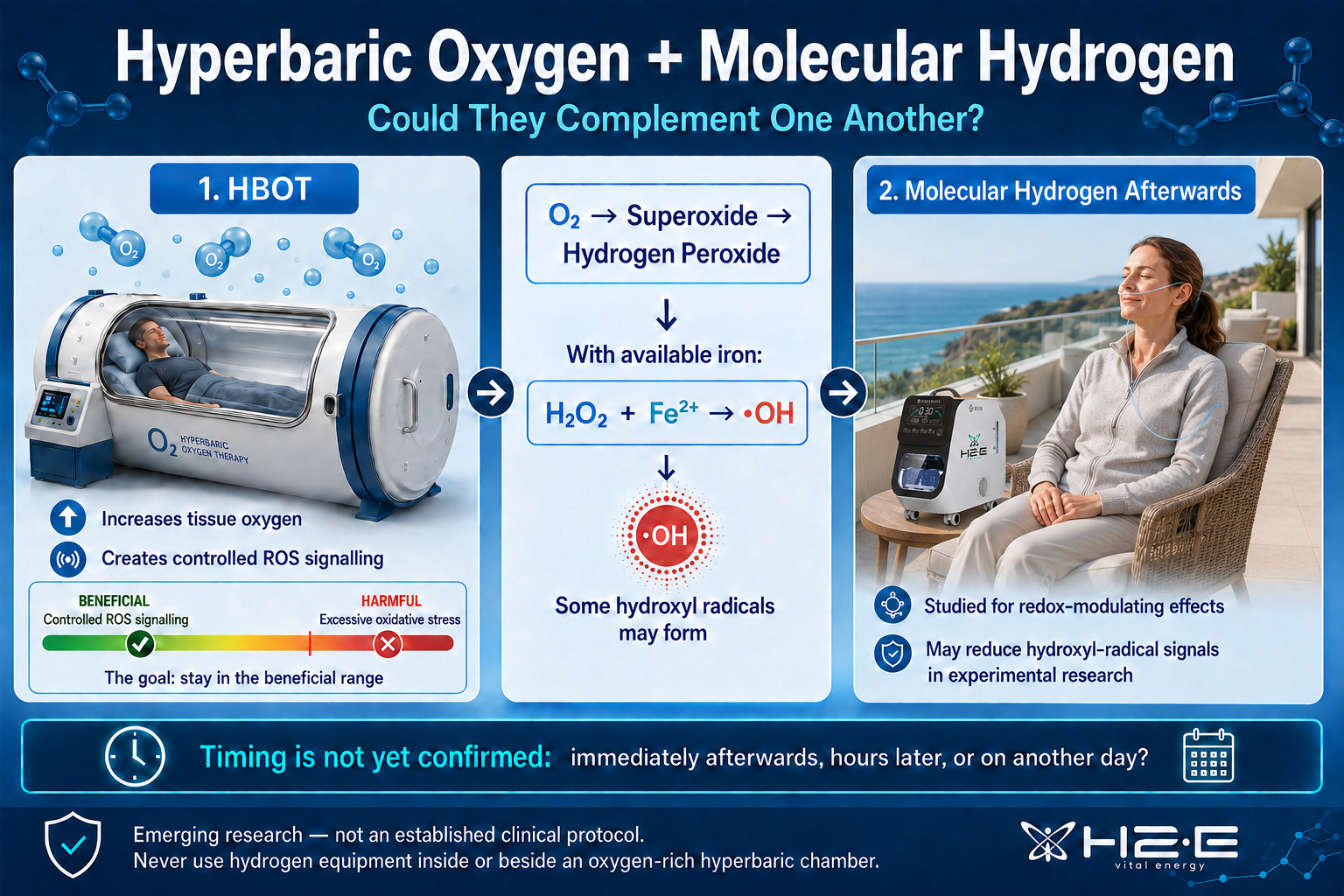
What Happens During Hyperbaric Oxygen Therapy?
During HBOT, a person breathes a high concentration of oxygen inside a pressurised chamber.
The increased atmospheric pressure allows substantially more oxygen to dissolve directly into the blood plasma and body fluids. This means oxygen can reach tissues independently of the amount carried by haemoglobin.
This temporary increase produces:
Hyperoxemia: unusually high oxygen levels in the blood.
Hyperoxia: unusually high oxygen availability in tissues.
For appropriately selected patients, this increased oxygen availability can support important therapeutic processes, including tissue oxygenation, selected wound-healing responses, antimicrobial activity and the treatment of conditions such as decompression illness.
HBOT does more than deliver oxygen. The temporary increase in oxygen also acts as a biological stimulus, changing redox signalling, inflammatory pathways, antioxidant defences and gene expression.
Does HBOT Produce Reactive Oxygen Species?
Yes. Increasing oxygen availability also increases the opportunity for some oxygen molecules to undergo partial reduction and become reactive oxygen species.
A simplified pathway is:
Oxygen → superoxide → hydrogen peroxide → water
Superoxide dismutase—SOD—converts superoxide into hydrogen peroxide. Enzymes including catalase and glutathione peroxidase then help convert hydrogen peroxide into water.
Hydrogen peroxide is not automatically harmful. In controlled amounts, it acts as an important signalling molecule involved in adaptation, immune activity and cellular responses.
Problems can arise when hydrogen peroxide is excessive or is present alongside chemically available iron.
Can Hydroxyl Radicals Form During an HBOT Session?
Some hydroxyl radicals may be formed during hyperbaric oxygen exposure.
The proposed chemistry involves the Fenton reaction, in which hydrogen peroxide reacts with ferrous iron:
Fe²⁺ + H₂O₂ → Fe³⁺ + OH⁻ + •OH
The •OH in this reaction is the hydroxyl radical—one of the most reactive and potentially damaging forms of ROS.
Because HBOT can increase superoxide and hydrogen-peroxide production, it can create more of the chemical precursors from which hydroxyl radicals may arise when suitable redox-active metals are available.
Hydroxyl radicals react almost immediately close to where they are formed. This makes them extremely difficult to measure directly inside the human body. It would therefore be too strong to claim that every clinical HBOT session produces a known quantity of hydroxyl radicals.
Nevertheless, the chemistry and experimental research support the conclusion that hydroxyl-radical formation is biologically plausible during hyperbaric oxygen exposure—particularly when oxidative production exceeds the local capacity of antioxidant and repair systems.
This does not mean a properly administered HBOT session is inherently damaging. A controlled rise in ROS is part of HBOT’s therapeutic mechanism. The aim of clinical protocols is to keep the oxygen exposure within a range that produces beneficial signalling without allowing it to develop into clinically significant oxygen toxicity.
When Does Oxygen Become Too Much?
A high oxygen level is called hyperoxia. Hyperoxia becomes oxygen toxicity when excessive oxygen exposure produces biological injury.
There is no single cut-off that applies to everyone. The risk depends on:
Oxygen concentration
Chamber pressure
Duration of exposure
Frequency and cumulative number of sessions
Use of air breaks
Individual health, medications and susceptibility
Excessive exposure can affect the central nervous system, lungs and eyes. Proper clinical protocols control pressure and duration and may incorporate periods of breathing normal air to reduce the oxidative load.
Therefore:
Hyperoxia describes increased oxygen availability. Oxygen toxicity describes injury caused when the oxygen exposure and resulting reactive species overwhelm the body’s protective systems.
Potential Effects of Molecular Hydrogen
Molecular hydrogen—H₂—is a small gas that can diffuse rapidly through biological tissues.
Research is investigating several possible effects:
Modulation of excessive oxidative stress
H₂ may influence highly reactive oxidants and the cellular pathways responsible for antioxidant defence.
Possible effects on hydroxyl-radical activity
Foundational laboratory research reported that molecular hydrogen reduced signals associated with hydroxyl radicals under the tested conditions, without comparable direct effects on superoxide, hydrogen peroxide or nitric oxide.
Influence on inflammatory signalling
Some studies have reported changes in inflammatory mediators, although these findings cannot yet be generalised to every disease or treatment method.
Cellular and mitochondrial support
H₂ is being investigated for its effects on mitochondrial stress, membrane function and cellular resilience.
A possible role in recovery
Early research provides a reason to investigate molecular hydrogen after oxidative challenges, but the ideal dose, delivery method, timing and clinical significance remain uncertain.
Hyperbaric Oxygen and Hydrogen Therapy: The Key Differences
| Feature | Hyperbaric oxygen therapy | Molecular hydrogen therapy |
|---|---|---|
| Main gas | Oxygen—O₂ | Molecular hydrogen—H₂, sometimes produced alongside oxygen through electrolysis |
| Environment | Pressurised hyperbaric chamber | Normally delivered at ordinary atmospheric pressure |
| Primary immediate effect | Greatly increases oxygen dissolved in plasma and tissues | H₂ diffuses rapidly into tissues and may influence redox and inflammatory signalling |
| Possible ROS produced or affected | Can increase superoxide and hydrogen peroxide as part of controlled oxidative signalling. Hydroxyl radicals may also form when hydrogen peroxide reacts with available iron. Excessive exposure can produce oxidative stress and oxygen toxicity | H₂ is not normally described as a significant ROS generator. Experimental studies suggest it may reduce signals associated with highly reactive hydroxyl radicals and influence endogenous antioxidant pathways, but its precise actions in humans remain under investigation |
| Main health benefits | For appropriate patients, HBOT can restore oxygen delivery to compromised tissue, support selected wound-healing processes, reduce gas-bubble size and help control certain oxygen-sensitive infections | Early research suggests H₂ may help regulate excessive oxidative stress, influence inflammatory pathways and support cellular resilience. |
| Clinical status | Established medical treatment for selected indications | Emerging intervention; not established as a treatment for most conditions studied |
| Oxidative relationship | Deliberately creates a controlled rise in reactive species that contributes to signalling and adaptation | Helps to modulate excessive oxidative stress without indiscriminately removing every signalling ROS |
| Typical duration | Often 60–120 minutes, depending on the clinical protocol | Varies considerably according to device, dose, route and research protocol |
| Main safety considerations | Pressure injury, oxygen toxicity, temporary vision changes, fire controls and medical contraindications | Device quality, gas purity, ventilation, cannula hygiene and strict separation from ignition sources |
Neither therapy should be presented as a substitute for diagnosis, urgent medical care or an evidence-based treatment plan.
Could Hydrogen Complement an HBOT Session Afterwards?
There is a scientifically credible reason to investigate this combination.
HBOT temporarily increases oxygen availability and ROS production. Some of this reactive-species activity is useful because it contributes to the signalling through which HBOT produces therapeutic responses.
However, the same chemistry also means that additional superoxide and hydrogen peroxide may be generated. When hydrogen peroxide encounters redox-active iron, some hydroxyl-radical formation may occur through Fenton-type chemistry.
Molecular hydrogen is being investigated partly because experimental studies suggest it may reduce excessive hydroxyl-radical-related activity and influence cellular antioxidant defences.
In a 2017 laboratory study using PC12 cells exposed to hyperbaric oxygen, hydrogen reduced hydroxyl-radical signals, lipid-peroxidation markers and DNA-oxidation markers. It did not produce comparable reductions in the measured levels of superoxide, hydrogen peroxide or nitric oxide.
This finding supports an important theoretical distinction:
Molecular hydrogen may potentially help manage highly damaging oxidative activity without broadly suppressing all of the reactive molecules involved in normal signalling.
That makes hydrogen a scientifically interesting candidate for use after HBOT. However, this remains a biological rationale—not proof of clinical benefit in people.
The study involved cells exposed to experimental conditions, including a pressure of 5 ATA for three hours. It was not a human trial of ordinary clinical HBOT followed by a hydrogen session.
We therefore cannot yet say that hydrogen:
Improves the clinical results of HBOT
Prevents oxygen toxicity in patients
Is necessary after every HBOT session
Should always be taken immediately afterwards
Has a confirmed four-hour waiting period
Immediately Afterwards or Four Hours Later?
The optimum timing has not been established.
There are two reasonable but currently unproven considerations:
Immediate use: Hydrogen given shortly after HBOT might theoretically be available while some excessive oxidative activity is still occurring.
Delayed use: Waiting several hours might allow HBOT’s initial ROS-dependent signalling to take place before hydrogen is introduced.
At present, human studies have not established whether immediate treatment, a four-hour interval, a longer interval or treatment on another day produces the best result.
A four-hour separation can therefore only be described as a cautious practical choice—not a scientifically validated protocol.
The chemistry tells us why the combination deserves investigation: HBOT can increase the precursors from which highly reactive oxidants may form, while experimental hydrogen research suggests possible effects on hydroxyl-radical-related activity and cellular stress responses.
What chemistry alone cannot tell us is the best clinical dose, timing or effect on patient outcomes.
Anyone receiving medically indicated HBOT should discuss additional hydrogen use with the clinician or hyperbaric team supervising the treatment.
HBOT and Hydrogen Must Not Be Used in the Same Chamber
Hydrogen is combustible within certain concentrations in air and oxygen.
A consumer hydrogen inhalation machine must never be taken into, connected to or operated beside a conventional hyperbaric oxygen chamber. Hydrogen must not be introduced into an oxygen-rich chamber unless it is part of specialised research using purpose-designed equipment and professional engineering controls.
The possible approach discussed in this article is separate, sequential use under appropriate conditions—not the simultaneous mixing of hydrogen and oxygen inside a hyperbaric chamber.
The Bottom Line
Hyperbaric oxygen therapy and molecular hydrogen therapy have different but potentially complementary biological roles.
HBOT uses oxygen under pressure to increase tissue oxygenation and deliberately activate physiological and redox responses. This can increase superoxide and hydrogen peroxide, and the chemistry indicates that some hydroxyl radicals may form when hydrogen peroxide reacts with available iron.
A properly controlled rise in ROS is not automatically harmful. It contributes to HBOT’s therapeutic signalling. Oxygen toxicity occurs when excessive exposure overwhelms the body’s protective and repair systems.
Molecular hydrogen is being studied for its potential to modulate excessive oxidative stress. Laboratory research suggests it may reduce hydroxyl-radical-related signals under certain experimental conditions without broadly removing several useful signalling molecules.
This creates a scientifically plausible reason why hydrogen might complement an HBOT session afterwards. However, plausible chemistry is not the same as a proven treatment protocol.
We do not yet know whether hydrogen should be used immediately after HBOT, four hours later or at another time. Direct human trials are needed to determine whether the combination improves recovery or clinical outcomes.
The responsible conclusion is:
Hyperbaric oxygen may increase the chemical conditions in which hydroxyl radicals can form, while experimental evidence suggests molecular hydrogen may influence this highly reactive oxidative activity. This makes post-HBOT hydrogen an important subject for further research—but not yet an established clinical recommendation.
Frequently Asked Questions
Does HBOT produce hydroxyl radicals?
HBOT increases oxygen availability and can increase superoxide and hydrogen-peroxide production. If hydrogen peroxide reacts with available ferrous iron, hydroxyl radicals may form through Fenton-type chemistry. Directly measuring these extremely short-lived radicals in patients is difficult, so the amount produced during an ordinary session is not established.
Can hydrogen therapy be used after HBOT?
The combination is scientifically interesting, but no accepted human protocol has established that post-HBOT hydrogen improves outcomes. Anyone receiving medical HBOT should discuss additional therapies with the supervising clinician.
Should hydrogen be used immediately or four hours after HBOT?
Research has not confirmed the best timing. Immediate and delayed use have different theoretical arguments, but neither has been validated in clinical trials. Four hours may be used as a cautious separation, but it must not be presented as a proven biological requirement.
Could hydrogen cancel HBOT’s beneficial ROS signals?
This is unknown. Laboratory findings suggest hydrogen does not act as a broad scavenger of superoxide, hydrogen peroxide and nitric oxide under the tested conditions. Nevertheless, human studies are needed to determine whether dose or timing affects HBOT’s beneficial signalling.
Can molecular hydrogen prevent oxygen toxicity?
Laboratory research has reported reduced markers associated with hyperbaric oxygen injury, but this does not prove that hydrogen prevents or treats oxygen toxicity in people. Suspected oxygen toxicity requires medical assessment.
Can hydrogen and oxygen equipment be used together inside a chamber?
No. Consumer hydrogen equipment must never be used in or beside an oxygen-rich hyperbaric chamber. Any discussion of combining the therapies refers only to separate sessions performed with appropriate safety precautions.
References
Thom SR. Oxidative stress is fundamental to hyperbaric oxygen therapy. Journal of Applied Physiology. 2009;106(3):988–995.
https://pmc.ncbi.nlm.nih.gov/articles/PMC2660252/Yu J, Yu Q, Liu Y, Zhang R, Xue L. Hydrogen gas alleviates oxygen toxicity by reducing hydroxyl radical levels in PC12 cells. PLOS ONE. 2017;12(3):e0173645.
https://journals.plos.org/plosone/article?id=10.1371/journal.pone.0173645Ohsawa I, Ishikawa M, Takahashi K, et al. Hydrogen acts as a therapeutic antioxidant by selectively reducing cytotoxic oxygen radicals. Nature Medicine. 2007;13:688–694.
https://pubmed.ncbi.nlm.nih.gov/17486089/de Wolde SD, Hulskes RH, Weenink RP, Hollmann MW, Van Hulst RA. The effects of hyperbaric oxygenation on oxidative stress, inflammation and angiogenesis. Biomolecules. 2021;11(8):1210.
https://pubmed.ncbi.nlm.nih.gov/34439872/