
Heart disease remains one of the most important health challenges of modern life. Yet behind conditions such as coronary artery disease, angina, heart attack and heart failure lies a complicated network of processes involving blood vessels, inflammation, oxidative stress, mitochondrial function and the body’s response to reduced blood flow.
One area attracting increasing scientific interest is molecular hydrogen (H₂).
Molecular hydrogen is being investigated for its potential influence on oxidative stress, inflammatory signalling, vascular function and the cellular damage that can occur when blood flow is interrupted and then restored.
Importantly, hydrogen therapy should not be regarded as a replacement for established cardiovascular treatment. Instead, researchers are investigating whether it could eventually have a role as an adjunctive therapy alongside conventional medical care.
And one particularly interesting human study has produced results that deserve attention.
Why Are Researchers Studying Molecular Hydrogen and the Heart?
The heart is an extraordinarily energy-demanding organ.
Every minute of every day, heart muscle cells depend on mitochondria to produce the energy required for contraction. At the same time, blood vessels must continually adjust their diameter and function to maintain adequate circulation.
Several biological processes associated with cardiovascular disease are therefore of particular interest to hydrogen researchers:
- excessive oxidative stress
- chronic inflammatory signalling
- endothelial dysfunction
- mitochondrial stress
- damage caused by ischaemia and reperfusion
- abnormal cellular signalling and apoptosis
Experimental studies suggest molecular hydrogen may influence several of these pathways, although exactly how H₂ produces its biological effects in humans is still being investigated.
Hydrogen and Ischaemia-Reperfusion Injury
When an area of the heart loses its blood supply — as happens during a heart attack — cells become deprived of oxygen.
Restoring circulation is essential and can save heart muscle.
However, the sudden return of oxygenated blood can itself trigger a burst of oxidative and inflammatory activity known as ischaemia-reperfusion injury.
This phenomenon is one reason researchers became interested in molecular hydrogen.
In a landmark 2008 animal experiment, researchers found that inhaled hydrogen during myocardial ischaemia and reperfusion reduced heart infarct size in rats without significantly altering haemodynamic parameters.
Animal research cannot automatically be translated into human treatment, but these early findings helped stimulate subsequent cardiovascular hydrogen research.
And that eventually led to an important human clinical trial.
The HYBRID II Trial: Hydrogen After Cardiac Arrest
One of the strongest human studies so far is the HYBRID II trial, published in EClinicalMedicine in 2023.
This is the study:
“Efficacy of inhaled hydrogen on neurological outcome following brain ischaemia during post-cardiac arrest care (HYBRID II): a multi-centre, randomised, double-blind, placebo-controlled trial.”
The study involved 73 patients who remained unconscious after an out-of-hospital cardiac arrest believed to have a cardiac cause.
Patients were treated across 15 hospitals in Japan.
They were randomly assigned to receive either:
2% molecular hydrogen with supplementary oxygen
or
supplementary oxygen without hydrogen.
Hydrogen was administered for 18 hours following resuscitation.
What did the researchers find?
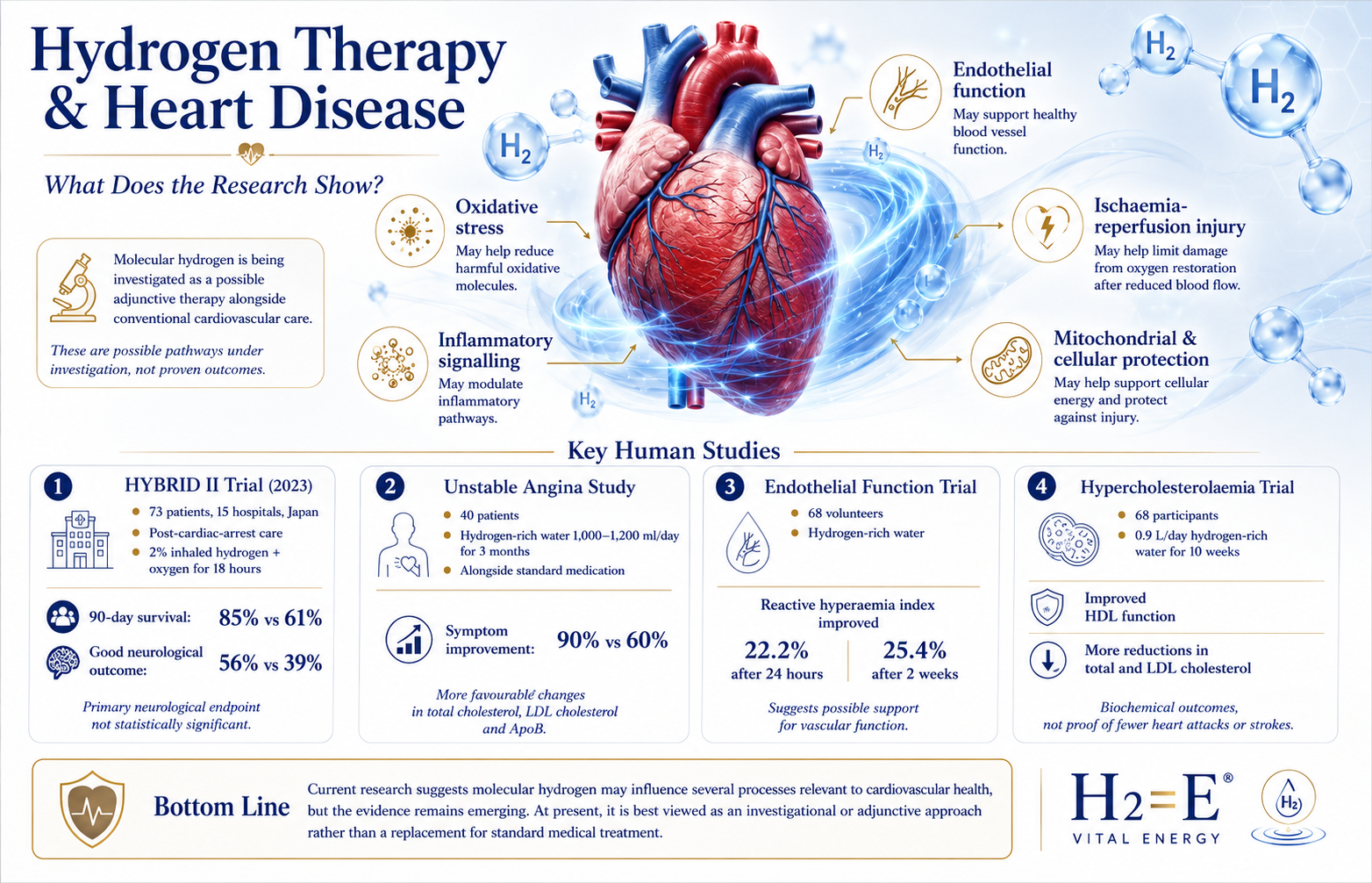
At 90 days, a good neurological outcome measured using the Cerebral Performance Category occurred in:
56% of the hydrogen group
compared with
39% of the control group.
However, this difference did not reach statistical significance, so the trial’s primary endpoint was not met.
That distinction is extremely important.
But some of the trial’s secondary findings were very interesting.
90-Day Survival
The researchers reported:
85% survival in the hydrogen group
compared with
61% survival in the control group.
This difference was statistically significant.
Another measure of disability, the Modified Rankin Scale, also favoured the hydrogen group. A score of zero — indicating no neurological symptoms — was recorded in 46% of the hydrogen group compared with 21% of controls.
These findings led the researchers to conclude that although the primary neurological endpoint was not statistically significant, the secondary findings suggested hydrogen inhalation may increase 90-day survival without neurological deficits in this selected population.
Why This Study Is Exciting — but Should Not Be Overstated
The HYBRID II findings are encouraging, but there are important limitations.
The researchers originally planned a substantially larger trial, but recruitment was disrupted by the COVID-19 pandemic and the study was stopped early. Only 73 patients were ultimately randomised.
That makes the results scientifically interesting rather than definitive.
It is also important to understand what this study does not demonstrate.
It does not prove that hydrogen:
- prevents heart attacks
- reverses coronary artery disease
- cures heart failure
- removes arterial plaque
- replaces cardiovascular medication
- reduces long-term cardiovascular mortality in the general population.
And the hydrogen protocol used in HYBRID II was a hospital-based 2% hydrogen intervention administered to critically ill patients following cardiac arrest.
It should therefore not be treated as direct clinical validation of any particular home hydrogen inhalation protocol or hydrogen-generating machine.
Nevertheless, HYBRID II represents an important milestone because it moved cardiovascular hydrogen research beyond laboratory and animal experiments into a randomised, double-blind human clinical trial.
Hydrogen-Rich Water and Unstable Angina
Another interesting human study looked at people with unstable angina.
Forty hospitalised patients were divided into two groups.
Both continued receiving their conventional cardiovascular medication, while one group also drank approximately 1,000–1,200 ml of hydrogen-rich water per day for three months.
The control group drank the same amount of ordinary water.
Researchers reported an improvement in their defined measure of angina symptoms in:
90% of the hydrogen-water group
compared with
60% of the control group.
They also reported more favourable changes in total cholesterol, LDL cholesterol and apolipoprotein B in the hydrogen group.
The researchers also conducted laboratory experiments in endothelial cells and reported reduced oxidative-stress and inflammatory signalling associated with oxidised LDL exposure.
Again, this was only a 40-person study, and symptom assessment and several biochemical endpoints were used rather than major cardiovascular outcomes such as heart attack or cardiovascular death.
It should therefore be regarded as preliminary evidence rather than proof of treatment effectiveness.
What is particularly interesting, however, is that hydrogen was used alongside conventional cardiovascular treatment, rather than replacing it.
That may ultimately prove to be the most realistic way of thinking about molecular hydrogen: as an investigated adjunct to established medicine.
Could Molecular Hydrogen Support Blood Vessel Function?
Healthy arteries depend heavily on the endothelium — the thin layer of cells lining the inside of blood vessels.
Endothelial dysfunction is closely involved in the development of vascular disease.
A randomised controlled trial published in PLOS ONE investigated whether hydrogen-rich water could influence endothelial function.
Researchers randomly assigned 68 volunteers to receive either hydrogen-rich water or placebo water.
The hydrogen water contained approximately 3.5 mg of dissolved H₂ in 500 ml of water.
Researchers measured vascular function using the reactive hyperaemia index.
Compared with placebo, the hydrogen group showed an improvement in this measurement after 24 hours and again following two weeks of daily intake.
The researchers reported approximately:
22.2% improvement after 24 hours
and
25.4% improvement following two weeks of daily consumption.
This does not demonstrate that hydrogen prevents cardiovascular disease.
However, it provides interesting human evidence that molecular hydrogen may influence vascular endothelial function, one of the biological areas involved in cardiovascular health.
Hydrogen, Cholesterol and Lipoprotein Function
Cholesterol is another area where molecular hydrogen has been investigated.
In a double-blind, randomised, placebo-controlled trial published in The Journal of Clinical Endocrinology & Metabolism, 68 people with untreated isolated hypercholesterolaemia were allocated to either:
0.9 litres of hydrogen-rich water per day
or
placebo water
for ten weeks.
Researchers reported several interesting changes.
HDL taken from participants receiving hydrogen demonstrated an increased ability to promote cholesterol efflux — one of the processes involved in transporting cholesterol away from tissues.
Several other laboratory measures of HDL function also improved, including resistance to LDL oxidation and inflammatory effects associated with oxidised LDL.
The investigators also reported a greater proportion of participants achieving reductions in total cholesterol and LDL cholesterol in the hydrogen group compared with placebo.
These findings are interesting because cardiovascular risk involves much more than simply measuring the total amount of cholesterol circulating in the blood.
The behaviour and function of lipoproteins may also matter.
But once again, these were biochemical outcomes. The trial was not designed to establish whether hydrogen reduced heart attacks, strokes or cardiovascular mortality.
Molecular Hydrogen and Heart Failure
Heart failure represents another area of investigation, but currently much of the evidence remains preclinical.
A 2018 study investigated hydrogen inhalation in rats with experimentally induced chronic heart failure.
Researchers reported improvements in measures of cardiac function together with reductions in oxidative-stress damage and cardiomyocyte apoptosis following hydrogen treatment.
The study suggested hydrogen may influence the ROS–p53–apoptosis signalling pathway, potentially protecting heart-muscle cells from oxidative-stress-associated cell death.
This is fascinating mechanistic research.
But it is essential to emphasise:
this was an animal study, not a human heart-failure trial.
It provides a reason for further research — not evidence that hydrogen inhalation currently treats human heart failure.
So How Might Hydrogen Potentially Support Cardiovascular Health?
Looking across the research, several recurring biological themes appear.
1. Oxidative Stress Regulation
Excessive oxidative stress can damage lipids, proteins, mitochondria and vascular cells.
Hydrogen appears to influence oxidative-stress pathways in both laboratory and animal cardiovascular models, although its biological activity is now believed to involve more than simply acting as a direct antioxidant.
2. Inflammatory Signalling
Inflammation plays an important part in atherosclerosis and cardiovascular injury.
Experimental hydrogen research has reported changes in inflammatory signalling pathways, including pathways activated by oxidised LDL.
3. Endothelial Function
The endothelium controls many aspects of vascular function.
The randomised hydrogen-water study showing improvements in reactive hyperaemia provides preliminary human evidence that H₂ exposure may influence endothelial function.
4. Ischaemia-Reperfusion Injury
This may ultimately prove to be one of the most interesting cardiovascular applications of hydrogen.
Animal myocardial research and the human HYBRID II cardiac-arrest trial both provide reasons to investigate whether hydrogen can help modify some of the biological damage that occurs when circulation is restored following severe ischaemia.
5. Mitochondrial and Cellular Protection
The mitochondria are central to cardiac energy production.
Experimental heart-failure research suggests hydrogen may influence pathways connecting mitochondrial oxidative stress, p53 signalling and programmed cell death.
This remains predominantly mechanistic and preclinical research, but it is an important area for future investigation.
Hydrogen Inhalation Versus Hydrogen Water
It is also important not to treat all hydrogen research as though the interventions were identical.
Studies have investigated molecular hydrogen through several different routes, including:
Hydrogen inhalation
and
Hydrogen-rich water.
The amount of hydrogen delivered, concentration, duration of exposure and resulting hydrogen availability can differ considerably.
For example, the HYBRID II cardiac-arrest study used 2% inhaled hydrogen continuously for 18 hours in a hospital environment.
Other cardiovascular studies have used hydrogen dissolved in water for several weeks or months.
Results from one delivery method therefore cannot automatically be transferred to another.
More research is needed to determine optimal concentrations, exposure times and treatment protocols for different applications.
Is Hydrogen Therapy a Treatment for Heart Disease?
At the present time, the scientifically responsible answer is: not yet.
The emerging research is encouraging, but the clinical evidence base is still relatively small.
Hydrogen therapy has not been established as a replacement for conventional cardiovascular treatment.
People with coronary heart disease, angina, previous heart attack, high cholesterol or heart failure should continue any medication and medical treatment prescribed by their healthcare team. NICE guidance continues to recommend established cardiovascular therapies for people with cardiovascular disease and acute coronary syndromes.
Hydrogen should therefore be viewed as an emerging area of cardiovascular research, rather than an alternative to cardiology.
The Bigger Picture
Perhaps the most interesting thing about molecular hydrogen is not that researchers are investigating it for one individual heart condition.
It is that H₂ appears to interact with several biological processes that are relevant across cardiovascular health:
oxidative stress
inflammatory signalling
endothelial function
mitochondrial stress
cellular survival
and
ischaemia-reperfusion injury.
That could explain why research has expanded from laboratory studies into areas including vascular health, lipid metabolism, angina, heart failure models and post-cardiac-arrest care.
The HYBRID II trial is especially important because it demonstrates that hydrogen research has progressed into multicentre, randomised human clinical investigation.
The results are not conclusive.
But they are certainly interesting.
The Future of Hydrogen and Cardiovascular Research
What is needed now are larger, independently replicated clinical trials.
Future research needs to answer several important questions:
What dose of molecular hydrogen is optimal?
How long should hydrogen be administered?
Does inhalation differ significantly from hydrogen-rich water?
Which cardiovascular conditions are most likely to respond?
Can improvements in biomarkers translate into fewer heart attacks, hospital admissions or cardiovascular deaths?
And can the encouraging survival findings seen in post-cardiac-arrest research be reproduced in much larger patient populations?
Until those questions are answered, hydrogen therapy should remain an adjunctive and investigational approach.
But the emerging cardiovascular research gives scientists good reason to continue asking those questions.
Conclusion
Molecular hydrogen is attracting growing interest within cardiovascular research because it may influence several processes involved in cardiovascular injury and recovery.
Human studies have reported preliminary findings involving:
- post-cardiac-arrest survival and neurological recovery
- vascular endothelial function
- unstable angina symptoms
- LDL and HDL-related biomarkers
- oxidative-stress and inflammatory signalling.
Experimental research has additionally reported potential protective effects involving heart-muscle cells, mitochondrial stress, apoptosis and ischaemia-reperfusion injury.
The evidence is promising but not yet definitive.
Hydrogen therapy cannot currently be described as a proven treatment for heart disease, nor should it replace prescribed medication, cardiac rehabilitation or conventional medical care.
What the research does show is that molecular hydrogen has moved beyond a theoretical antioxidant concept and into serious clinical investigation.
And for cardiovascular medicine, that makes it a fascinating area to watch.
Key Research Referenced
Tamura T, Suzuki M, Homma K, et al. (2023)
Efficacy of inhaled hydrogen on neurological outcome following brain ischaemia during post-cardiac arrest care (HYBRID II): a multi-centre, randomised, double-blind, placebo-controlled trial.
EClinicalMedicine, 58:101907.
Si Y, Tian H, Dong B, et al. (2021)
Effects of hydrogen as adjuvant treatment for unstable angina.
Experimental Biology and Medicine.
Ishibashi T, Kawamoto K, Matsuno K, et al. (2020)
Peripheral endothelial function can be improved by daily consumption of water containing over 7 ppm of dissolved hydrogen: A randomized controlled trial.
PLOS ONE.
Song G, Lin Q, Zhao H, et al. (2015)
Hydrogen Activates ATP-Binding Cassette Transporter A1-Dependent Efflux Ex Vivo and Improves High-Density Lipoprotein Function in Patients With Hypercholesterolemia: A Double-Blinded, Randomized, and Placebo-Controlled Trial.
The Journal of Clinical Endocrinology & Metabolism.
Chi J, Li Z, Hong X, et al. (2018)
Inhalation of Hydrogen Attenuates Progression of Chronic Heart Failure via Suppression of Oxidative Stress and P53 Related to Apoptosis Pathway in Rats.
Frontiers in Physiology. Animal study.
Hayashida K, Sano M, Ohsawa I, et al. (2008)
Inhalation of hydrogen gas reduces infarct size in the rat model of myocardial ischemia-reperfusion injury.
Biochemical and Biophysical Research Communications. Animal study.
Important Medical Information
Hydrogen therapy is an emerging area of research and is not an approved replacement for established cardiovascular treatment.
Anyone diagnosed with heart disease should discuss hydrogen therapy with their cardiologist or healthcare professional before incorporating it into their health programme.
If you develop sudden persistent chest pain or pressure, particularly if it spreads to the arms, neck, jaw, stomach or back, or is accompanied by sweating, nausea, light-headedness or shortness of breath, the NHS advises calling 999 immediately.
This article is provided for educational purposes and does not constitute medical advice, diagnosis or treatment.