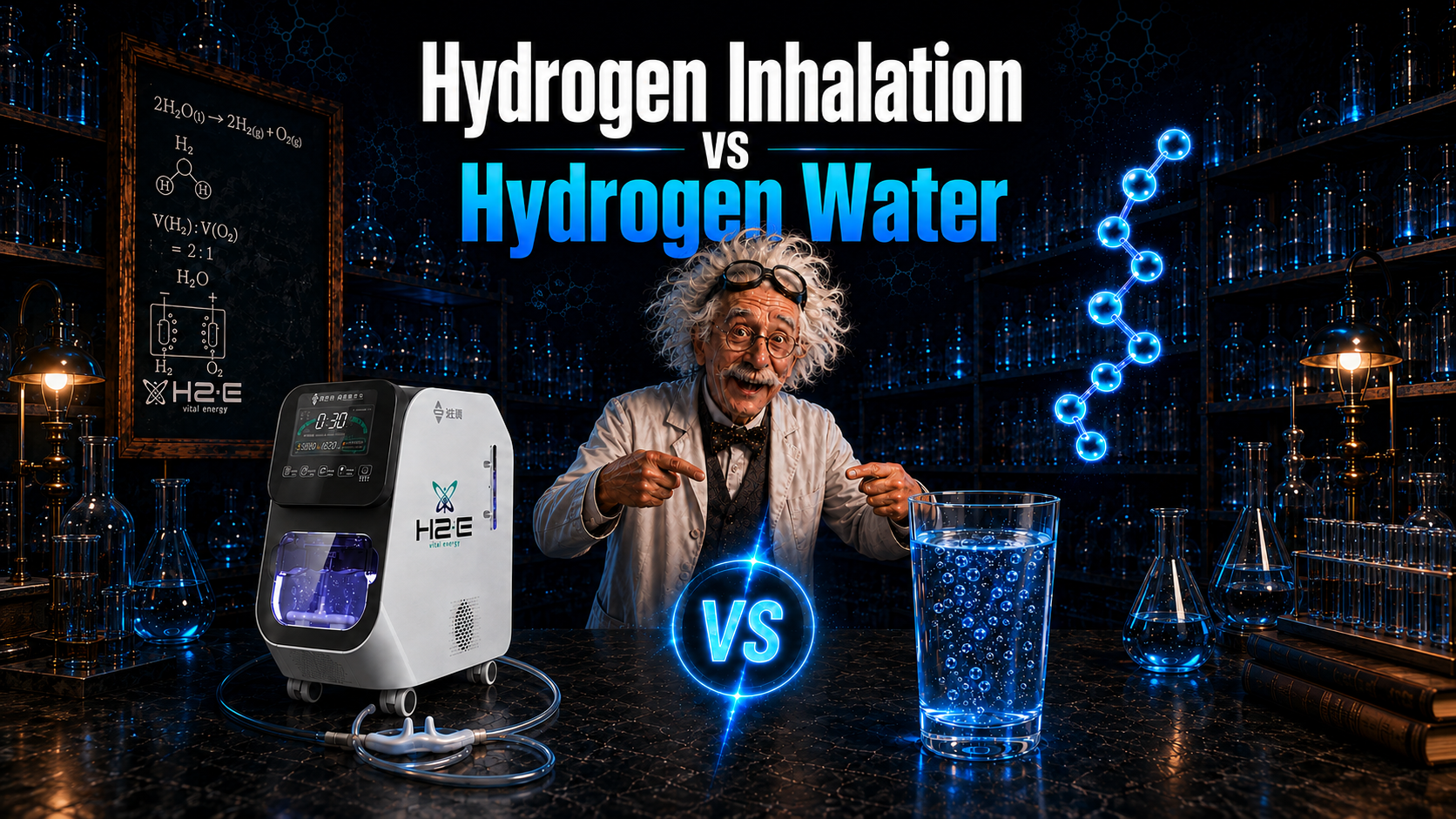
Hydrogen inhalation vs hydrogen water is one of the most common comparisons people make when exploring molecular hydrogen therapy.
Both methods deliver molecular hydrogen (H₂), but they differ considerably in how hydrogen is administered, how much can be made available during a session, portability, convenience and the way each method has been studied.
Hydrogen-rich water contains molecular hydrogen dissolved in drinking water. Hydrogen inhalation provides a continuous supply of an H₂-containing gas through a nasal cannula or mask.
So, is one method better than the other?
The answer is not quite that simple. In this guide, we compare seven important differences between hydrogen inhalation and hydrogen water, including delivery, concentration, session duration, convenience, research and potential applications.
It is also important to understand that delivering a larger theoretical quantity of hydrogen does not necessarily guarantee a greater clinical benefit.
Hydrogen Inhalation vs Hydrogen Water: Quick Comparison
| Feature | Hydrogen inhalation | Hydrogen-rich water |
|---|---|---|
| Method | Inhaled through a nasal cannula or mask | Consumed as drinking water |
| Delivery | Continuous throughout the session | Delivered when the water is consumed |
| Hydrogen quantity | Can provide substantially more hydrogen | Limited by hydrogen solubility and water intake |
| Convenience | Requires a suitable hydrogen generator | Portable and easy to drink |
| Session length | Commonly used for longer sessions | Can be consumed throughout the day |
| Research | Studied in laboratory and clinical settings | Studied in numerous small human trials |
| Primary limitation | Requires equipment and appropriate operation | Hydrogen gradually escapes from the water |
What Is Molecular Hydrogen?
Molecular hydrogen, written chemically as H₂, consists of two hydrogen atoms joined together. It is the smallest gas molecule and can diffuse rapidly through biological tissues.
Researchers are investigating molecular hydrogen for its possible influence on processes associated with:
- Oxidative stress
- Inflammatory signalling
- Mitochondrial function
- Cellular stress responses
- Metabolic health
- Exercise and recovery
- Ischaemia-reperfusion injury
However, molecular hydrogen research remains an emerging field. Results from laboratory or animal studies cannot automatically be assumed to produce the same effects in humans.
Molecular hydrogen therapy is not currently an established treatment for any particular medical condition in the UK and should not replace professional medical care.
If you are new to this subject, read our complete guide explaining what hydrogen therapy is.
1. How Each Method Delivers Molecular Hydrogen
The first important difference in the hydrogen inhalation vs hydrogen water comparison is how H₂ enters the body.
How hydrogen inhalation works
A hydrogen generator produces an H₂-containing gas that is breathed through a nasal cannula or suitable mask.
The lungs have a large surface area for gas exchange. This allows inhaled molecular hydrogen to pass from the lungs into the circulation while the person continues breathing normally.
Hydrogen inhalation therefore provides continuous exposure throughout the session. The potential quantity presented to the respiratory system depends on factors including:
- Hydrogen concentration
- Gas-production rate
- Breathing pattern
- Session duration
- Cannula or mask design
- Individual physiology
The total amount generated by a machine should not be confused with the amount inhaled or absorbed. Some gas is lost to the surrounding air, and the body does not retain all the hydrogen it breathes.
How hydrogen-rich water works
Hydrogen-rich water is ordinary water containing dissolved molecular hydrogen.
When the water is consumed, hydrogen can be absorbed through the digestive system. Some hydrogen may also escape from the water before it is consumed, particularly if the container is left open or the water is stored for too long.
The concentration of hydrogen-rich water is generally expressed in milligrams per litre (mg/L) or parts per million (ppm). In water, these measurements are approximately equivalent:
Hydrogen water is simple to consume and can be incorporated into everyday hydration without requiring an inhalation session.
2. Hydrogen Concentration and Quantity
Hydrogen gas and hydrogen-rich water cannot be compared using flow rate alone because they use different measurements.
Hydrogen inhalation is normally described using:
- Millilitres of gas per minute
- Litres of gas per minute
- Percentage of hydrogen in the gas mixture
- Duration of exposure
Hydrogen water is normally described using:
- Milligrams of dissolved hydrogen per litre
- Parts per million
- Volume of water consumed
A litre of hydrogen-rich water containing 1.6 mg/L provides a maximum theoretical amount of 1.6 mg of dissolved hydrogen at the time that concentration is measured.
By contrast, an inhalation machine can continuously generate litres of H₂-containing gas during a session. This means inhalation can present a considerably greater theoretical quantity of molecular hydrogen.
However, these are quantities generated or delivered—not measurements of the amount ultimately absorbed or used by the body.
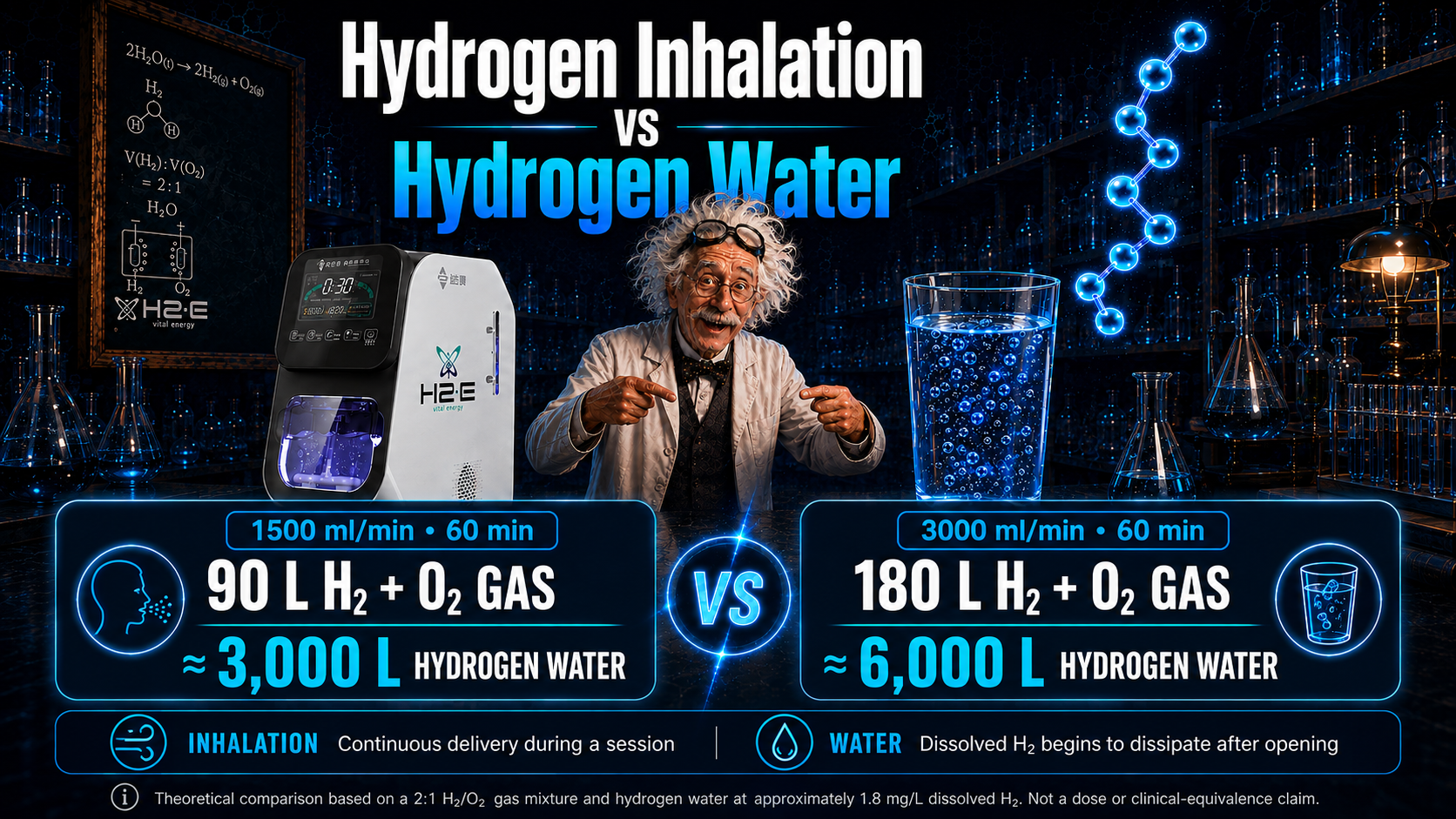
3. Comparing a 1,500 ml/min Session with Hydrogen Water
Many electrolysis-based hydrogen machines generate a mixture containing hydrogen and oxygen in an approximate 2:1 ratio. If a machine is rated by total combined H₂/O₂ output, around two-thirds of that volume is hydrogen.
For example, if 1,500 ml/min represents the combined gas output:
Depending on the temperature and pressure assumptions used in the calculation, 60 litres of hydrogen gas represents approximately 5,000–5,400 mg of molecular hydrogen.
At a water concentration of 1.6 mg/L, the theoretical dissolved-water equivalent would be approximately:
This does not mean that a person absorbs 5,000–5,400 mg during the session. It only illustrates the considerable difference between the amount of hydrogen produced as a gas and the amount that can be dissolved in a drinkable quantity of water.
If a manufacturer’s stated flow rate measures pure hydrogen rather than combined H₂/O₂ output, the calculation will be different. Equipment specifications should therefore clearly state exactly what the advertised flow rate represents.
4. Comparing a 3,000 ml/min Session with Hydrogen Water
Using the same assumption that 3,000 ml/min represents combined H₂/O₂ output, the approximate hydrogen component would be 2,000 ml/min.
Over a 60-minute session:
Depending on temperature and pressure, this represents approximately 10,000–10,800 mg of molecular hydrogen.
The theoretical equivalent at 1.6 mg/L would be approximately:
Once again, this comparison represents hydrogen generated—not hydrogen absorbed. It should not be interpreted as a clinical dose comparison or proof that one method produces better health outcomes.
5. Speed and Duration of Delivery
Hydrogen-rich water delivers H₂ when the water is consumed. Because molecular hydrogen is volatile, its concentration can begin to decrease after the container is opened or the water is prepared.
For this reason, freshly prepared hydrogen water should generally be consumed promptly and stored in a suitable sealed container.
Hydrogen inhalation provides continuous gas production during the session. This allows exposure to continue for a selected period, such as 30, 60 or 90 minutes, depending on the equipment, intended protocol and appropriate professional guidance.
A pharmacokinetic study found that inhaled hydrogen could be detected in arterial and venous circulation following administration, demonstrating its ability to move rapidly through the body. You can read the study through PubMed.
The presence of hydrogen in circulation does not by itself establish a therapeutic effect, but it helps researchers understand its distribution and pharmacokinetics.
6. Convenience and Portability
When comparing hydrogen inhalation vs hydrogen water, hydrogen water has a clear advantage in portability.
Hydrogen water can be:
- Consumed at home or while travelling
- Incorporated into normal hydration
- Used without a nasal cannula
- Prepared with a suitable bottle, tablet or water generator
Hydrogen inhalation requires a hydrogen generator, a power source and appropriate accessories. It is therefore better suited to planned sessions at home, in a clinic or in a wellness environment.
Some people prefer hydrogen water for everyday convenience. Others choose inhalation when they want a longer and more controlled session.
The two methods should not necessarily be viewed as competitors. They are different ways of administering the same molecule.
7. Research and Potential Applications
Both hydrogen inhalation and hydrogen-rich water are being investigated scientifically.
Hydrogen-rich water has been used in small human studies examining areas such as metabolic health, exercise, oxidative-stress markers and inflammatory responses.
For example, a randomised controlled pilot trial investigated six months of hydrogen-rich water consumption in adults with metabolic syndrome. The study reported changes in some measured health markers, but it was a pilot study and larger independent trials are needed. The research is available through PubMed.
Hydrogen inhalation has also been investigated in preclinical and clinical research. Studies vary considerably in their hydrogen concentration, session duration, participant group and intended outcome.
A published review of molecular-hydrogen clinical studies found that inhalation and hydrogen-rich water are among the most frequently investigated administration methods. However, the authors also highlighted considerable variation between study protocols. You can read the clinical research review here.
This variation makes it difficult to determine a single optimal dose or delivery method.
You can explore more of the developing evidence in our guide to hydrogen therapy benefits and current research.
Does Higher Hydrogen Delivery Mean Better Results?
Not necessarily.
Hydrogen inhalation can make a much larger theoretical quantity of molecular hydrogen available than a practical serving of hydrogen-rich water. However, a larger quantity does not automatically mean a greater biological or clinical effect.
Potential outcomes may depend on:
- Hydrogen concentration
- Absorption and distribution
- Frequency of use
- Duration of exposure
- Timing
- Individual physiology
- The outcome being investigated
- The condition and design of the research study
Hydrogen-rich water has produced measurable findings in some human studies despite containing a comparatively small amount of dissolved hydrogen.
This suggests that molecular-hydrogen research cannot be reduced to a simple “more is always better” calculation.
At present, there is insufficient high-quality evidence to establish universal dosing protocols or to conclude that one administration method is superior for every purpose.
Which Method Is More Suitable?
The right choice depends on what the person values and why they are considering molecular hydrogen.
Hydrogen-rich water may appeal to people who want:
- Portability
- Simple daily use
- Hydrogen combined with hydration
- No inhalation equipment
- A lower initial equipment commitment
Hydrogen inhalation may appeal to people who want:
- Continuous delivery during a planned session
- Adjustable session duration
- A substantially larger theoretical hydrogen quantity
- Home, clinic or wellness-centre sessions
- An alternative to drinking several servings of hydrogen water
Anyone with a medical condition, respiratory problem, implanted medical device or ongoing treatment should consult an appropriately qualified healthcare professional before beginning hydrogen inhalation or another new wellness intervention.
Equipment should always be used according to its safety instructions and manufacturer guidance.
Frequently Asked Questions
Is hydrogen inhalation stronger than hydrogen water?
Hydrogen inhalation can deliver a substantially larger theoretical quantity of molecular hydrogen during a session. However, “stronger” does not necessarily mean more effective. Clinical outcomes depend on many factors, and direct comparative human evidence remains limited.
Is hydrogen-rich water still worth using?
Hydrogen-rich water is convenient and has been investigated in human studies. Its hydrogen concentration is much lower than the quantity generated during an inhalation session, but research suggests that biological effects may not depend only on total theoretical quantity.
Can hydrogen inhalation and hydrogen water be combined?
Some people use hydrogen water for hydration and inhalation for planned sessions. However, high-quality clinical evidence establishing the benefits or optimal protocol for combining the two methods is currently limited.
How quickly should hydrogen water be consumed?
Molecular hydrogen can escape from water after preparation or opening. Hydrogen-rich water is therefore normally best consumed soon after preparation and kept in a suitable sealed container until use.
How long is a hydrogen inhalation session?
Session duration varies between equipment, research protocols and individual circumstances. Research studies have used widely different concentrations and exposure periods, so there is currently no single scientifically established session length suitable for everyone.
Is molecular hydrogen therapy medically proven?
Molecular hydrogen is being actively researched, but it is not an established replacement for conventional medical treatment. Evidence varies between applications, and many studies are preliminary, small or preclinical.
Hydrogen Inhalation vs Hydrogen Water: Key Takeaways
The hydrogen inhalation vs hydrogen water comparison reveals several important differences:
- Both methods provide molecular hydrogen through different routes.
- Hydrogen inhalation offers continuous delivery during a session.
- Hydrogen-rich water is convenient, portable and easy to incorporate into daily life.
- Inhalation can generate a substantially larger theoretical quantity of hydrogen.
- Machine output must distinguish between pure hydrogen and combined H₂/O₂ gas.
- The amount generated is not the same as the amount inhaled, absorbed or retained.
- Greater hydrogen delivery does not automatically guarantee a greater clinical benefit.
- Both methods have been studied, but optimal protocols have not yet been established.
- More large, independent and well-controlled human trials are needed.
Rather than asking which method is universally “best,” it may be more useful to consider how each method works, what the research has actually demonstrated and which approach is most appropriate for the individual situation.
You can explore the evidence in more detail in our guide to hydrogen therapy benefits and current scientific research.
Disclaimer
This article is provided for general educational purposes only. It does not constitute medical advice, diagnosis or treatment.
The calculations compare theoretical quantities of hydrogen produced or presented using stated assumptions. They do not represent the amount absorbed, retained or used by the human body.
Molecular hydrogen remains an active area of research and should not be used as a replacement for prescribed medication, emergency treatment or professional medical care. Always speak with an appropriately qualified healthcare professional before beginning a new therapy, particularly if you have an existing medical condition or are receiving treatment.