Important medical notice: Hypoxic-ischaemic encephalopathy is a life-threatening neonatal emergency requiring immediate specialist hospital care. Molecular hydrogen is investigational and is not an approved or established treatment for HIE. Nothing in this article should be used to guide treatment, delay emergency care or justify using a consumer hydrogen device with a baby.
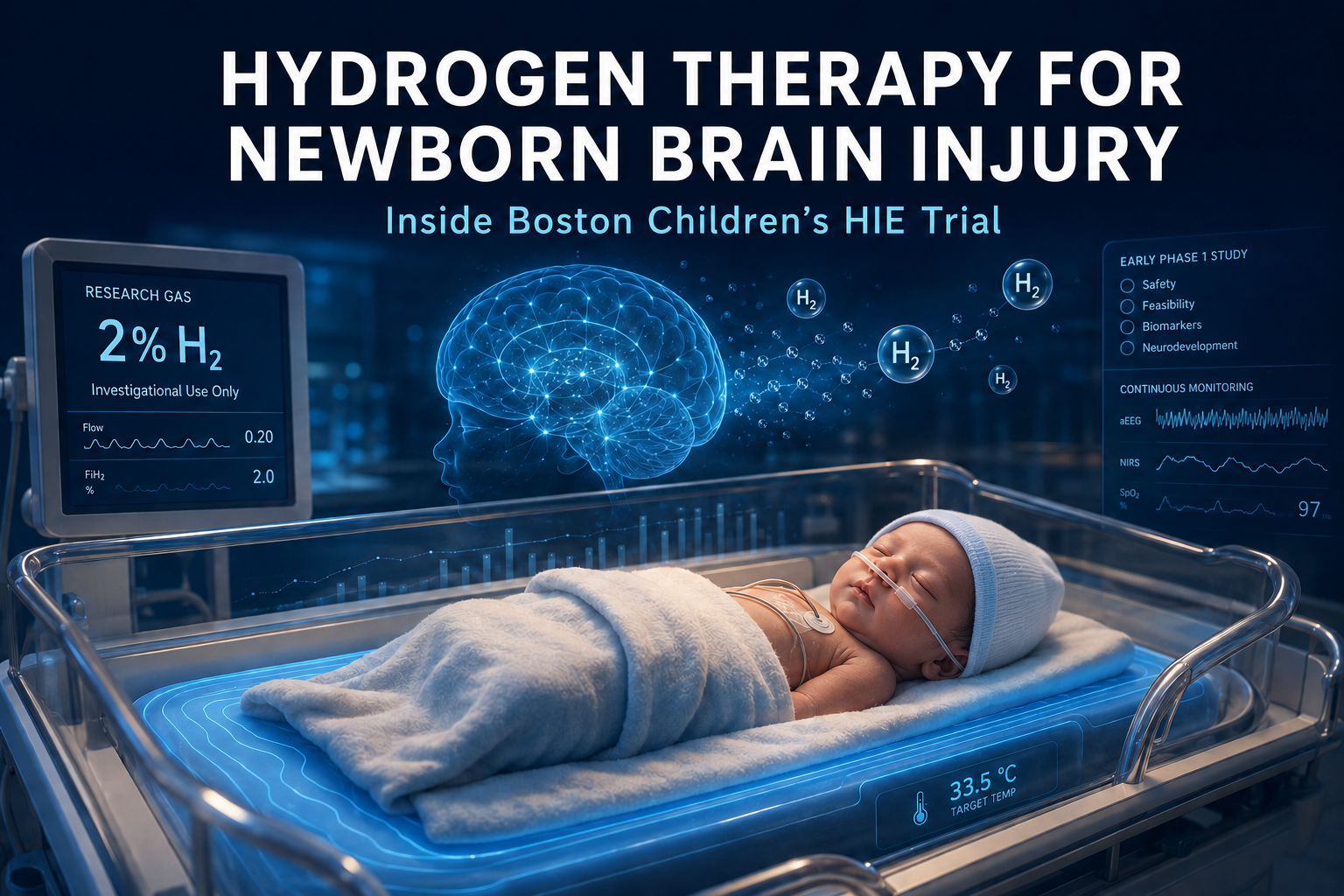
Hydrogen therapy for newborn brain injury is moving from animal research towards an early human safety trial at Boston Children’s Hospital. The planned study will investigate whether a low concentration of inhaled molecular hydrogen can be delivered safely and reliably to newborns with hypoxic-ischaemic encephalopathy (HIE) while they receive established intensive care, including therapeutic hypothermia.
This is an important development—but it is essential to describe it accurately.
The study is a small Phase 1 trial focused primarily on safety and feasibility, not proof that hydrogen prevents disability or saves lives. According to the ClinicalTrials.gov record verified in February 2026, the trial was listed as not yet recruiting, with no results available. Its findings will be needed before researchers can decide whether a larger efficacy trial is justified.
Here is what HIE means, why hydrogen is being investigated, how the trial is designed and what parents and readers should understand about the evidence.
What is hypoxic-ischaemic encephalopathy?
Hypoxic-ischaemic encephalopathy is a type of brain dysfunction caused by an inadequate supply of oxygen and blood flow around the time of birth.
-
Hypoxic means insufficient oxygen.
-
Ischaemic means insufficient blood flow.
-
Encephalopathy means altered or impaired brain function.
HIE can follow emergencies such as placental abruption, uterine rupture, umbilical-cord compression or other complications affecting circulation and oxygen delivery. Not every case has an immediately identifiable cause.
The brain is particularly vulnerable, but a severe hypoxic-ischaemic event may also affect the kidneys, heart, liver and lungs. Babies may require respiratory support, cardiovascular treatment, seizure monitoring, laboratory investigations and neuroimaging in a neonatal intensive care unit (NICU).
Signs can include altered consciousness, low muscle tone, abnormal reflexes, feeding or breathing difficulty and seizures. Specialist teams assess the clinical history, neurological examination, blood gases, brain activity and other findings to determine severity and treatment eligibility.
HIE is not something that can be diagnosed or managed at home. Time-sensitive evaluation and care are critical.
Why brain injury can continue after oxygen returns
The initial interruption of oxygen and blood flow causes primary energy failure. Cells cannot generate enough ATP, ion gradients become disturbed, excitatory signalling increases and cellular swelling may begin.
Restoring circulation and oxygen is essential, but it does not instantly end the biological process. A latent period may be followed by secondary energy failure, involving interacting mechanisms such as:
-
Mitochondrial dysfunction
-
Excitotoxicity
-
Calcium imbalance
-
Oxidative and nitrosative stress
-
Inflammation
-
Cell-death pathways
-
Disruption of the blood–brain barrier
This evolving injury pattern creates a limited therapeutic window. Clinicians use therapeutic hypothermia to slow damaging processes while supporting the baby’s organs and monitoring brain function.
Our guide to molecular hydrogen and oxidative stress explains the wider redox biology, but newborn HIE is far more complex than oxidative stress alone.
The established treatment: therapeutic hypothermia
Therapeutic hypothermia—often called cooling—is established care for eligible newborns with moderate-to-severe HIE in appropriately equipped centres.
An updated American Academy of Pediatrics clinical report states that cooling to approximately 33.5–34.5°C, started within six hours of birth and continued for 72 hours, reduces the risk of death or moderate-to-severe neurodevelopmental impairment in newborns of at least 36 weeks’ gestation with moderate-to-severe HIE.
Cooling is a specialised medical treatment. It requires continuous temperature control, cardiovascular and respiratory support, neurological monitoring, management of seizures and complications, neuroimaging and long-term developmental follow-up.
Therapeutic hypothermia improves outcomes, but it does not prevent every death or disability. This is why researchers continue to evaluate adjunctive therapies—treatments intended to be added to cooling rather than replace it.
Hydrogen therapy for newborn brain injury: why investigate H₂?
Molecular hydrogen (H₂) is a small, colourless gas being studied as a possible modulator of biological responses to ischaemia-reperfusion injury.
Early research proposed that hydrogen might interact selectively with highly reactive species. More recent work suggests that any effects may be broader and could involve redox-sensitive signalling, inflammatory pathways, mitochondrial function, cell-death responses and the body’s endogenous defences.
Researchers are interested in H₂ for neonatal HIE for several reasons:
-
Rapid diffusion: Molecular hydrogen can move quickly through biological membranes.
-
Reperfusion relevance: H₂ has been investigated in models where injury develops after blood flow and oxygen return.
-
Multi-organ potential: HIE may affect the brain, kidneys and other organs, and preclinical hydrogen research has examined several tissues.
-
Gas-delivery compatibility: A controlled concentration can potentially be incorporated into respiratory support already used in intensive care.
-
Preclinical signals: Rodent and piglet models have reported neuroprotective effects under selected experimental conditions.
These points explain why a clinical trial is reasonable. They do not establish that hydrogen benefits newborn babies.
What the animal evidence shows—and what it cannot show
A 2021 review examined molecular-hydrogen research in rodent and piglet models of neonatal hypoxic-ischaemic injury. Across the included preclinical studies, hydrogen was associated with findings such as preserved neuronal viability, neurovascular function and later neurobehavioural performance. Proposed mechanisms included antioxidant-related, anti-inflammatory and anti-apoptotic effects.
Animal models are valuable for understanding mechanisms, delivery timing and potential toxicity, but translation to neonatal care is difficult.
-
A laboratory injury does not reproduce every feature of human HIE.
-
Animal brains differ from human newborn brains in development, metabolism and scale.
-
Gas concentration, timing and duration vary among experiments.
-
Outcomes measured in animals are not equivalent to a child’s cognition, movement, communication or quality of life years later.
-
Positive animal studies may be more likely to be published than neutral studies.
-
The combined effect of hydrogen and therapeutic hypothermia cannot be assumed.
The review specifically noted that additive neuroprotection from hydrogen plus hypothermia had not yet been demonstrated at the time of publication. That combination matters because cooling—not no treatment—is the appropriate comparator for eligible babies in modern specialist care.
What is the Boston Children’s HIE trial?
The Hydrogen In Neonatal Encephalopathy (HIE) Trial is sponsored by Boston Children’s Hospital and led by principal investigator Brian Kalish, MD. Boston Children’s describes John Kheir, MD, as a research leader involved in the programme.
According to the ClinicalTrials.gov record (NCT07411911), the study is designed as:
-
Phase: Phase 1
-
Design: Randomised, parallel-group study
-
Masking: Outcomes assessor masked
-
Planned enrolment: 54 newborns
-
Experimental treatment: 2% molecular hydrogen incorporated into respiratory gases
-
Delivery: Mechanical ventilation, non-invasive ventilation or nasal cannula
-
Duration: 72 hours
-
Control: Standard care without the study gas
-
Allocation described by Boston Children’s: Approximately two babies assigned to hydrogen for every one assigned to control
All babies are intended to receive the standard clinical care they would otherwise receive. Hydrogen is an investigational addition—not a replacement for therapeutic hypothermia or any other necessary treatment.
Current study status
As of the ClinicalTrials.gov record verified in February 2026, the study was listed as not yet recruiting. The registry gave an estimated start of March 2026, estimated primary completion in March 2028 and estimated final completion in March 2031.
Study dates and recruitment status can change. Boston Children’s public information describes the intended enrolment process, while the registry provides the formal status. Readers should check the live trial record for subsequent updates rather than assuming recruitment or results.
What will the trial actually measure?
The two primary outcomes concern safety and feasibility.
Safety
Researchers plan to track adverse events during the first 30 days after randomisation that are classified as treatment-related or possibly treatment-related.
Feasibility
The team will calculate how much of the first 72-hour treatment period hydrogen was successfully administered. This asks whether a precise H₂ concentration can be integrated reliably into the complex respiratory care of critically ill newborns.
The trial also lists exploratory secondary outcomes:
-
Evidence of brain injury on clinically ordered imaging after cooling
-
Laboratory markers of ischaemic injury
-
Survival and length of stay
-
Neurodevelopment assessed with the Bayley Scales at 24–36 months
These measures are important, but the small Phase 1 study is not the same as a large trial designed to prove improvement in survival or long-term development. Any apparent difference in a secondary outcome would need careful interpretation and confirmation.
Why use 2% hydrogen for 72 hours?
The study plans to add 2% hydrogen to gases delivered through the baby’s existing respiratory interface. This is well below hydrogen’s lower flammability limit in air under standard conditions, but that does not make gas delivery simple or suitable for ordinary devices.
Hospital administration requires controlled equipment, verified gas concentration, continuous monitoring, engineering safeguards and a regulated research protocol. Newborn physiology, respiratory support and intensive-care environments introduce considerations that cannot be reproduced with a consumer hydrogen machine.
The 72-hour period overlaps with the standard cooling window and targets the evolving phase of injury after the initial hypoxic-ischaemic event. Whether this timing is biologically effective in babies remains one of the questions for research.
For broader background—not neonatal approval—see our evidence-led guide to hydrogen therapy safety and essential precautions.
Safety in healthy adults is not neonatal safety
Boston Children’s reports that the dose being investigated was well tolerated in a study involving healthy adults. That is useful preliminary information for equipment and human exposure, but it cannot establish safety in critically ill newborns.
Newborns have developing brains and organs, different gas exchange, different metabolism and far less physiological reserve. Babies with HIE may also have unstable circulation, organ injury, seizures and multiple concurrent treatments.
That is why the neonatal trial must assess safety directly and why its Phase 1 design is appropriate.
“Well tolerated in healthy adults” should never be rewritten as “proven safe for babies.”
Why the emergency-consent framework needs careful explanation
The hospital’s public information explains that the study may use an emergency research pathway known as Exception from Informed Consent. HIE is sudden and life-threatening, and an investigational intervention intended to begin very early may leave insufficient time for prospective consent in every case.
This does not mean ethical oversight is absent. Such research requires regulatory and institutional-review approval, community consultation, strict eligibility rules and procedures for notifying families. Boston Children’s states that study personnel will seek consent or provide an opportunity to object whenever possible, promptly discuss enrolment afterwards and honour a parent’s request to withdraw the child from the study.
This is an emotionally difficult subject. Families deserve a clear explanation of:
-
Why the baby was eligible
-
Which group the baby entered
-
What treatment was delivered
-
Known and unknown risks
-
What data will be collected
-
The right to ask questions and request withdrawal
Parents who want information about the actual trial should use the contact details on the official Boston Children’s study page or ClinicalTrials.gov—not a hydrogen-device retailer.
What the trial cannot tell us yet
Until recruitment, follow-up, analysis and peer-reviewed reporting are complete, the trial cannot establish:
-
That hydrogen reduces newborn brain injury
-
That it improves survival
-
That it prevents cerebral palsy or developmental disability
-
That it protects the kidneys or other organs in human babies
-
That 2% is the optimal concentration
-
That 72 hours is the optimal duration
-
That hydrogen adds benefit to therapeutic hypothermia
-
That hydrogen is suitable for newborns outside a regulated clinical trial
The existence of a trial demonstrates scientific interest and sufficient preliminary rationale to study the intervention. It is not an endorsement, approval or positive result.
Why this Phase 1 study still matters
Critical-care interventions often fail not only because the underlying mechanism is ineffective but because treatment cannot be delivered reliably within real clinical workflows. A feasibility trial can reveal problems involving respiratory interfaces, interruptions, monitoring, equipment integration and timing.
Safety data are equally fundamental. Researchers need to identify adverse events that could plausibly relate to hydrogen and distinguish them from complications expected in severe HIE.
If the trial finds that delivery is feasible and no prohibitive safety signal emerges, the next step could be a larger, adequately powered study. Such a study would need predefined clinical outcomes, sufficient enrolment, long-term follow-up and transparent reporting.
If the trial identifies safety or delivery problems, that result will also be scientifically valuable.
What parents should know
For a parent facing possible HIE, the immediate priority is specialist neonatal care—not independently sourcing hydrogen.
-
Therapeutic decisions should be made by the NICU team.
-
Do not give hydrogen-rich water, supplements or inhaled gas to a newborn.
-
Never connect a consumer hydrogen device to an incubator, ventilator, CPAP system, nasal cannula or oxygen source.
-
Do not delay cooling, transfer, seizure treatment or other established care.
-
Ask the clinical team whether a proposed intervention is standard care, compassionate use or research.
-
If research enrolment is discussed, request the official study information and contact details.
H2=E does not provide neonatal medical treatment, trial enrolment or equipment for this study.
The responsible conclusion
Boston Children’s planned HIE trial represents a significant step in the clinical investigation of molecular hydrogen. It moves the question from encouraging animal experiments towards direct evaluation in the population researchers ultimately hope to help.
But the correct headline is not “hydrogen protects newborn brains”. The correct headline is that researchers are preparing to test whether 2% inhaled hydrogen can be delivered safely and feasibly alongside standard care in a small Phase 1 study.
There are no trial results yet, and molecular hydrogen remains investigational for neonatal HIE. Therapeutic hypothermia and specialist NICU management remain the evidence-based foundation for eligible newborns.
The study deserves attention precisely because it is designed to replace speculation with data. Its value will come from rigorous methods, transparent results and long-term follow-up—not from assumptions made before the first outcomes are known.
Frequently asked questions
Is molecular hydrogen an approved treatment for newborn HIE?
No. Molecular hydrogen is investigational for neonatal HIE and is not established or approved as standard treatment. The Boston Children’s study is an early Phase 1 safety-and-feasibility trial.
Is the Boston Children’s hydrogen trial recruiting?
The ClinicalTrials.gov record verified in February 2026 listed the trial as not yet recruiting. Status can change, so check the current official registry record rather than relying on an older article or social-media post.
Will babies receive hydrogen instead of therapeutic hypothermia?
No. The study is designed to compare standard care with standard care plus 2% hydrogen. Hydrogen is being investigated as an adjunct, not a substitute for cooling or other necessary intensive care.
Has hydrogen already been proven to protect newborn brains?
No. Animal studies have reported encouraging findings, but they do not prove benefit in human babies. The planned Phase 1 trial is primarily assessing safety and feasibility.
How will hydrogen be administered in the trial?
The protocol plans to incorporate 2% hydrogen into respiratory gases delivered through mechanical ventilation, non-invasive ventilation or a nasal cannula for 72 hours under tightly controlled hospital conditions.
Can a home hydrogen machine be used for a baby with HIE?
No. A consumer device must never be used to treat a newborn or connected to neonatal respiratory equipment. HIE requires emergency specialist care, and the study gas can only be delivered within an approved clinical protocol using controlled systems.
When will the study results be available?
The registry estimated primary completion in March 2028 and final completion in March 2031. These dates may change, and publication may occur later. No neonatal trial result should be claimed until data are officially reported and reviewed.
References
-
Boston Children’s Hospital. Hydrogen In Neonatal Encephalopathy (HIE) Study. https://research.childrenshospital.org/research-units/hie-study
-
ClinicalTrials.gov. Hydrogen In Neonatal Encephalopathy (HIE) Trial. NCT07411911. Record first posted 17 February 2026. https://clinicaltrials.gov/study/NCT07411911
-
Domoki F. Hydrogen-induced Neuroprotection in Neonatal Hypoxic-Ischemic Encephalopathy. Current Pharmaceutical Design. 2021;27(5):687–694. doi:10.2174/1381612826666201113095720.
-
Zanelli SA, et al. Therapeutic Hypothermia for Neonatal Hypoxic-Ischemic Encephalopathy: Clinical Report. Pediatrics. 2026;157(2). PubMed PMID: 41581784.
-
Mathew JL, Kaur N, Dsouza JM. Therapeutic hypothermia in neonatal hypoxic encephalopathy: a systematic review and meta-analysis. Journal of Global Health. 2022. PubMed PMID: 35444799.
-
Tagin MA, Woolcott CG, Vincer MJ, Whyte RK, Stinson DA. Hypothermia for neonatal hypoxic ischemic encephalopathy: an updated systematic review and meta-analysis. Archives of Pediatrics & Adolescent Medicine. 2012;166(6):558–566. PubMed PMID: 22312166.
-
Ranjan AK, et al. Advances in therapies to treat neonatal hypoxic-ischemic encephalopathy. 2023. PubMed PMID: 37892791.
-
Dixon BJ, Reis C, Ho WM, et al. Neuroprotective strategies after neonatal hypoxic ischemic encephalopathy. International Journal of Molecular Sciences. 2015;16(9):22368–22401. doi:10.3390/ijms160922368.