Medical disclaimer: This article is for general information and does not replace individual medical advice. Supplements can cause side effects and interact with medicines or medical treatments. Speak to a doctor or pharmacist before using high-dose antioxidants, particularly if you are pregnant, have a health condition, smoke, take prescribed medication or are receiving cancer treatment.
The word antioxidant appears everywhere—from berry packets and skincare products to supplement bottles and wellness advertisements. It is often used as though antioxidants form one interchangeable group: if one is helpful, more must be better, and the product with the highest “antioxidant power” must be best.
Biology is far more sophisticated.
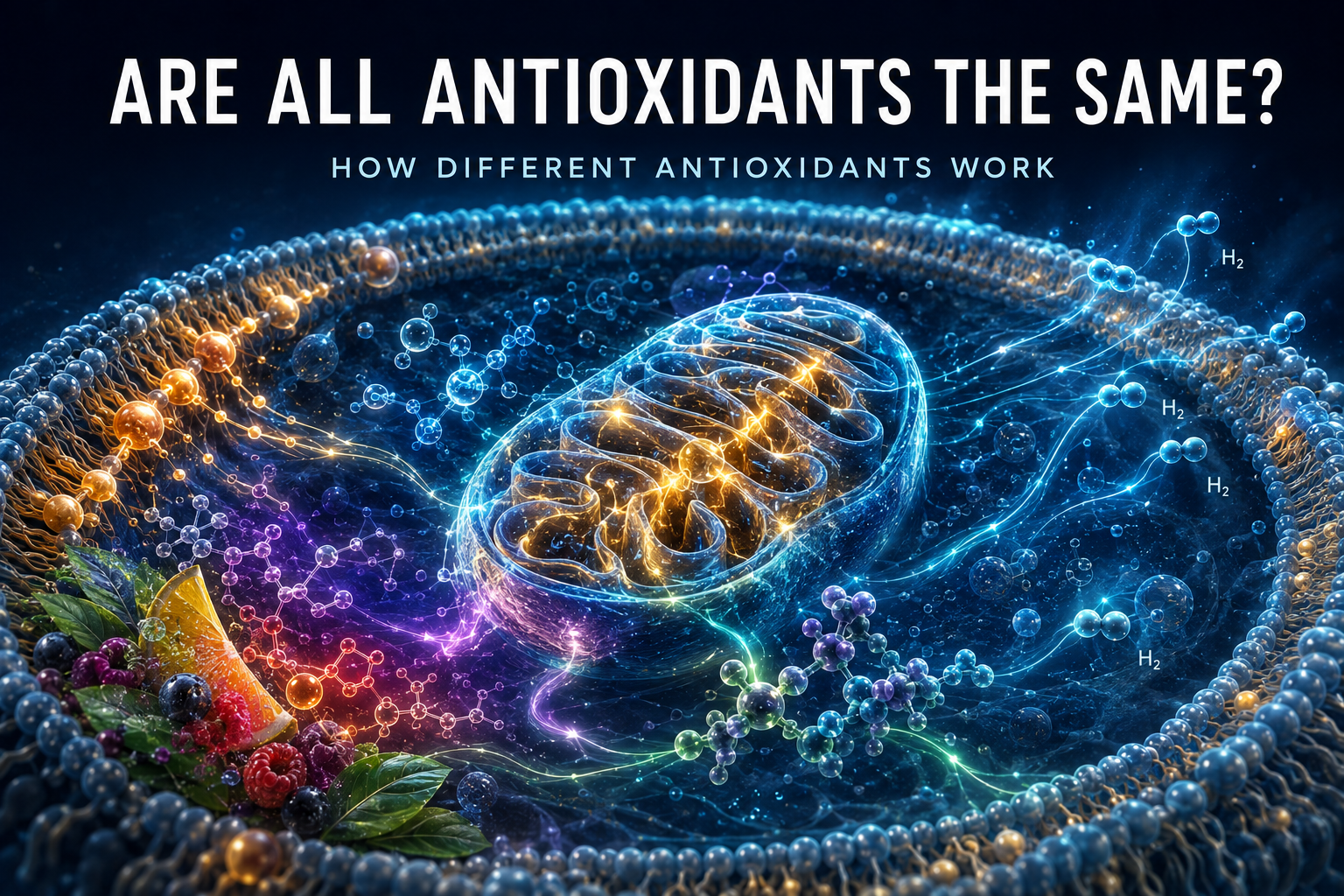
Vitamin C travels mainly through watery environments. Vitamin E helps protect lipid-rich cell membranes. Glutathione works inside cells and supports enzyme systems. Coenzyme Q10 participates in mitochondrial energy production. Plant polyphenols may influence cellular signalling more than they directly “mop up” free radicals. Molecular hydrogen is a small gas being studied for its potential effects on redox regulation and stress-response pathways.
So, are all antioxidants the same? No. They differ in where they work, how the body obtains them, which reactions they influence, how long they remain active and what evidence supports their use.
Understanding these differences leads to a better question than “Which antioxidant is strongest?” The useful question is: what role does each antioxidant play within the body’s wider redox network?
What is an antioxidant?
An antioxidant is broadly defined as a substance or system that can help delay, prevent or repair oxidative damage. Some antioxidants interact directly with reactive molecules. Others prevent those molecules from forming, convert them into less reactive compounds, recycle other antioxidants or activate the body’s own protective genes.
The body constantly produces reactive oxygen species (ROS) during energy production, immune defence, exercise and normal metabolism. Environmental factors such as tobacco smoke, air pollution and ultraviolet radiation can add to this burden.
ROS are not automatically “bad”. At controlled levels, molecules such as hydrogen peroxide help cells communicate, adapt to exercise, fight microbes and respond to stress. Problems can arise when reactive species exceed the body’s ability to regulate them, potentially disturbing redox signalling and damaging lipids, proteins or DNA. This is known as oxidative stress.
For a fuller explanation, read Molecular Hydrogen and Oxidative Stress: How Could H₂ Help Protect Cells?.
The aim is therefore not to eliminate every oxidant. It is to maintain redox balance.
Why antioxidants are not all the same
Antioxidants differ across at least five important dimensions.
1. Where they work
Water-soluble antioxidants circulate in blood and cellular fluids. Fat-soluble antioxidants concentrate in membranes and lipoproteins. Some antioxidant enzymes operate in specific cellular compartments, including mitochondria, cytosol and peroxisomes.
An antioxidant effective in one location may have limited access to another.
2. What they act on
“Free radical” is not one substance. Superoxide, hydroxyl radicals, lipid radicals and reactive nitrogen species have different chemistry and biological roles. Hydrogen peroxide is a reactive oxygen species but is not itself a free radical.
No single antioxidant simply neutralises every reactive species throughout the body.
3. How they work
Some antioxidants donate an electron or hydrogen atom. Enzymes catalyse reactions repeatedly. Others bind metals that could promote oxidation, regenerate another antioxidant or influence gene expression and signalling pathways.
4. How the body obtains them
The body manufactures some antioxidants, including glutathione and key enzymes. Others must come from food, such as vitamin C. Minerals including selenium, copper, zinc and manganese are not necessarily antioxidants themselves, but they help antioxidant enzymes function.
5. Dose and context
An antioxidant’s effects can change with dose, tissue, timing, oxygen level and a person’s health. At high concentrations or in particular chemical environments, some compounds may become pro-oxidant. This helps explain why an antioxidant-rich diet can be associated with health benefits while high-dose isolated supplements often produce disappointing—and occasionally harmful—results.
The body’s antioxidant defence network
Antioxidants should be understood as a coordinated system rather than a competition.
Superoxide dismutase: the first conversion step
Superoxide dismutase (SOD) enzymes convert superoxide into hydrogen peroxide. Different forms of SOD use copper and zinc or manganese and operate in different parts of the cell.
This is not the end of the process: hydrogen peroxide must then be regulated by other systems.
Catalase: rapid hydrogen-peroxide breakdown
Catalase converts hydrogen peroxide into water and oxygen. It is especially concentrated in peroxisomes, cellular structures involved in oxidative metabolism.
Glutathione peroxidase: peroxide control
Glutathione peroxidases help reduce hydrogen peroxide and lipid hydroperoxides. Several forms require selenium. They work with glutathione, which is converted from its reduced form, GSH, to its oxidised form, GSSG.
Glutathione: a central cellular antioxidant
Glutathione is a small molecule produced from amino acids. It participates in redox control, detoxification reactions and the recycling of other antioxidants. Calling it the “master antioxidant” is popular marketing language, but it functions as one important component of a much larger system.
Glutathione status depends on synthesis, recycling, enzyme activity and nutritional supply. Swallowing a supplement does not necessarily reproduce the tightly regulated glutathione activity inside every cell.
Major dietary antioxidants compared
| Antioxidant | Main environment or role | Common food sources | Important distinction |
|---|---|---|---|
| Vitamin C | Water-soluble; supports antioxidant recycling and collagen synthesis | Peppers, berries, citrus fruit, broccoli, potatoes | Circulates in watery compartments and can regenerate vitamin E |
| Vitamin E | Fat-soluble; helps interrupt lipid-peroxidation chains | Nuts, seeds, plant oils, wheat germ | Especially relevant to cell membranes and lipoproteins |
| Carotenoids | Pigments with varied tissue-specific roles | Carrots, tomatoes, leafy greens, peppers | Beta-carotene, lycopene, lutein and zeaxanthin are not interchangeable |
| Polyphenols | Influence signalling, enzymes and stress responses | Berries, cocoa, tea, coffee, herbs, colourful plants | Many effects may arise from signalling rather than direct radical scavenging in the body |
| CoQ10 | Mitochondrial electron transport and lipid-phase redox activity | Organ meats, fish, meat; also produced by the body | Both an energy-transfer molecule and a redox-active compound |
| Glutathione | Intracellular redox buffer and enzyme cofactor | Made by the body from amino acids | Its cellular function cannot be reduced to the amount consumed orally |
| Molecular hydrogen (H₂) | Small gas under investigation as a redox modulator | Delivered experimentally through hydrogen-rich water or inhaled gas | Human evidence is emerging and condition-specific; it is not a dietary vitamin |
Vitamin C: water-soluble and multifunctional
Vitamin C, or ascorbic acid, is an essential nutrient. In addition to its redox roles, the body needs it for collagen production, iron absorption and the synthesis of certain molecules.
Because it is water-soluble, vitamin C works mainly in aqueous environments. It can also help regenerate vitamin E after vitamin E interrupts lipid oxidation. This illustrates the network principle: antioxidants often support one another.
Vitamin C from a balanced diet is not equivalent to unlimited supplementation. High supplemental doses can cause diarrhoea, nausea or stomach cramps and may be unsuitable for people with particular conditions, including iron-overload disorders.
Vitamin E: protection within lipids
Vitamin E refers to a family of fat-soluble compounds, with alpha-tocopherol being the form maintained most strongly in human tissues. It helps interrupt chain reactions of lipid peroxidation, making it especially relevant in cell membranes and circulating lipoproteins.
Vitamin E and vitamin C are therefore not substitutes: they occupy different environments but can interact within the antioxidant network.
Carotenoids: a family, not a single antioxidant
Carotenoids are colourful plant pigments. Beta-carotene can be converted into vitamin A, while lutein and zeaxanthin concentrate in the retina. Lycopene has different absorption and distribution patterns.
Their biological effects depend on the compound and context. High-dose beta-carotene supplements increased lung-cancer risk in major trials involving smokers and asbestos-exposed participants. Beta-carotene in vegetables has not shown the same harm.
This is one of the clearest examples of why “antioxidant” does not automatically mean “safe at any dose”.
Polyphenols: more than direct scavengers
Polyphenols include flavonoids, phenolic acids and many other plant compounds found in berries, tea, coffee, cocoa, olive oil, herbs and vegetables.
Laboratory tests can show impressive direct antioxidant capacity. However, many polyphenols are extensively metabolised, and their concentrations in human tissues may be far lower than those used in a test tube. Their real biological importance may involve cell signalling, enzyme regulation, the gut microbiome and activation of endogenous stress-response pathways.
This is why an ORAC score or test-tube antioxidant ranking cannot tell us which food or supplement will produce the greatest health benefit.
Coenzyme Q10: energy and redox biology
CoQ10 is made by the body and also obtained in small amounts from food. It transfers electrons within the mitochondrial respiratory chain, making it central to energy production. In its reduced form, ubiquinol, it can also help limit lipid oxidation.
CoQ10 illustrates how a molecule can have an antioxidant role without existing primarily as a free-radical “sponge”. Evidence for supplementation varies by condition, dose and formulation.
Food versus antioxidant supplements
Fruit, vegetables, legumes, nuts, whole grains, herbs and spices provide complex combinations of vitamins, minerals, fibre and phytochemicals. They are associated with health in the context of overall dietary patterns—not because one molecule performs all the work.
Isolated supplements deliver a narrower set of compounds, sometimes at doses that would be difficult to obtain from food. They may be appropriate for a diagnosed deficiency, restricted diet, pregnancy requirement or particular clinical indication, but they are not automatically healthier than food.
Large trials have not shown that general high-dose antioxidant supplementation reliably prevents cancer or cardiovascular disease. Some interventions have caused harm in specific groups. Supplements can also interact with anticoagulants, chemotherapy, radiotherapy and other treatments.
The practical foundation is straightforward:
Eat a varied range of colourful vegetables and fruit.
Include nuts, seeds, legumes and whole grains where appropriate.
Avoid smoking and minimise exposure to tobacco smoke.
Exercise regularly, allowing normal adaptive redox signalling to occur.
Use supplements to meet a defined need, not to chase the highest antioxidant number.
Ask a clinician or pharmacist about interactions and safe doses.
Where does molecular hydrogen fit?
Molecular hydrogen is different from conventional dietary antioxidants. H₂ is a small, non-polar gas that can diffuse rapidly through biological membranes. It has been investigated through methods including hydrogen-rich water and controlled gas inhalation.
Early molecular-hydrogen research proposed that H₂ could react selectively with highly damaging species such as hydroxyl radicals while preserving physiologically useful signals. That idea helped launch the field, but the direct-scavenging explanation has important limitations: H₂ is relatively unreactive, remains in the body for a short time and may not reach concentrations sufficient to explain every reported biological effect through direct neutralisation alone.
Researchers are now investigating a broader model in which molecular hydrogen may influence:
Redox-sensitive signalling
Nrf2 and endogenous defence pathways
Inflammatory signalling
Mitochondrial function
Gene and protein expression
Cellular adaptation to stress
These mechanisms remain under investigation and may vary by tissue and condition. It is more accurate to describe H₂ as a potential redox modulator than as a universal free-radical scavenger.
Human trials have reported signals of benefit in selected areas, but the evidence base is heterogeneous. Studies use different populations, outcomes, delivery methods, concentrations and durations. Positive laboratory or animal findings do not prove that hydrogen therapy prevents disease, treats every oxidative-stress-related condition or improves longevity.
For a broader review of the clinical literature, see Hydrogen Therapy Benefits: What Does Scientific Research Really Show?.
Is molecular hydrogen the “best” antioxidant?
There is no scientifically meaningful universal ranking of antioxidants.
Molecular hydrogen has unusual properties: it is extremely small, diffuses quickly and does not behave like a vitamin or plant polyphenol. Those differences make it scientifically interesting, but “different” does not mean “best”.
Vitamin C remains essential because humans cannot make it. Vitamin E has a specialised role in lipid environments. Glutathione-based enzymes regulate peroxides inside cells. Carotenoids and polyphenols have compound-specific functions. H₂ cannot replace essential nutrients, and an orange or portion of leafy vegetables cannot replicate a controlled hydrogen exposure.
The comparison is therefore not like choosing the strongest cleaner. It is more like comparing members of a coordinated emergency team: each has different access, tools and responsibilities.
Can too many antioxidants be harmful?
Yes—particularly in high-dose supplement form.
Excessive antioxidant exposure may disrupt useful redox signalling or interact with medication and treatment. High doses of beta-carotene are a recognised concern for people who smoke or have been exposed to asbestos. Excess vitamin E may increase bleeding risk in some circumstances, while large amounts of vitamin C can cause digestive effects and may aggravate iron overload.
Antioxidant supplements during chemotherapy or radiotherapy require individual medical advice. Some cancer treatments deliberately use oxidative mechanisms, and the effect of supplemental antioxidants may depend on the treatment, dose and timing.
“Natural”, “antioxidant” and “high strength” are not safety guarantees.
How to compare antioxidant claims
Before buying a product, ask:
Where is the evidence? Was the effect observed in a test tube, animal model or controlled human trial?
What outcome changed? A laboratory biomarker is not automatically a meaningful health improvement.
Was the same formulation tested? Food, extracts, tablets, water and inhaled gases have different pharmacology.
Who was studied? Results from one population may not apply to everyone.
What was the dose and duration? More is not necessarily better.
Are risks and interactions disclosed? Credible information discusses limitations as well as potential benefits.
Does the claim rely on an ORAC score? Test-tube antioxidant capacity does not establish effectiveness inside the human body.
The bottom line: diversity matters more than a winner
Antioxidants are not all the same. They differ in chemistry, location, bioavailability and biological purpose. They work within an interconnected defence and signalling network that also depends on enzymes, minerals, repair systems and normal reactive-oxygen signalling.
For most people, a varied diet rich in plant foods is a better foundation than megadoses of isolated antioxidants. Supplements can be valuable when they address a genuine need, but they should be selected with attention to evidence, safety and individual circumstances.
Molecular hydrogen adds an intriguing new category to the antioxidant conversation. Its size, diffusion and possible effects on redox signalling distinguish it from vitamins and polyphenols. However, it should not be presented as a replacement for nutrition, a universal antioxidant or a proven treatment for every condition associated with oxidative stress.
The most scientifically accurate conclusion is not that one antioxidant wins. It is that context, balance and the entire network matter.
Frequently asked questions
Are all antioxidants the same?
No. Antioxidants differ in where they work, which reactions they influence, how the body obtains them and what scientific evidence supports their use. Vitamin C, vitamin E, glutathione, polyphenols and molecular hydrogen are not interchangeable.
What is the most powerful antioxidant?
There is no universal “most powerful” antioxidant. Laboratory rankings do not account for absorption, metabolism, tissue location, dose or clinical outcomes. The body uses a network of complementary antioxidant and repair systems.
Is it better to obtain antioxidants from food or supplements?
For most people, a varied diet is the best foundation. Whole foods provide combinations of nutrients, fibre and phytochemicals. Supplements may be appropriate for a deficiency or specific clinical need, but high doses can cause harm or interact with medication.
Is glutathione the master antioxidant?
Glutathione is a central intracellular redox molecule, but “master antioxidant” oversimplifies biology. It works alongside enzymes, vitamins, thioredoxin systems and repair mechanisms rather than controlling everything alone.
Is molecular hydrogen an antioxidant?
Molecular hydrogen is widely investigated for antioxidant-related and redox-modulating effects. Direct interaction with highly reactive species has been proposed, but researchers are also studying effects on signalling and endogenous defence pathways. It is not an essential nutrient or a universal antioxidant treatment.
Can antioxidant supplements interfere with exercise adaptations?
Exercise-generated reactive species help trigger some beneficial adaptations. Research on whether high-dose vitamin C or E blunts particular training responses is mixed and depends on dose, population and outcome. Routine megadosing should not be assumed to improve performance or recovery.
Can you take too many antioxidants?
Yes. High-dose supplements can cause side effects, disrupt redox signalling or interact with medicines and treatment. Beta-carotene supplements are particularly unsuitable for smokers and people with substantial asbestos exposure unless a clinician advises otherwise.
References
Sies H. Oxidative Stress: a concept in redox biology and medicine. Redox Biology. 2015;4:180–183. doi:10.1016/j.redox.2015.01.002.
Sies H. Oxidative Stress: Concept and Some Practical Aspects. Antioxidants. 2020;9(9):852. doi:10.3390/antiox9090852.
Averill-Bates DA. Reactive oxygen species and cell signalling. Biochimica et Biophysica Acta. 2024. PubMed PMID: 37949302.
Jomova K, Raptova R, Alomar SY, et al. Reactive oxygen species, toxicity, oxidative stress, and antioxidants: chronic diseases and ageing. Archives of Toxicology. 2023;97:2499–2574. doi:10.1007/s00204-023-03562-9.
Jomova K, et al. Several lines of antioxidant defense against oxidative stress. 2024. PubMed PMID: 38483584.
National Institutes of Health, Office of Dietary Supplements. Vitamin C: Fact Sheet for Health Professionals. Updated 2025. https://ods.od.nih.gov/factsheets/VitaminC-HealthProfessional/
National Institutes of Health, Office of Dietary Supplements. Vitamin E: Fact Sheet for Health Professionals. https://ods.od.nih.gov/factsheets/VitaminE-HealthProfessional/
National Institutes of Health, Office of Dietary Supplements. Vitamin A and Carotenoids: Fact Sheet for Health Professionals. Updated 2025. https://ods.od.nih.gov/factsheets/VitaminA-HealthProfessional/
National Center for Complementary and Integrative Health. Antioxidant Supplements: What You Need To Know. https://www.nccih.nih.gov/health/antioxidant-supplements-what-you-need-to-know
Ohsawa I, Ishikawa M, Takahashi K, et al. Hydrogen acts as a therapeutic antioxidant by selectively reducing cytotoxic oxygen radicals. Nature Medicine. 2007;13:688–694. doi:10.1038/nm1577.
Hirano SI, Ichikawa Y, Sato B, et al. Molecular hydrogen as a potential clinically applicable radioprotective agent. International Journal of Molecular Sciences. 2021;22(9):4566. doi:10.3390/ijms22094566.
Wang W, et al. H₂ as a potential redox homeostasis modulator: a review of regulatory mechanisms. 2025. PubMed PMID: 41254431.
NHS. Why 5 A Day? https://www.nhs.uk/live-well/eat-well/5-a-day/why-5-a-day/