Interest in molecular hydrogen continues to grow as more people explore its potential role in supporting general wellbeing, exercise recovery, healthy ageing and the body’s response to oxidative stress.
However, choosing a hydrogen machine is not always straightforward. Output figures can be confusing, different machines use different electrolysis systems, and the purchase price does not always reflect the complete cost of owning the equipment.
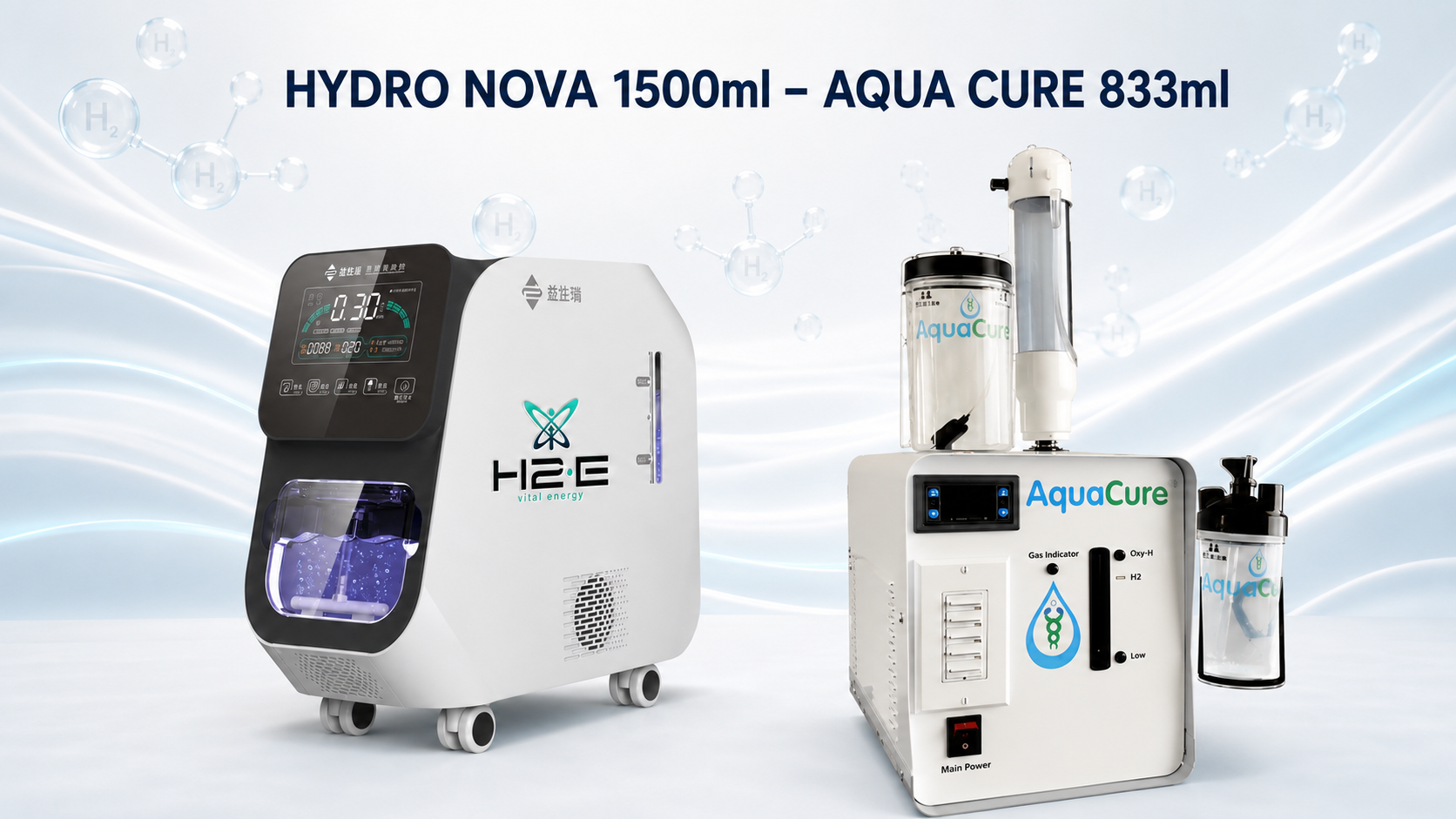
In this comparison, we look at two established options:
- The H2=E Hydro Nova 1500ml
- The AquaCure AC50 V2
Both machines generate a mixture containing approximately two-thirds hydrogen and one-third oxygen. However, they differ considerably in gas output, technology, design, maintenance, intended use and customer support.
At a Glance: Hydro Nova vs AquaCure
| Feature | Hydro Nova 1500ml | AquaCure AC50 V2 |
|---|---|---|
| Maximum total gas output | 1,500 ml/min | Approximately 833 ml/min |
| Approximate hydrogen output | 1,000 ml/min | Approximately 555 ml/min |
| Gas composition | 66.6% hydrogen and 33.3% oxygen | Approximately 66% hydrogen and 33% oxygen |
| Output settings | 450, 900 or 1,500 ml/min | Electronically adjustable |
| Primary design | Hydrogen inhalation and home wellness | Multi-purpose Brown’s Gas generator |
| Electrolysis technology | PEM with USA-made N117 membrane | Electrolyser using a water-and-lye solution |
| Maximum stated operation | Timer up to 8 hours | Designed for continuous operation |
| Machine weight | 9.4 kg without water | Approximately 7.3 kg in operation |
| Noise level | 20 dB | Not stated on the product page |
| Water tank | 2.6 litres | Approximately 1 litre, plus reserve system |
| Maintenance | Distilled water and periodic filter replacement | Pure water, electrolyte handling and rinsing around every 100 hours |
| Warranty | Two years | One-year manufacturer warranty; lifetime repair support subject to conditions and charges |
| Listed price | £2,750 | US$2,999 |
| Delivery and support | Free UK delivery and UK-based support | Supplied by a US-based company |
| Voltage | Suitable for the UK market | User must manually select 120V or 240V on the V2 |
| Medical-device status | Listed as a rehabilitation medical device in China | Seller states it is not an FDA-defined medical device |
Specifications and prices were checked on the manufacturers’ websites in July 2026 and may change.
Understanding the Output Figures
This is the most important part of the comparison.
Both machines produce a gas mixture containing approximately 66% hydrogen and 33% oxygen. Therefore, the advertised total gas-flow figure is not the same as the amount of molecular hydrogen being generated.
The Hydro Nova produces up to:
- 1,500 ml of total gas per minute
- Approximately 1,000 ml of molecular hydrogen per minute
- Approximately 500 ml of oxygen per minute
The AquaCure produces up to:
- 50 litres of total gas per hour
- Approximately 833 ml of total gas per minute
- Approximately 555 ml of molecular hydrogen per minute
- Approximately 278 ml of oxygen per minute
This means that at maximum output, the Hydro Nova produces approximately 80% more molecular hydrogen per minute than the AquaCure.
Approximate Output Over One Hour
| Machine | Total mixed gas | Molecular hydrogen | Oxygen |
|---|---|---|---|
| Hydro Nova 1500ml | 90 litres | 60 litres | 30 litres |
| AquaCure AC50 V2 | 50 litres | Approximately 33 litres | Approximately 17 litres |
These calculations are based on the manufacturers’ published flow rates and gas proportions.
Higher output should not automatically be interpreted as guaranteed better health results. Individual requirements vary, and scientific research has not established a universally appropriate dose for every purpose. Nevertheless, output is an important practical consideration when comparing the amount of hydrogen generated during a session.
Two Different Types of Machine
Although both products generate a hydrogen-and-oxygen mixture, they have been designed with somewhat different users in mind.
Hydro Nova: Purpose-Built for Hydrogen Inhalation
The Hydro Nova is designed primarily as an easy-to-use hydrogen inhalation machine for the home.
The user fills the machine with suitable distilled water, connects the humidifier and nasal cannula, selects the desired output and sets the timer. Its three output levels—450, 900 and 1,500 ml/min—allow the user to choose a lower or higher flow without having to make complicated adjustments.
The machine includes:
- A PEM electrolysis system
- A USA-made N117 proton-exchange membrane
- Three selectable output levels
- A timer for sessions of up to eight hours
- A 2.6-litre water tank
- Water-level monitoring
- Intelligent water-quality detection
- Cooling and water-circulation systems
- Purification and humidification
- Triple explosion-protection features
- A one-way sealed humidifier
- Voice notifications
- Ten nasal cannulas
- A TDS water-quality testing pen
For people whose main objective is incorporating hydrogen inhalation into a regular wellness routine, this focused design may make the Hydro Nova easier to understand and operate.
AquaCure: A Multi-Purpose Brown’s Gas System
The AquaCure AC50 V2 is a more industrial-looking Brown’s Gas generator developed from equipment originally intended to supply gas to a micro-torch.
It has subsequently been modified with additional controls, filtration and safety systems. Its manufacturer presents it as a multi-purpose machine capable of supporting several applications, including:
- Producing hydrogen-rich water
- Direct gas breathing
- Bubbling gas through water
- Supplying gas for external applications
- Hydroponic and animal-related applications
- Fuel for a suitable micro-torch
The AquaCure therefore offers more experimental versatility than the Hydro Nova. For someone specifically seeking a multi-purpose Brown’s Gas generator, that versatility may be attractive.
For a customer primarily interested in straightforward hydrogen inhalation, however, some of these additional applications may not be necessary.
PEM Technology vs Electrolyte-Based Electrolysis
The machines also use different approaches to electrolysis.
Hydro Nova PEM System
The Hydro Nova uses a proton-exchange membrane, or PEM, incorporating a USA-made N117 membrane.
PEM systems are widely used in modern hydrogen-generating equipment because they can produce gas using distilled water without requiring the user to prepare or handle a caustic electrolyte solution.
For the owner, this helps make routine operation relatively straightforward:
- Test the distilled water with the supplied TDS pen.
- Fill or top up the machine.
- Select the flow and session time.
- Replace the external filter when required.
The Hydro Nova product information recommends distilled water with a reading of 2 ppm or below, with 0 ppm being ideal.
AquaCure Electrolyte System
The AquaCure uses a lightly caustic electrolyte made from approximately 80 grams of lye in around one litre of water.
This method can support efficient and continuous gas generation, but it introduces additional handling and maintenance considerations. The AquaCure incorporates a Tower Cap and water-filled humidifier designed to reduce the possibility of lye mist leaving the electrolyser.
The manufacturer recommends rinsing the machine approximately every 100 operating hours. The humidifier must also contain enough clean water and be changed according to the operating instructions.
Some technically minded users may be comfortable preparing and maintaining this kind of system. Others may prefer the convenience of a PEM machine that operates using distilled water without the need to mix a lye solution.
Gas Output and Session Practicality
The Hydro Nova’s higher maximum output may be valuable for people who want to generate a larger quantity of molecular hydrogen during a given period.
For example, based purely on the published flow rates:
- A 60-minute Hydro Nova session generates approximately 60 litres of molecular hydrogen.
- A 60-minute AquaCure session generates approximately 33 litres of molecular hydrogen.
To generate approximately 60 litres of hydrogen at full output, the AquaCure would need to operate for roughly 108 minutes.
That does not mean the two sessions will necessarily produce different health outcomes. Hydrogen dosing depends on more than the machine’s headline output, including session duration, the delivery setup, breathing rate and how much gas mixes with surrounding air.
However, the figures show that the Hydro Nova can generate a comparable quantity of hydrogen in less time.
Adjustability
Both machines provide adjustable gas production, although they approach it differently.
The Hydro Nova provides three clearly defined settings:
- 450 ml/min
- 900 ml/min
- 1,500 ml/min
This makes the controls simple and repeatable. Users can easily select the same setting for each session.
The AquaCure provides electronically adjustable gas output through buttons and a display. This gives the operator greater control over the exact production level and could appeal to people who enjoy fine-tuning technical equipment.
The choice depends on the user:
- The Hydro Nova prioritises simplicity.
- The AquaCure prioritises detailed adjustability.
Continuous Operation
One clear strength of the AquaCure is continuous operation.
Its manufacturer states that the machine is designed to run continuously without overheating. At full production, it can reportedly operate for around ten hours on one fill; at 40% output, it may operate for more than 24 hours.
The Hydro Nova provides a timer that can be set for up to eight hours. That is considerably longer than a typical personal inhalation session and should be more than sufficient for most home wellness routines.
For continuous gas generation, hydroponics or other specialist applications, the AquaCure has an advantage. For conventional personal sessions, the Hydro Nova’s eight-hour timer is likely to be more than adequate.
Safety Systems
Hydrogen is non-toxic, but mixtures of hydrogen and oxygen are combustible. Any hydrogen-generating machine must therefore be operated according to its instructions, in a ventilated location and away from flames, sparks, smoking or heat sources.
Hydro Nova Safety Features
The Hydro Nova lists:
- Triple explosion protection
- Intelligent sensor detection
- Water-level monitoring
- Water-quality detection
- Intelligent air cooling
- Water circulation
- A one-way sealed humidifier
- Automatic alerts and voice notifications
- Built-in hydrogen-and-oxygen mixing
AquaCure Safety Features
The AquaCure provides detailed information about several systems, including:
- Low-liquid shutoff
- High-liquid shutoff
- Low-level alarm
- Anti-backfill protection
- A Tower Cap pre-scrubber
- A water humidifier for scrubbing residual lye mist
- A 2 psi electrical shutoff
- A 3 psi pressure-relief system
- Adjustable gas production
- A master switch disconnecting both power and neutral
- Gas generation on demand rather than gas storage
The AquaCure provides more extensive public explanations of its individual safety mechanisms. However, its electrolyte system also requires the owner to understand how to handle and maintain a caustic solution safely.
Whichever machine is chosen, owners should read the complete manual and follow the manufacturer’s operating, ventilation, water-quality and maintenance instructions.
Noise and Home Use
The Hydro Nova has a stated operating noise level of just 20 dB. This makes it suitable for use while reading, working, watching television or relaxing.
The AquaCure product page does not provide an equivalent noise rating, so a direct numerical comparison is not possible.
The Hydro Nova has the more polished appearance of a modern home wellness appliance. The AquaCure has a functional, industrial appearance, which reflects its multi-purpose design and origins as a modified electrolyser.
Appearance will not affect gas production, but it may matter when a machine is used regularly in a bedroom, lounge, wellness centre or clinic.
Maintenance and Water Requirements
Both machines require very pure water.
Maintaining the Hydro Nova
The Hydro Nova requires 2.6 litres of distilled water for its initial fill. Under average use, H2=E estimates that it will require approximately three litres of additional distilled water per month.
Every machine includes a TDS pen so the owner can test the water before adding it. H2=E recommends a reading of no more than 2 ppm.
The machine also includes a filter expected to last for approximately 12 months, depending on use.
Maintaining the AquaCure
The AquaCure also requires pure water, but its internal electrolyser uses water mixed with lye. In addition to topping up the system, the owner is advised to:
- Monitor the electrolyte level
- Maintain the humidifier water
- Check for foaming
- Avoid overfilling
- Rinse the electrolyser approximately every 100 hours
- Follow the instructions for safely handling the electrolyte
The AquaCure includes an hour meter to help users track maintenance intervals.
Both systems require owner care, but the Hydro Nova is likely to offer the simpler maintenance routine.
Purchase Price and the Real UK Cost
The Hydro Nova is currently listed at £2,750 and includes free UK delivery.
The AquaCure AC50 V2 is listed at US$2,999. For a UK customer, its final cost cannot be determined by looking at the dollar price alone.
Possible additional costs include:
- International delivery
- Currency-conversion charges
- UK import VAT
- Customs or courier administration fees
- Return shipping to the United States if servicing is required
- Replacement electrolyte or maintenance items
Exchange rates also fluctuate. UK buyers should obtain a complete landed-cost estimate before purchasing internationally.
With the Hydro Nova, the price is already stated in pounds and UK delivery is included, making the total initial cost easier to understand.
Warranty and Customer Support
The Hydro Nova comes with a comprehensive two-year warranty and support from H2=E in the UK. A setup guide and instructional video are provided, and customers can contact the UK team if they require assistance.
The AquaCure product page describes:
- A one-year warranty covering qualifying manufacturing issues
- A one-year satisfaction guarantee, subject to a US$200 restocking fee and exclusions
- Lifetime access to repairs when the owner pays the relevant parts, labour and shipping charges after the warranty expires
This is better described as lifetime repair support than an unconditional lifetime warranty.
The AquaCure company has operated in the United States for many years and provides online instructions and customer resources. Nevertheless, UK customers should consider the practical cost and inconvenience of returning a heavy machine internationally if hands-on servicing becomes necessary.
For a UK buyer, local support can be almost as important as the machine itself.
Where the AquaCure Stands Out
A fair comparison should recognise the AquaCure’s genuine strengths.
It may be the better choice for someone who wants:
- Continuous operation
- Fine electronic adjustment of gas output
- Multiple gas and water applications
- A system that can also support technical or non-wellness uses
- Extensive publicly documented safety mechanisms
- A one-year satisfaction guarantee
- Long-term repair availability
- Equipment designed for technically confident users
The AquaCure is a versatile Brown’s Gas generator with an unusual range of potential uses.
Where the Hydro Nova Stands Out
The Hydro Nova is likely to be the stronger choice for a UK buyer who primarily wants convenient hydrogen inhalation at home.
Its principal advantages include:
- Approximately 80% more molecular hydrogen output per minute
- A modern PEM electrolysis system
- No lye solution for the user to prepare
- Simple 450, 900 and 1,500 ml/min settings
- Very quiet 20 dB operation
- An eight-hour timer
- A 2.6-litre tank
- Water-quality and water-level monitoring
- A TDS pen and ten nasal cannulas included
- A two-year warranty
- Free UK delivery
- UK-based guidance and customer support
- A clear price in pounds without international import uncertainty
It brings together higher output, straightforward operation and convenient local ownership.
Which Machine Offers Better Value?
The answer depends on what the buyer wants the machine to do.
The AquaCure is a multi-purpose Brown’s Gas system. It is particularly interesting for technically confident users who value continuous operation and want to explore applications beyond ordinary hydrogen inhalation.
The Hydro Nova is more focused. It is designed for people who want a practical, high-output machine that can become part of a regular home wellness routine without complicated electrolyte preparation.
For most UK customers primarily interested in hydrogen inhalation, the Hydro Nova offers the more compelling overall package. It produces approximately 1,000 ml of molecular hydrogen per minute, compared with around 555 ml/min from the AquaCure, while adding a two-year UK warranty, free UK delivery and local support.
Final Verdict
Both machines have strengths, but they serve different priorities.
Choose the AquaCure AC50 V2 if you want an adjustable, multi-purpose Brown’s Gas generator capable of continuous operation and you are comfortable maintaining an electrolyte-based system purchased from overseas.
Choose the Hydro Nova 1500ml if you want:
- Significantly higher molecular-hydrogen output
- A straightforward PEM machine
- Quiet home operation
- Simple maintenance
- A two-year warranty
- UK-based delivery and support
For UK customers seeking a strong balance of output, convenience, support and value, the Hydro Nova 1500ml is our preferred choice.
Discover the Hydro Nova 1500ml
Important Notice
Molecular-hydrogen research is promising, but it remains an evolving scientific field. Hydrogen machines should not be presented or used as replacements for medical diagnosis, prescribed medication or conventional medical treatment. People who are pregnant, receiving treatment or living with a medical condition should seek advice from an appropriately qualified healthcare professional.