A look at the road ahead for one of the world’s most researched emerging wellness technologies.
If you had mentioned probiotics twenty-five years ago, most people would have looked at you with confusion.
Today they’re sold in almost every pharmacy and supermarket.
The same was once true for vitamin D, omega-3 oils, wearable fitness trackers, red light therapy and even mindfulness meditation. Nearly every innovation in health follows the same journey—from being questioned, to being researched, to eventually becoming accepted.
So where does molecular hydrogen therapy fit into that timeline?
While nobody can predict the future with certainty, we can look at history, current scientific research, and healthcare trends to make an educated assessment.
Where Are We Today?
Hydrogen therapy is no longer a new scientific idea.
Over the past two decades, researchers around the world have published thousands of scientific papers investigating molecular hydrogen and its potential role in reducing oxidative stress, inflammation and supporting cellular health.
Research has explored areas including:
- Healthy ageing
- Sports recovery
- Metabolic health
- Cardiovascular health
- Neurological conditions
- Recovery after physical stress
- General wellness
Despite this growing body of research, hydrogen therapy remains relatively unknown among the general public in the UK.
This isn’t unusual.
Scientific discoveries often take many years before they reach everyday healthcare.
Why Does Adoption Take So Long?
Healthcare moves carefully—and for good reason.
Before any therapy becomes widely accepted, several things usually need to happen.
1. More Clinical Research
Scientists continue conducting larger human studies.
The more high-quality evidence that accumulates, the more confidence healthcare professionals gain.
2. Education
Doctors, physiotherapists, nutritionists, longevity practitioners and wellness clinics first need to understand how the therapy works and where it may fit within existing approaches.
Education often spreads gradually through conferences, journals and professional training.
3. Early Adopters
The first users are usually people who actively seek new wellness technologies.
Professional athletes, biohackers, longevity clinics and forward-thinking practitioners often adopt innovations years before they become mainstream.
Hydrogen therapy is already following this pattern.
4. Public Awareness
Eventually, media coverage, patient stories and word of mouth begin introducing the technology to the wider public.
People start asking their practitioners about it instead of the other way around.
5. Commercial Availability
As demand increases, manufacturers improve devices, prices become more competitive, and more clinics begin offering the therapy.
Accessibility grows.
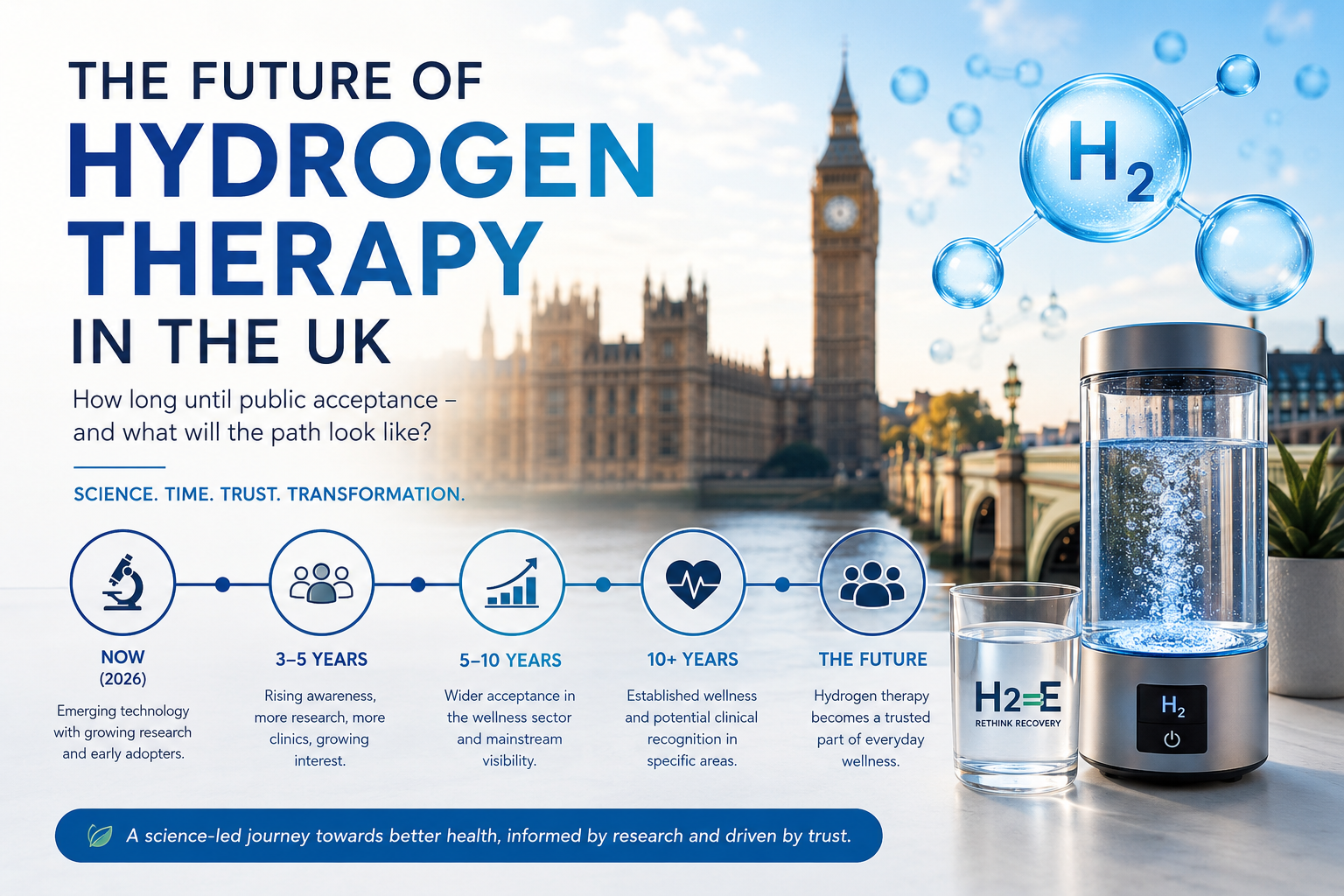
What Might the Timeline Look Like?
Nobody can predict the exact pace, but based on previous healthcare innovations, a reasonable estimate might look something like this.
Today (2026)
Hydrogen therapy remains an emerging wellness technology.
Most people in the UK have never heard of it, although awareness is steadily increasing.
Specialist wellness clinics and longevity practitioners are beginning to incorporate it into their services.
The Next 3–5 Years
Public awareness is likely to increase significantly.
We may see:
- More published human clinical studies
- More UK clinics offering hydrogen therapy
- Increased discussion within longevity medicine
- Greater interest from physiotherapists, sports recovery centres and wellness practitioners
- Growing online education through podcasts, YouTube and health conferences
Hydrogen therapy could become recognised by many people interested in preventive wellness, even if it is not yet widely used.
The Next 5–10 Years
If research continues to develop positively, hydrogen therapy may become a familiar option within the wider wellness sector.
People may begin seeing hydrogen offered alongside therapies such as:
- Red light therapy
- Hyperbaric oxygen
- Cryotherapy
- Infrared saunas
- PEMF therapy
- Compression recovery systems
Rather than replacing existing approaches, hydrogen therapy may become another tool available to practitioners.
Beyond 10 Years
If larger clinical evidence continues to accumulate and healthcare systems determine there is sufficient evidence for particular applications, hydrogen therapy could become far more familiar to healthcare professionals and the public.
Exactly how far that extends will depend on future research, regulatory decisions and clinical evidence.
What Could Speed Up Acceptance?
Several developments could accelerate adoption.
These include:
- Large, high-quality clinical trials with consistent findings
- Positive attention from respected universities and research hospitals
- Greater education for healthcare professionals
- More affordable, reliable devices
- Well-designed studies showing practical benefits in defined patient groups
- Responsible communication that accurately reflects the evidence
What Could Slow It Down?
Emerging therapies also face challenges.
Hydrogen therapy may progress more slowly if there are:
- Exaggerated marketing claims
- Confusion between wellness devices and medical devices
- Limited awareness among healthcare professionals
- Inconsistent product quality
- Insufficient large-scale human trials
Building trust requires transparency, realistic expectations and careful communication.
Looking Back at Other Innovations
History shows that today’s “unusual” ideas often become tomorrow’s everyday tools.
Once, people questioned whether:
- Gut bacteria influenced health.
- Exercise could improve mental wellbeing.
- Meditation had measurable biological effects.
- Wearable devices could track health.
- Vitamin D deficiency mattered.
Today, these concepts are widely accepted.
Scientific progress often happens gradually—and then, almost suddenly, public awareness catches up.
Our Perspective
At H2=E, we believe hydrogen therapy is still in the early stages of its journey.
We do not see it as a miracle treatment or a replacement for conventional medical care.
Instead, we believe molecular hydrogen has the potential to become an increasingly important part of preventive wellness and healthy ageing as scientific understanding continues to grow.
Whether widespread public acceptance takes five years, ten years or longer, one thing seems clear:
Interest in molecular hydrogen is increasing around the world.
As more research is published, more healthcare professionals become familiar with the science, and more people experience hydrogen therapy responsibly within wellness settings, awareness is likely to continue growing.
The future of hydrogen therapy will ultimately be shaped not by marketing, but by the quality of the science.
Disclaimer: This article reflects informed opinion based on current research trends and historical patterns of healthcare innovation. It is not a prediction or guarantee. Hydrogen therapy devices intended for wellness purposes should not be considered a substitute for professional medical advice, diagnosis or treatment. Always consult an appropriately qualified healthcare professional regarding any medical condition or treatment decisions.