Choosing the right hydrogen inhalation machine is about more than just marketing claims. With several premium hydrogen therapy systems now available, many people ask us:
“Is the Inhale H₂ really more efficient, or does the Hydro Nova actually deliver more hydrogen over a treatment session?”
The answer isn’t as simple as comparing output numbers.
In this article we’ll look at the technology behind both systems, explain what current scientific research tells us, and help you understand which features really matter.
Two Different Engineering Approaches
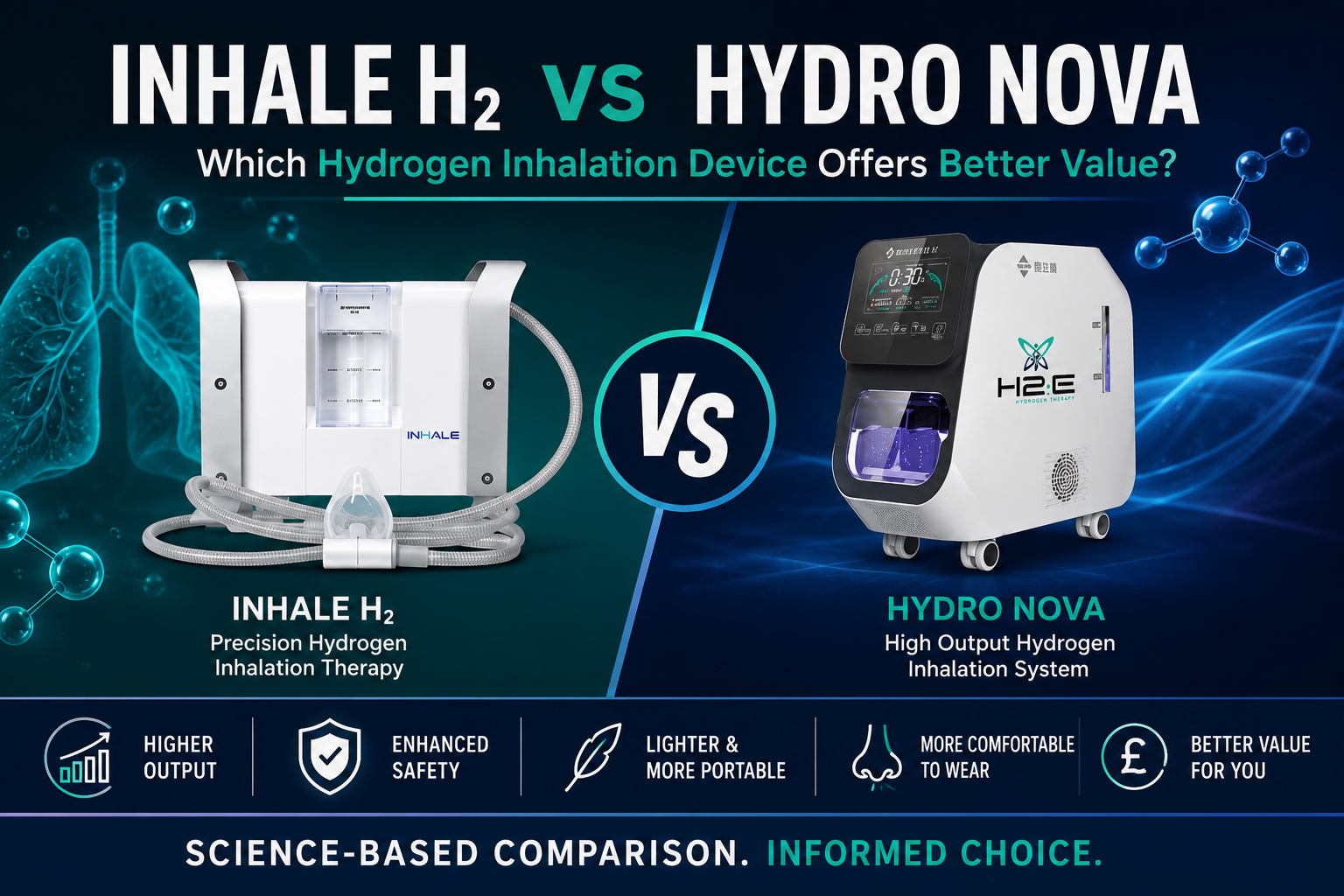
Both the Inhale H₂ and the Hydro Nova are designed to deliver molecular hydrogen gas for inhalation.
However, they use different delivery philosophies.
Inhale H₂
The Inhale H₂ stores hydrogen in an internal reservoir bag and delivers it primarily during inhalation.
The goal is to reduce hydrogen lost during exhalation and increase the Fraction of Inspired Hydrogen (FiH₂).
Their website states that therapeutic effects can be achieved with approximately 480 mL of hydrogen per minute, compared with conventional constant-flow systems that may require much higher flow rates.
This is an innovative engineering solution designed to improve delivery efficiency.
Hydro Nova
The Hydro Nova uses a different approach.
Instead of storing hydrogen between breaths, it continuously produces 1500 mL of hydrogen per minute, delivered through a comfortable nasal cannula.
Its philosophy is straightforward:
- High continuous output
- Simple operation
- Comfortable long treatment sessions
- Excellent portability
- Outstanding value
Rather than concentrating hydrogen into each individual breath, it continuously provides hydrogen throughout the treatment session.
Does Breath Synchronisation Mean More Hydrogen Is Absorbed?
This is perhaps the biggest question.
The short answer is:
Not necessarily.
This is where it’s important to distinguish between:
- Hydrogen produced
- Hydrogen delivered
- Hydrogen actually absorbed by the body
These are three different things.
What Happens When You Inhale Hydrogen?
Hydrogen is the smallest molecule in nature.
When it reaches the tiny air sacs of the lungs (alveoli), it diffuses into the bloodstream extremely rapidly.
Published research has shown that hydrogen concentrations in blood begin rising within minutes of inhalation.
Many tissues approach their peak hydrogen concentration within approximately 6–9 minutes, although deeper tissues such as muscle may take longer.
The important point is this:
The body absorbs hydrogen because of simple diffusion—not because one machine has a more sophisticated delivery system.
Understanding FiH₂
One of the key selling points of the Inhale H₂ is a higher Fraction of Inspired Hydrogen (FiH₂).
FiH₂ simply describes the percentage of hydrogen contained in the air you inhale.
A higher FiH₂ during each breath is certainly desirable.
However,
a higher FiH₂ does not automatically mean that more hydrogen enters the body over an entire treatment session.
Why?
Because total hydrogen exposure depends on several factors:
- hydrogen concentration
- duration of treatment
- breathing pattern
- hydrogen production
Looking at only one measurement does not tell the complete story.
Let’s Compare a Typical 30-Minute Session
Hydro Nova
Output
1500 mL/min
Over 30 minutes
= 45 litres of hydrogen produced
Inhale H₂
Output specification
1200 mL/min
Over 30 minutes
= 36 litres of hydrogen produced
Because the Inhale H₂ concentrates hydrogen during inhalation, less gas may be lost during exhalation.
This can improve delivery efficiency.
However, the Hydro Nova begins with a substantially higher total hydrogen output.
As a result, despite some unavoidable loss during exhalation, the total amount of hydrogen available during the session remains very high.
At present, there are no published head-to-head human clinical studies comparing tissue hydrogen levels after using the Hydro Nova versus the Inhale H₂.
Without that evidence, it is not possible to conclude that one device results in greater hydrogen absorption than the other.
What Does the Scientific Literature Say?
One interesting aspect of hydrogen research is that many successful clinical studies have used surprisingly modest hydrogen flow rates.
Published studies have reported biological effects using inhalation systems producing approximately 250–300 mL/min.
Other studies have used much higher outputs.
Despite these differences, therapeutic benefits have been reported across a broad range of delivery systems.
This suggests that once adequate hydrogen reaches the bloodstream, simply increasing engineering complexity does not necessarily translate into greater clinical benefit.
Current research has not demonstrated that breath-synchronised delivery produces superior health outcomes compared with continuous-flow hydrogen inhalation.
Beyond Output: Everyday Practicality Matters
When comparing two premium devices, everyday usability becomes just as important as engineering specifications.
Hydro Nova Advantages
✓ Higher continuous hydrogen output (1500 mL/min)
✓ Approximately 28% lower purchase price
✓ Lightweight design (9.4 kg)
✓ Compact footprint
✓ Comfortable nasal cannula
✓ Explosion-proof triple safety protection
✓ Easy to transport
✓ Excellent value for clinics and home users
Inhale H₂ Advantages
✓ Innovative breath-synchronised delivery
✓ Internal hydrogen reservoir
✓ Three-year warranty
Both systems are well-designed products with different engineering philosophies.
Which Machine Offers Better Value?
If your goal is simply to own an effective hydrogen inhalation device, either system is capable of delivering molecular hydrogen.
However, when balancing:
- performance
- portability
- comfort
- safety
- simplicity
- purchase price
the Hydro Nova represents exceptional value.
Its higher continuous output, lightweight construction, comfortable nasal cannula, advanced safety features and significantly lower purchase price make it an excellent choice for most users.
Our Perspective
At H2=E, we believe customers deserve honest comparisons backed by science rather than marketing.
The Inhale H₂ introduces an interesting engineering concept by increasing the concentration of hydrogen during inhalation.
The Hydro Nova takes a different approach by providing a consistently high hydrogen output throughout the entire treatment session.
Current scientific evidence does not demonstrate that one of these delivery methods results in superior hydrogen absorption or better clinical outcomes.
What matters most is choosing a reliable, high-quality hydrogen inhalation system that you will use consistently.
For many customers, the Hydro Nova delivers the ideal balance of performance, comfort, portability and value.
References
- Ohsawa I, et al. Hydrogen acts as a therapeutic antioxidant by selectively reducing cytotoxic oxygen radicals. Nature Medicine. 2007.
- Ichihara M, et al. Beneficial biological effects and the underlying mechanisms of molecular hydrogen. Medical Gas Research.
- LeBaron TW, et al. Reviews on molecular hydrogen pharmacology and therapeutic applications.
- Hydrogen inhalation clinical studies published in Medical Gas Research and indexed in PubMed.