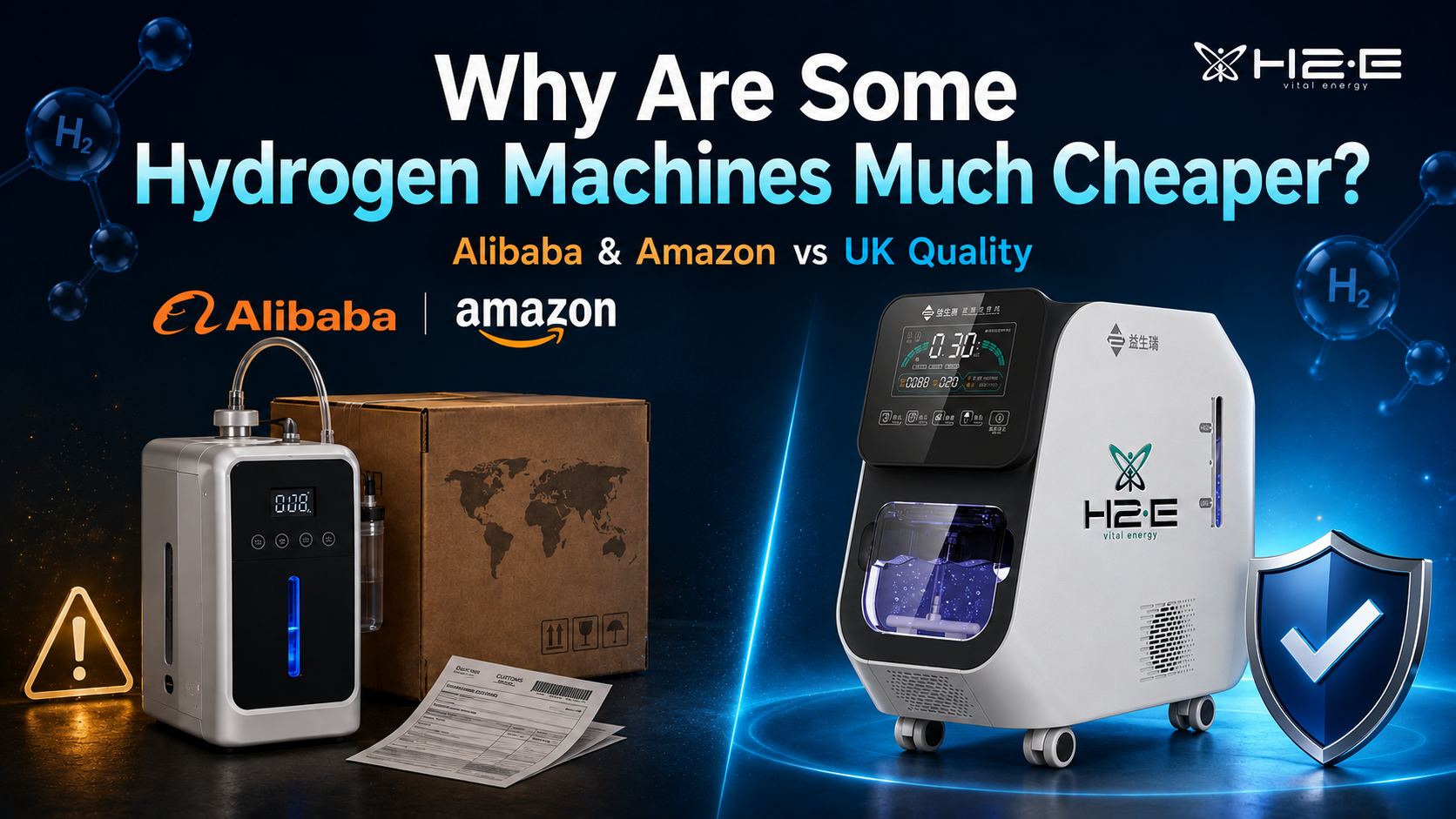
Cheap hydrogen machines are now easy to find on Amazon, Alibaba and other international marketplaces. Some appear to offer similar hydrogen output and features to UK-supplied equipment—but at a fraction of the price.
This leads to an understandable question:
Why should I pay more for a hydrogen machine if I can find a similar-looking model online for less?
Sometimes a less expensive machine may offer reasonable value. However, the advertised price does not always reveal the complete cost, internal specification, output measurement, product documentation, warranty arrangements or support available after purchase.
Two machines can look almost identical while providing very different ownership experiences.
This guide explains nine important factors UK buyers should investigate before choosing a hydrogen inhalation machine.
Why Do Hydrogen-Machine Prices Vary So Much?
The price of a hydrogen machine may be influenced by:
- Electrolysis-cell construction
- PEM membrane specification
- Gas-production capacity
- Quality-control procedures
- Internal tubing, seals and moisture management
- Electrical components
- Monitoring and safety features
- Product testing and documentation
- Manufacturer experience
- Shipping and customs arrangements
- Warranty coverage
- Replacement-part availability
- Local technical support
It is therefore not enough to compare two product photographs or the largest flow-rate number in each listing.
A meaningful comparison must establish exactly what the customer receives for the advertised price.
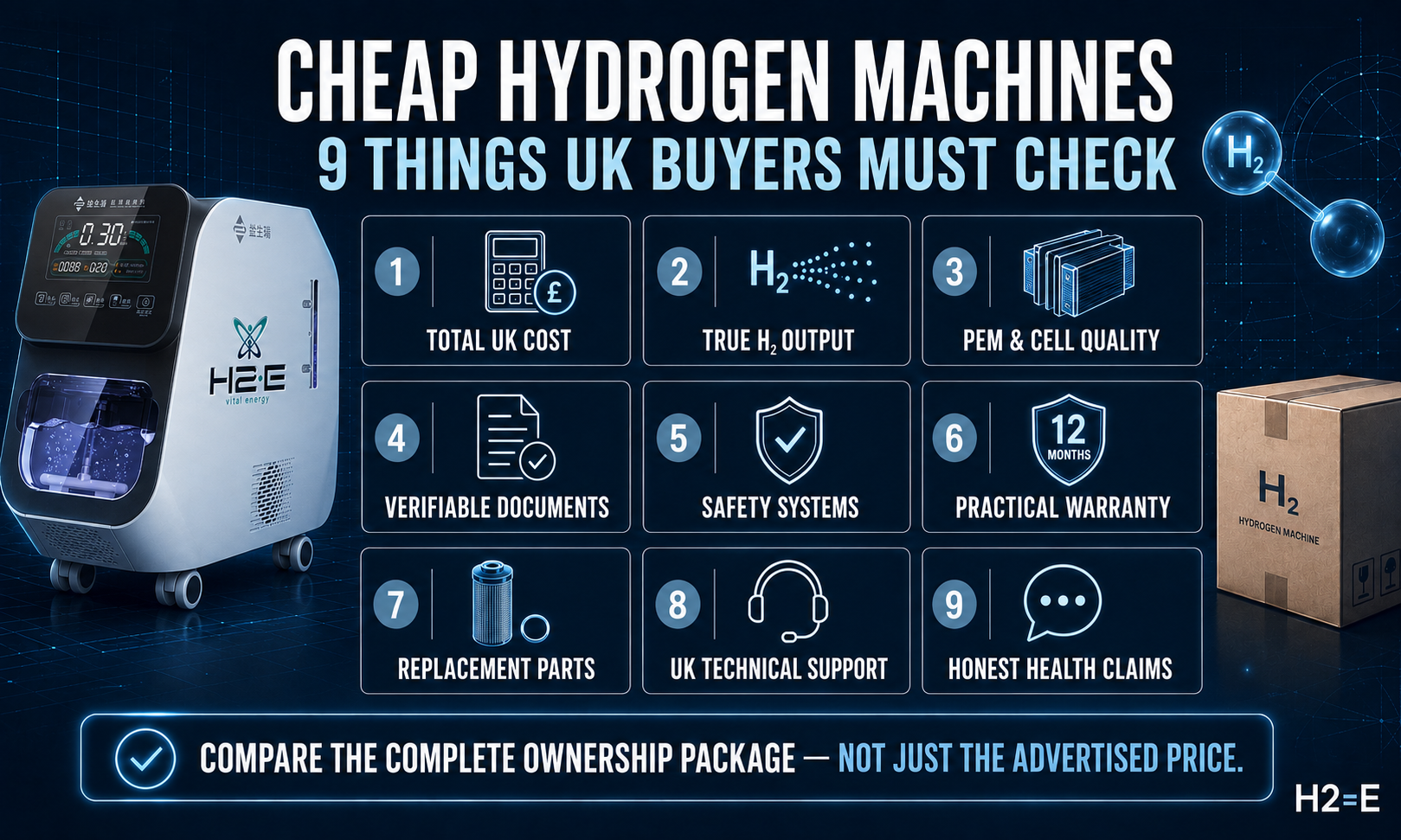
1. Is the Advertised Price the Final UK Cost?
The first consideration when evaluating cheap hydrogen machines is whether the price displayed online represents the final amount you will pay.
A machine shipped from outside the UK may involve additional costs such as:
- International shipping
- Transit insurance
- Import VAT
- Customs Duty, where applicable
- Courier clearance charges
- Currency-conversion fees
- Storage charges if clearance is delayed
- International return shipping
- Bank or payment-provider fees
For consignments worth more than £135, import VAT is normally collected at the point of import, and Customs Duty may also apply depending on the product classification and country of origin.
Official information is available in the UK Government’s guidance on tax and customs for goods sent from abroad.
Before ordering, ask the seller for a written landed-cost estimate that clearly explains:
- Whether VAT is included
- Whether Customs Duty is included
- Who acts as the importer
- Whether delivery is DDP—Delivered Duty Paid
- Whether the courier may collect additional fees
- Who is responsible if the shipment is delayed
A machine that looks significantly cheaper may become less competitive once every charge is included.
2. What Does the Advertised Output Actually Measure?
Flow rate is one of the most confusing areas of hydrogen-machine marketing.
A listing may advertise:
But that number could represent:
- Pure hydrogen output
- Total combined hydrogen-and-oxygen output
- The output of one gas channel
- A peak laboratory measurement
- A selectable maximum setting
- The output achieved consistently during normal operation
These are not interchangeable measurements.
Many electrolysis machines produce hydrogen and oxygen in an approximate 2:1 ratio. If the stated figure represents the combined H₂/O₂ gas output, around two-thirds of the volume is hydrogen.
For example:
A seller should state clearly whether the advertised figure represents hydrogen alone or the complete gas mixture.
You should also ask whether the output has been independently measured and whether it remains stable during a longer session.
A larger number is only useful when the measurement is accurate, clearly defined and delivered consistently.
3. What Is Inside the Machine?
Similar outer cases do not guarantee identical internal components.
Manufacturing costs may vary according to the specification of:
- The electrolysis cell
- PEM membrane
- Electrodes
- Power supply
- Pumps
- Cooling system
- Tubing
- Connectors
- Seals
- Moisture-control system
- Sensors and alarms
- Internal wiring
These components can influence reliability, output consistency, noise, heat management and the machine’s working life.
A listing that simply says “PEM technology” does not provide enough information to judge quality. PEM describes a type of technology, not a universal standard of construction.
Useful questions include:
- Who manufactures the PEM membrane?
- Can the membrane specification be documented?
- What materials are used in the electrolysis cell?
- How is excess moisture managed?
- What automatic monitoring systems are included?
- Is the output tested before dispatch?
- Are replacement cells and internal components available?
The appearance of a machine tells you very little about the components working inside it.
4. Can the Product Documentation Be Verified?
Words such as “medical grade,” “hospital quality,” “certified” and “professional standard” appear frequently in online listings.
These descriptions should not be accepted without supporting documentation.
The regulatory requirements applying to a product depend partly on how it is designed, classified, marketed and intended to be used. A general wellness product and a regulated medical device are not automatically subject to identical requirements.
A declaration or certificate should clearly identify:
- The manufacturer
- The exact product or model
- The relevant regulation or standard
- The assessment or testing organisation
- The report or certificate number
- The date of issue
- The scope of the assessment
A collection of certification logos on a product page does not prove that every certificate applies to the exact machine being sold.
Great Britain currently permits relevant products to use UKCA or recognised CE marking, depending on the applicable product rules. Government guidance explains that businesses must identify the applicable regulations, follow the appropriate conformity-assessment procedure and retain the necessary documentation.
You can read the current guidance on placing UKCA or CE-marked products on the Great Britain market.
Buyers do not need to become regulatory experts, but they should expect clear and verifiable answers from the seller.
5. What Safety and Monitoring Features Are Included?
Hydrogen is a flammable gas. This does not mean that properly designed hydrogen equipment is inherently unsafe, but it does mean that engineering quality and correct operation matter.
When comparing machines, investigate whether the equipment includes appropriate features such as:
- Automatic water-level monitoring
- Overheat protection
- Pressure monitoring
- Automatic shutdown
- Backflow prevention
- Moisture separation
- Suitable ventilation design
- Clear operating instructions
- Maintenance warnings
- Error alerts
Not every machine will use the same safety architecture. The important question is whether its systems are appropriate for its design and intended use.
The seller should also provide clear guidance covering:
- The correct type of water
- Safe positioning and ventilation
- Cleaning and maintenance
- Cannula use
- Session operation
- Warning messages
- What to do if the machine behaves unexpectedly
- Keeping the equipment away from flames and ignition sources
A low price should never come at the expense of understandable safety information.
6. What Does the Warranty Cover in Practice?
A warranty is valuable only when the customer can use it.
Before buying, ask:
- How long is the warranty?
- Which components are covered?
- Are labour and parts included?
- Is there a UK return address?
- Who pays for return shipping?
- Must the machine be shipped internationally?
- How long could inspection and repair take?
- Is technical assistance available in English?
- What happens if the seller stops carrying the model?
- Are replacement parts kept in stock?
Marketplace purchase protection may help if a product arrives damaged or significantly different from its listing. However, short-term purchase protection is not necessarily the same as a meaningful two-year warranty.
Returning a large electrical machine overseas can be expensive, slow and complicated. Ask for the warranty conditions in writing before placing the order.
7. Are Replacement Parts and Consumables Available?
Hydrogen machines may require ongoing access to:
- Nasal cannulas
- Tubing
- Moisture-separation accessories
- Filters, where applicable
- Water containers
- Connectors
- Seals
- Replacement electrolysis components
- Servicing support
An inexpensive machine may become difficult to maintain if the manufacturer changes the design or the seller disappears from the marketplace.
Ask whether parts are available individually and how long the supplier expects to support the model.
Long-term ownership cost matters more than the initial purchase price alone.
8. Who Will Help You Set Up and Maintain It?
Online listings can make sophisticated equipment look like a simple plug-in appliance. In practice, customers may still need guidance concerning:
- Initial setup
- Water selection
- Filling and draining
- Condensation
- Cannula connection
- Session settings
- Cleaning
- Storage
- Error messages
- Troubleshooting
- Routine maintenance
UK-based support can make a considerable difference when a customer has a question or a machine needs attention.
Before buying from any supplier, test the support:
- Send a technical question.
- Note how quickly they respond.
- Assess whether the answer addresses your actual question.
- Ask whether telephone or video assistance is available.
- Confirm who provides support after the marketplace return period ends.
Reliable aftercare is part of the product’s value, even though it is not visible in the product photograph.
9. Is the Seller Transparent About What You Are Buying?
A trustworthy supplier should be willing to explain both the strengths and limitations of the equipment.
Look for clear information about:
- Whether flow rate means pure H₂ or combined H₂/O₂
- Session guidance
- Water requirements
- Maintenance
- Warranty exclusions
- Product classification
- Included accessories
- Dispatch location
- Import responsibility
- Replacement parts
- Customer support
- Evidence behind health-related claims
Be cautious when a listing promises to cure diseases, guarantees particular medical outcomes or relies heavily on scientific language without linking the claims to appropriate human research.
Hydrogen therapy remains an emerging research field. A machine may generate molecular hydrogen reliably without being clinically proven to treat a particular condition.
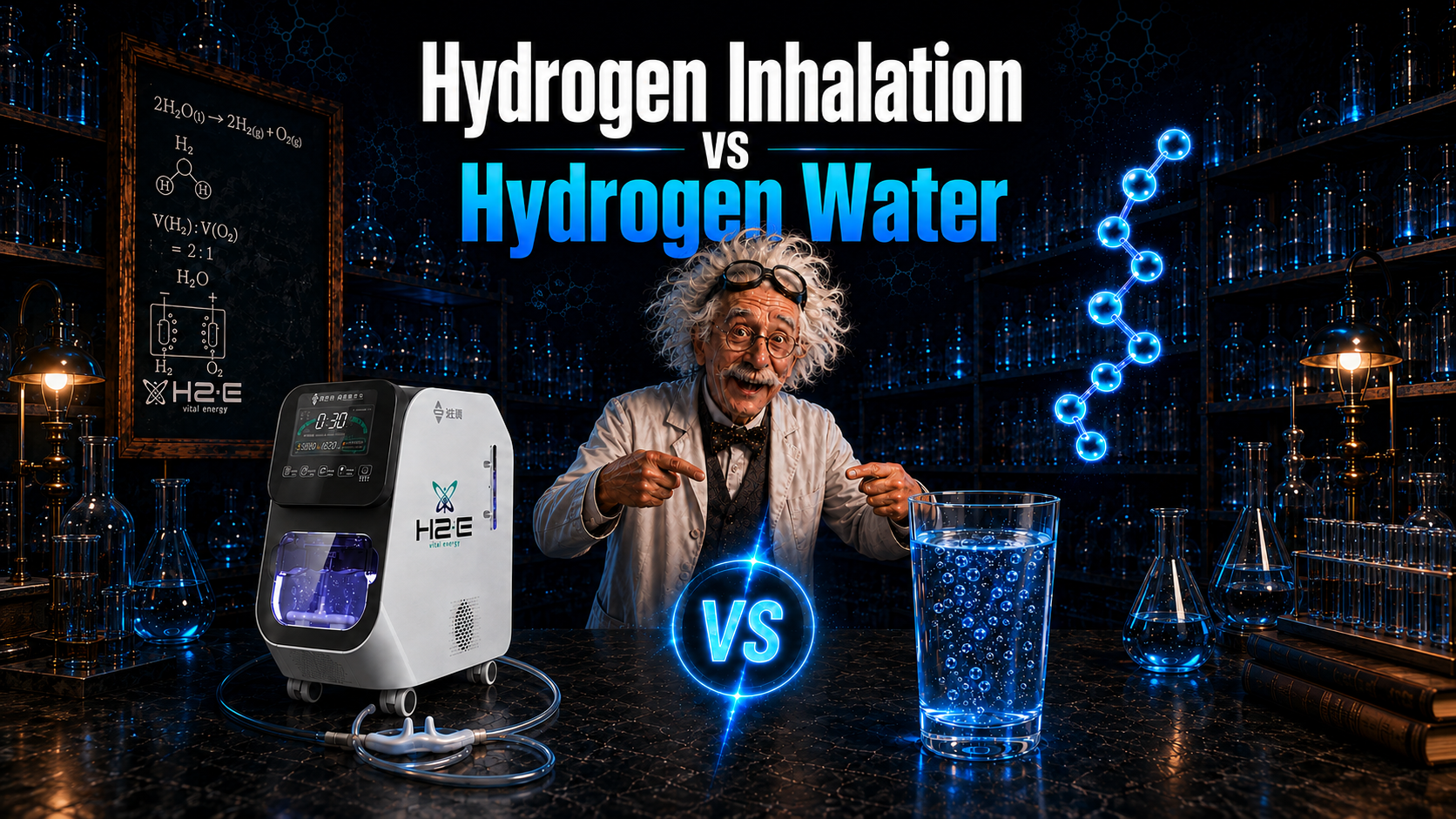
For a clearer explanation of the different delivery methods, read our guide comparing hydrogen inhalation with hydrogen-rich water.
Cheap Hydrogen Machines vs UK-Supported Equipment
| What to compare | Direct marketplace purchase | UK-supported purchase |
|---|---|---|
| Displayed price | May exclude import costs | Usually presented as the UK customer price |
| Import process | Customer may carry responsibility | Normally managed by the UK supplier |
| Output description | May be unclear | Should be explained clearly |
| Documentation | Customer must verify it | Supplier should maintain relevant records |
| Warranty return | May require overseas shipping | UK-based arrangements may be available |
| Technical support | Varies between sellers | Local product support |
| Replacement parts | Availability may be uncertain | Supported models and parts |
| Delivery time | International transit and customs | Dispatch from UK stock, when available |
| Long-term relationship | Often marketplace based | Direct relationship with the supplier |
This does not mean that every marketplace machine is poor quality or that every UK-supplied machine is automatically superior.
The purpose of the comparison is to show that the supplier, documentation, service and ownership arrangements matter alongside the machine itself.
Are All Amazon and Alibaba Hydrogen Machines Poor Quality?
No.
Amazon and Alibaba host many different manufacturers, distributors and sellers. Some may offer well-made equipment and responsive support.
The difficulty is establishing which listings provide:
- Accurate specifications
- Suitable components
- Verifiable documentation
- Honest health-related marketing
- Reliable long-term support
- A practical warranty for UK customers
Customer reviews can provide useful information, but reviews alone cannot verify internal components, gas composition, long-term output stability or regulatory documentation.
The right question is not simply:
Where can I find the cheapest hydrogen machine?
A better question is:
What exactly am I receiving, what will it cost after import and who will support me if something goes wrong?
What Is Included When Buying from H2=E?
H2=E has specialised in molecular-hydrogen equipment since 2017.
Our aim is not to compete with the cheapest anonymous listing. We focus on providing a complete UK-supported ownership experience that includes:
- Carefully selected hydrogen equipment
- Clearly explained combined H₂/O₂ output
- USA PEM membrane technology
- UK-based stock and dispatch
- No unexpected customer customs process
- Two-year warranty
- UK customer and technical support
- Setup and maintenance guidance
- Replacement parts and accessories
- Ongoing aftercare
- Nine years of specialist experience
We believe customers should understand what they are purchasing before they make an investment.
You can compare specifications and output levels across our range of H2=E molecular hydrogen machines.
Hydrogen-Machine Buyer’s Checklist
Before buying, obtain clear answers to these questions:
- What does the stated ml/min output measure?
- What percentage of the output is hydrogen?
- Has the flow rate been tested?
- Who manufactures the electrolysis cell and PEM membrane?
- What product documentation is available?
- Which safety and monitoring systems are included?
- What water does the machine require?
- What is the complete landed UK price?
- Who is responsible for VAT and customs clearance?
- Where must the machine be returned for a warranty claim?
- Who pays the return shipping?
- Are replacement parts available?
- Who provides technical support after purchase?
- Are the health claims appropriately qualified?
If the seller cannot answer these questions clearly, the lower price may carry more uncertainty than it first appears.
Frequently Asked Questions
Why are some hydrogen machines so cheap?
Lower prices may reflect reduced component costs, large-scale manufacturing, direct factory sales, fewer included services, limited documentation or the absence of a local warranty and support network. The reason will vary between manufacturers and sellers.
Is a more expensive hydrogen machine always better?
No. Price alone does not prove quality. Buyers should compare output definitions, components, testing, documentation, safety features, warranty terms and aftercare.
Will I pay VAT on a hydrogen machine imported into the UK?
VAT applies to goods imported into the UK, although the collection method depends on the consignment value and how the product is sold. For consignments above £135, import VAT is generally collected at import, and Customs Duty may also apply.
Is CE or UKCA marking enough to prove quality?
No. A conformity mark is not a general quality award. It indicates a manufacturer’s declaration that the product meets applicable requirements. Buyers should check that the documentation identifies the correct manufacturer and model.
Does a higher flow rate mean a better machine?
Not automatically. The figure must state whether it represents pure hydrogen or combined H₂/O₂ output. Stability, gas composition, build quality, session requirements and technical support also matter.
Are marketplace reviews reliable?
They can provide helpful information about delivery and early customer experience, but they cannot normally verify internal construction, long-term reliability or the accuracy of technical and medical claims.
Cheap Hydrogen Machines: Key Takeaways
Cheap hydrogen machines are not automatically poor-quality products. However, a low advertised price should be treated as the beginning of the comparison—not the conclusion.
Before buying, consider:
- The final delivered UK cost
- Import VAT and possible duty
- How output is measured
- Internal component quality
- Product documentation
- Safety systems
- Warranty practicality
- Replacement-part availability
- UK technical support
- The accuracy of health-related claims
A machine that includes dependable equipment, transparent specifications, UK delivery, a practical warranty, replacement parts and knowledgeable aftercare may provide better long-term value than one selected on price alone.
Disclaimer
This article is provided for general consumer information and does not constitute legal, tax, regulatory or medical advice.
Import charges and product regulations can change and may depend on the product’s classification, value, origin and intended use. Buyers should consult current UK Government guidance and obtain professional advice where necessary.
Molecular-hydrogen equipment should not be used as a substitute for professional medical advice, diagnosis or treatment.