Inhale H2 vs Hydro Nova: Which Hydrogen Machine Offers Better Value?
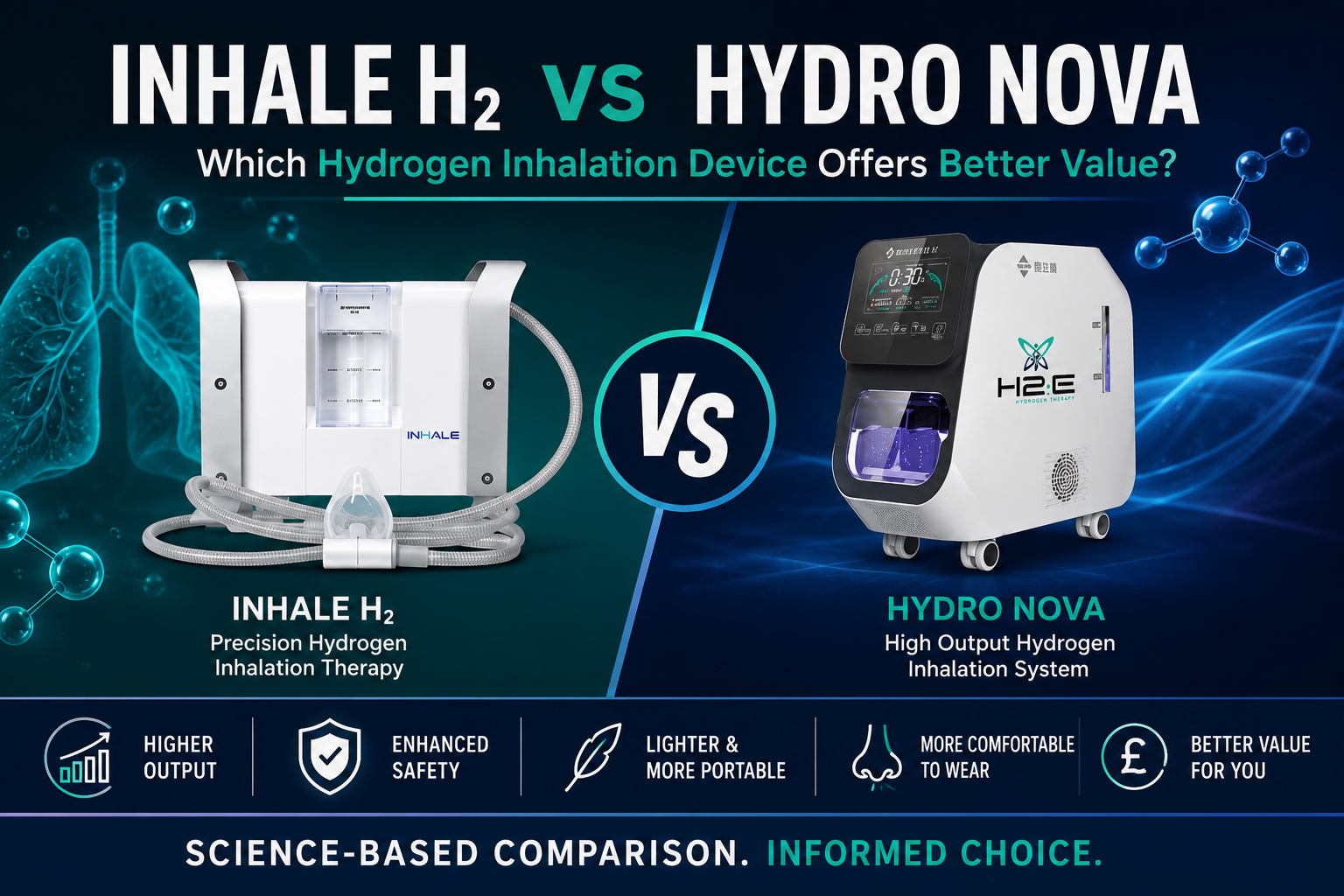
The Inhale H2 vs Hydro Nova comparison is not as straightforward as placing two flow-rate figures next to each other.
These hydrogen inhalation machines follow two different engineering approaches:
- Inhale H₂ mixes pure hydrogen with ambient air and delivers a controlled concentration through a mask and reservoir.
- Hydro Nova generates a continuous hydrogen–oxygen mixture and delivers it through a nasal cannula.
Both approaches expose the user to molecular hydrogen, but output, inspired concentration, delivery efficiency, comfort and purchase cost must be measured separately.
This updated comparison examines the publicly available specifications of both machines and explains which measurements matter when choosing a hydrogen inhalation system.
Disclosure: H2=E supplies the Hydro Nova. We have therefore used publicly available information for Inhale H₂ and clearly distinguished verified specifications from our own product information. Prices and warranty terms should be checked with the respective seller before purchasing.
Inhale H2 vs Hydro Nova: Quick Comparison
| Feature | Inhale H₂ | Hydro Nova 1500 |
|---|---|---|
| Delivery approach | Hydrogen mixed with ambient air | Continuous hydrogen–oxygen generation |
| User interface | Mask, valve and reservoir bag | Nasal cannula |
| Total stated flow | Approximately 12 L/min, mostly ambient air | Up to 1,500 mL/min generated H₂/O₂ gas |
| Hydrogen component | Approximately 133–487 mL/min across settings | Approximately 1,000 mL/min at maximum output |
| Inspired hydrogen | Adjustable, approximately 1–4% | Depends on output, cannula position and breathing |
| Maximum 30-minute hydrogen volume | Approximately 14.6 litres at the highest tested setting | Approximately 30 litres generated |
| UK price checked | £4,899 | £2,750 |
| Warranty | Verify with the current retailer; one-year manufacturer warranty reported by H2HUBB | Two years from H2=E |
| Machine weight | Approximately 12.25 kg | 9.4 kg without water |
| Water requirement | Distilled water below 5 ppm TDS | Distilled water; H2=E recommends 2 ppm or less |
| Best suited to | Users wanting controlled inspired concentration and mask delivery | Users prioritising higher continuous hydrogen generation, cannula comfort and lower cost |
Prices and specifications were checked in August 2026 and may change.
Two Different Hydrogen-Delivery Systems
Before comparing output, it is important to understand what each machine is designed to do.
How Inhale H₂ works
Inhale H₂ produces high-purity hydrogen and mixes it with filtered ambient air.
The resulting hydrogen-and-air mixture is delivered through:
- A mask
- A one-way valve
- A three-litre reservoir bag
- A constant total gas flow of approximately 12 L/min
The user can select an inspired hydrogen concentration of approximately 1%, 2%, 3% or 4%.
The principal advantage is control over FiH₂, or the fraction of inspired hydrogen. Its mask and reservoir system are intended to reduce dilution and provide a more predictable concentration during each breath.
Independent H2HUBB testing reported an estimated hydrogen component of approximately 133–487 mL/min, depending on the selected setting. The remaining flow is primarily ambient air. Independent Inhale H₂ testing and specifications.
The current UK retail listing shows a price of £4,899. UK Inhale H₂ product listing.
How Hydro Nova works
Hydro Nova uses PEM electrolysis to split distilled water and generate a continuous mixture containing approximately:
- 66.6% hydrogen
- 33.3% oxygen
Its maximum total generated-gas output is 1,500 mL/min. That represents approximately:
- 1,000 mL/min of hydrogen
- 500 mL/min of oxygen
The machine offers three total-output settings:
- 450 mL/min
- 900 mL/min
- 1,500 mL/min
The gas is delivered through a lightweight nasal cannula, allowing users to breathe normally, speak, read, work or watch television during a session.
The Hydro Nova currently costs £2,750, including free UK delivery and a two-year H2=E warranty. View the Hydro Nova 1500 specifications.
Why the 12 L/min Figure Can Be Misleading
One of the most important points in the Inhale H2 vs Hydro Nova comparison is that their headline flow rates do not measure the same thing.
Inhale H₂’s approximately 12 L/min figure represents the complete breathing mixture:
It does not mean the machine produces 12 litres of hydrogen per minute.
At its highest independently evaluated setting, the hydrogen component is approximately 487 mL/min. The remainder is the air used to create the selected concentration.
Hydro Nova’s 1,500 mL/min specification represents gas actually produced through electrolysis:
Therefore, directly comparing “12 L/min” with “1.5 L/min” would incorrectly make Inhale H₂ appear to produce eight times more hydrogen.
It does not.
Produced Hydrogen, Inspired Hydrogen and Absorbed Hydrogen
Three different measurements must be kept separate:
Hydrogen produced
This is the volume of hydrogen generated by the machine.
At maximum settings:
- Inhale H₂: approximately 487 mL/min hydrogen
- Hydro Nova: approximately 1,000 mL/min hydrogen
Hydrogen inspired
This is the amount and concentration entering the user’s airways.
Inhale H₂ is designed to provide a defined 1–4% inspired concentration through its mask and reservoir.
Hydro Nova generates more hydrogen, but cannula delivery is open to the surrounding air. Actual inspired concentration will vary according to:
- The machine setting
- Cannula placement
- Breathing rate
- Breath depth
- Whether the user breathes through the nose or mouth
- Ambient-air dilution
Hydrogen absorbed
This is the amount that crosses the lungs into the bloodstream and reaches tissues.
Neither produced volume nor inspired percentage alone proves how much hydrogen is absorbed over an entire session.
There is currently no published head-to-head human trial comparing blood or tissue hydrogen levels after using these two specific machines. Therefore, neither manufacturer can scientifically claim superior absorption or health outcomes from engineering specifications alone.
Comparing a 30-Minute Session
A volume comparison can show how much hydrogen each machine makes available, but it does not measure absorption.
Inhale H₂ at the highest tested setting
The mask-and-reservoir system is designed to deliver that gas efficiently while maintaining an inspired concentration near 4%.
Hydro Nova at maximum output
The complete hydrogen–oxygen gas mixture produced during the session would be:
Hydro Nova therefore generates approximately twice as much hydrogen at maximum output. However, some of that gas will enter the surrounding room because a nasal cannula is an open delivery method.
The comparison demonstrates the machines’ different philosophies:
- Inhale H₂ emphasises controlled concentration and reduced delivery loss.
- Hydro Nova emphasises higher continuous hydrogen generation and user comfort.
It does not establish which system produces greater biological absorption or better health outcomes.
FiH₂: Why Inspired Concentration Matters
FiH₂ means Fraction of Inspired Hydrogen—the percentage of hydrogen in the gas mixture being inhaled.
Inhale H₂ allows the user to choose a defined concentration of approximately 1–4%. This is a meaningful advantage for:
- Researchers
- Practitioners following concentration-based protocols
- Users who prefer a sealed mask
- Environments requiring more standardised delivery
Hydro Nova does not claim to maintain a fixed inspired percentage at the nose. Instead, it provides a larger continuous volume through a cannula.
A higher inspired percentage can increase the concentration gradient across the lungs, but concentration is not the only relevant variable. Total exposure also depends on:
- Hydrogen flow
- Session duration
- Ventilation
- Breathing pattern
- Delivery efficiency
- Individual physiology
No clinical evidence currently demonstrates that the Inhale H₂ mask-and-reservoir method produces better health outcomes than continuous cannula delivery.
Comfort and Everyday Use
Specifications matter, but a machine must be practical enough to use consistently.
Inhale H₂ experience
Inhale H₂ requires the user to wear a fitted mask connected to a valve and reservoir bag.
Potential advantages include:
- Controlled inspired concentration
- Reduced dilution with room air
- More repeatable delivery
- Structured protocol settings
Possible disadvantages include:
- Some users may find a mask restrictive
- Speaking, drinking and working may be less convenient
- The reservoir and valve create additional components to handle
- The system is heavier
Hydro Nova experience
Hydro Nova uses a nasal cannula.
Potential advantages include:
- Lightweight and unobtrusive
- Easy to use while reading or working
- Less restrictive during longer sessions
- No face seal required
- Simple continuous operation
Possible disadvantages include:
- Inspired concentration is less precisely controlled
- Mouth breathing can reduce nasal delivery
- Some generated gas is inevitably released into the room
The better experience depends on whether the buyer prioritises concentration control or everyday comfort.
Price and Ownership Value
The UK prices checked for this comparison were:
- Inhale H₂: £4,899
- Hydro Nova 1500: £2,750
The difference is:
Hydro Nova is therefore approximately 44% less expensive than the listed Inhale H₂ price.
The lower price does not make Hydro Nova technologically superior, but it is an important consideration for households and wellness businesses seeking higher generated hydrogen volume at a lower initial investment.
Hydro Nova also includes:
- Free UK delivery
- A two-year warranty
- UK-based customer support
- A TDS water-testing pen
- Cannulas
- A setup manual and video
- Replaceable filtration
Inhale H₂ justifies its higher price through a more complex delivery system, controlled FiH₂ settings, a reservoir and mask assembly, filtration and integrated safety monitoring.
Warranty and Support
The original article described Inhale H₂ as including a three-year warranty. We could not verify that from the current UK retailer listing.
H2HUBB currently reports a one-year manufacturer warranty, with customers responsible for applicable shipping, duties and taxes. Buyers should confirm the exact terms with their chosen retailer before ordering.
Hydro Nova includes a two-year H2=E warranty, free UK delivery and UK-based support.
For a buyer in Britain, local support can matter because hydrogen machines may eventually require:
- Replacement filters
- Cannulas or tubing
- Setup assistance
- Water-quality guidance
- Diagnosis of operational alerts
- Warranty servicing
The true purchase cost should therefore include the ownership and support package—not only the advertised price.
Safety Considerations
Both systems approach safety differently.
Inhale H₂ mixes hydrogen with ambient air to maintain an inspired concentration at or below approximately 4%. It also lists an internal leak sensor, ventilation, pressure-relief support and automatic shutdown features.
Hydro Nova generates hydrogen and oxygen together and lists an intelligent sensor array, cooling system, sealed humidifier and triple protective safety system.
All hydrogen equipment should be:
- Used exactly as instructed
- Operated in a ventilated room
- Kept away from flames, smoking and ignition sources
- Filled only with the specified distilled water
- Maintained according to the manufacturer’s instructions
Published human research found that prolonged inhalation of a 2.4% hydrogen-in-air mixture was well tolerated by healthy adults, but this does not validate every machine, concentration or usage protocol. Prolonged hydrogen-inhalation safety study.
Read our complete guide to hydrogen-therapy safety and essential precautions.
Which Machine Is Better for You?
Inhale H₂ may suit you if:
- You want a defined inspired hydrogen concentration
- You prefer mask-and-reservoir delivery
- Repeatable concentration settings are a priority
- You are comfortable paying more for its delivery design
- You do not mind wearing a fitted mask
Hydro Nova may suit you if:
- You want higher continuous hydrogen generation
- You prefer a lightweight nasal cannula
- You want to read, work or relax during longer sessions
- Lower purchase cost is important
- You value a two-year warranty and UK support
- You are buying for a household or wellness setting
Which Machine Offers Better Value?
There is no scientifically proven winner for absorption or health outcomes because the machines have not been compared in a head-to-head clinical study.
Inhale H₂ offers the stronger proposition for controlled inspired concentration. Its mask, valve and reservoir system may appeal to users seeking a defined FiH₂ and reduced ambient-air dilution.
Hydro Nova offers the stronger proposition for generated hydrogen volume, comfort and purchase value. At maximum output, it produces approximately 1,000 mL/min of hydrogen, compared with Inhale H₂’s independently evaluated maximum of approximately 487 mL/min.
At the prices checked, Hydro Nova also costs £2,149 less and includes a longer reported warranty.
For most UK home users and wellness businesses prioritising straightforward operation, cannula comfort, higher continuous hydrogen generation and lower ownership cost, Hydro Nova represents the better overall value.
For users prioritising precise inspired concentration and a mask-based reservoir system, Inhale H₂ may justify its higher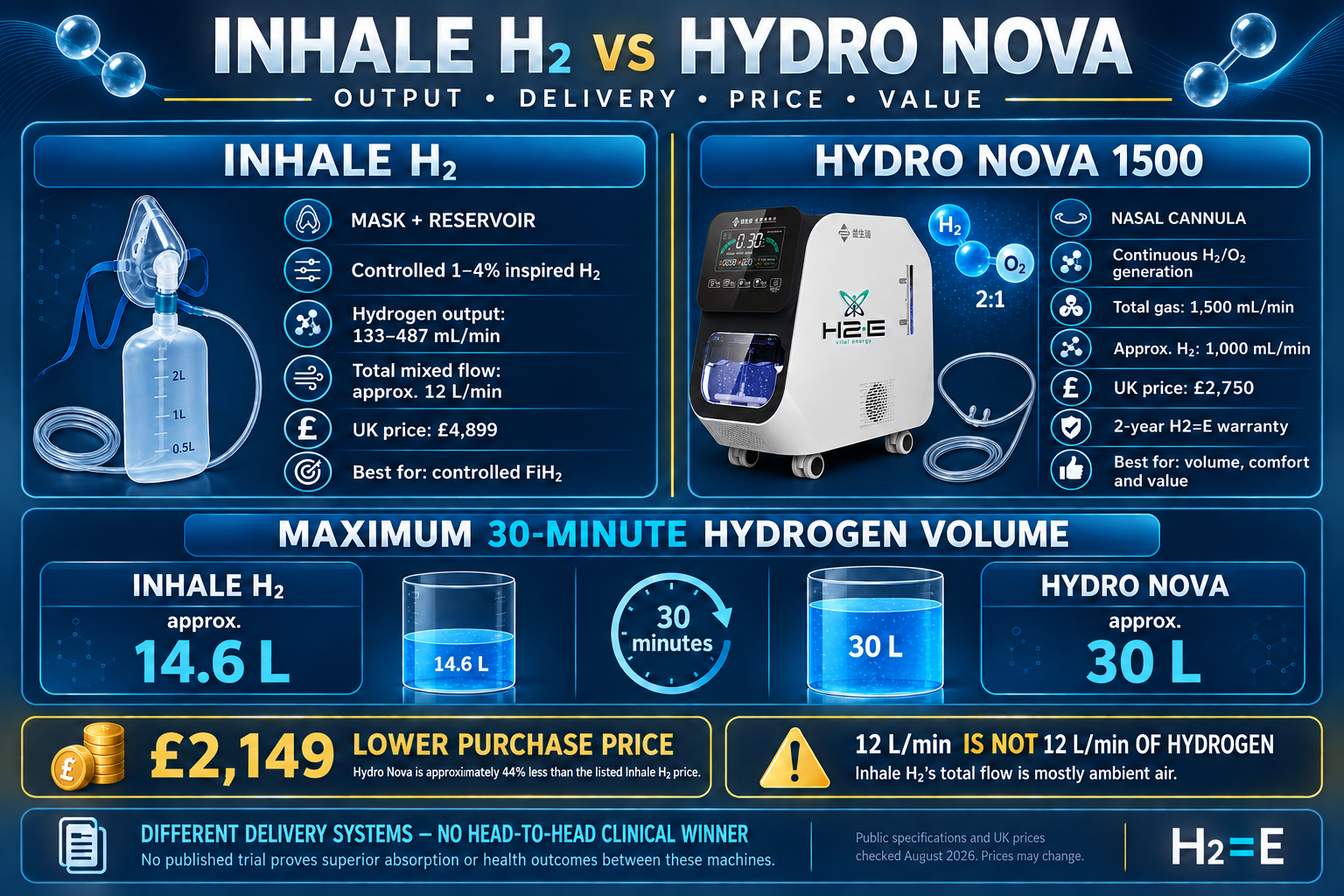
Final Verdict
The Inhale H2 vs Hydro Nova decision comes down to two different priorities:
Neither machine has been clinically proven to deliver superior health outcomes.
Choose according to the delivery experience, specifications, warranty, service package and budget that best suit you—not unsupported medical promises.
Explore the Hydro Nova 1500 or read our guide comparing hydrogen inhalation with hydrogen-rich water.