Molecular Hydrogen Therapy for Depression: What Does the Research Show?
Molecular hydrogen therapy for depression is an emerging area of scientific interest—but it is not currently an approved or proven treatment for depression.
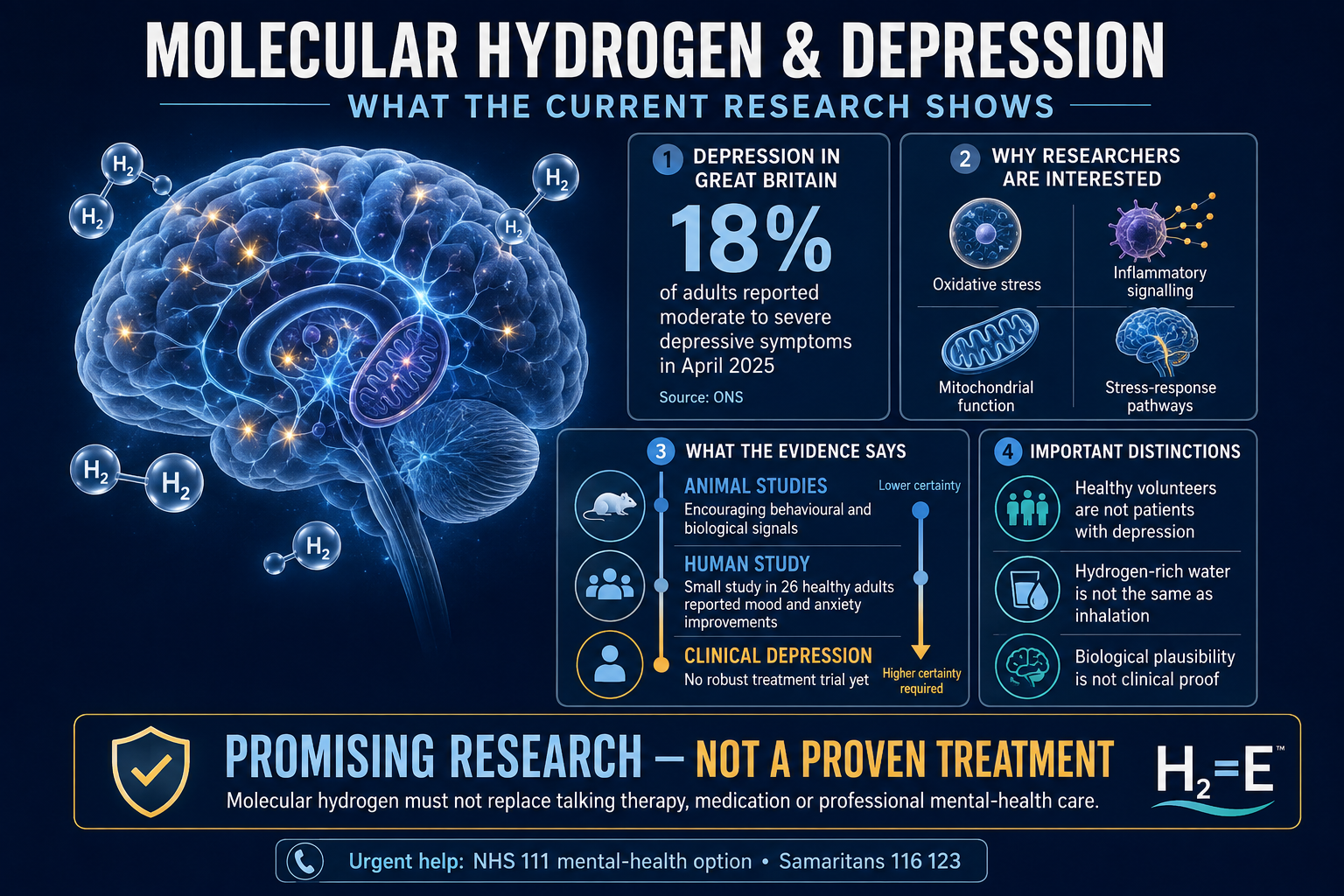
Researchers are investigating molecular hydrogen, or H₂, because of its possible effects on oxidative stress, inflammatory signaling, mitochondrial function and the body’s response to chronic stress. These processes have all been studied in connection with mental health.
Early laboratory and animal studies have produced encouraging findings. A small human study has also reported improvements in mood and anxiety after hydrogen-rich water. However, no robust clinical trial has yet demonstrated that hydrogen inhalation or hydrogen-rich water can treat people diagnosed with major depressive disorder.
This article examines what researchers have discovered, where the evidence remains limited and why larger human trials are essential.
Depression in the UK
Depression is more than feeling temporarily unhappy. It can affect mood, motivation, sleep, appetite, concentration, relationships and a person’s ability to manage everyday life.
In April 2025, approximately 18% of adults in Great Britain reported moderate to severe depressive symptoms. The figure was particularly high among adults aged 16–29, at 26%, according to the Office for National Statistics.
Common symptoms can include:
- Persistent sadness or low mood
- Loss of interest or enjoyment
- Feelings of hopelessness or helplessness
- Low energy and motivation
- Changes in sleep or appetite
- Difficulty concentrating
- Anxiety or irritability
- Feelings of guilt or low self-worth
- Thoughts of self-harm or suicide
Anyone experiencing persistent symptoms should speak to their GP or another qualified healthcare professional. Depression is treatable, and established options include talking therapies, medication and combinations of treatment tailored to the individual.
What Is Molecular Hydrogen Therapy?
Molecular hydrogen therapy involves introducing hydrogen gas into the body, most commonly through:
- Inhaling a carefully produced hydrogen-containing gas
- Drinking hydrogen-rich water
- Using hydrogen-rich saline in clinical research
Hydrogen is the smallest molecule in nature. Its size allows it to diffuse rapidly through biological membranes and reach tissues throughout the body.
Researchers are exploring whether molecular hydrogen may influence biological processes associated with cellular stress. To understand its broader areas of investigation, read our guide to hydrogen therapy benefits and what the scientific research shows.
It is important not to confuse molecular hydrogen with antidepressant medication or psychotherapy. Molecular hydrogen therapy has not been approved as a treatment for depression.
Why Are Researchers Studying Hydrogen and Depression?
Depression is complex and cannot be explained by one chemical imbalance or biological pathway. Genetics, stressful experiences, physical health, hormones, social circumstances and multiple brain systems may all contribute.
Scientists are studying several biological processes that may be relevant to both depression and molecular hydrogen research.
1. Oxidative stress
Oxidative stress occurs when the production of reactive molecules exceeds the body’s ability to manage them.
Some studies have found altered markers of oxidative stress in people with depression. Researchers have therefore questioned whether approaches that influence oxidative balance could have value as part of future mental-health research.
Molecular hydrogen is being investigated for its potential to modulate oxidative stress without indiscriminately suppressing every reactive molecule, many of which also perform essential signaling functions.
This proposed effect remains under investigation and does not prove an antidepressant benefit.
2. Inflammatory signaling
Depression is not simply an inflammatory condition. Nevertheless, a subset of people with depression appear to have elevated inflammatory markers.
Inflammatory signals may affect neurotransmitter metabolism, stress responses, sleep, energy regulation and communication between the immune system and brain.
Preclinical research suggests molecular hydrogen may influence certain inflammatory pathways. Whether these effects can produce meaningful improvements in people with clinical depression remains unknown.
3. Mitochondrial function
Mitochondria generate much of the energy used by cells. The brain has particularly high energy requirements, making healthy mitochondrial function important for normal neurological activity.
Changes in cellular energy metabolism have been investigated in several psychiatric conditions. Molecular hydrogen research is exploring possible effects on mitochondrial stress and energy regulation.
This is a plausible research pathway, but a plausible mechanism should never be mistaken for proof of clinical effectiveness.
4. The stress-response system
Long-term stress can influence cortisol regulation, sleep, immune activity and mood.
Researchers using chronic-stress animal models have investigated whether hydrogen can affect behavioral and biological responses to stress. Some results have been encouraging, but animal behavior cannot reproduce the full complexity of human depression.
What Does the Research Show?
Hydrogen inhalation in a chronic-stress animal model
A frequently discussed 2017 study investigated repeated hydrogen-gas inhalation in mice exposed to chronic mild stress.
The researchers reported that hydrogen inhalation reduced depression-like and anxiety-like behaviors. They also observed changes involving stress-response and inflammatory pathways.
The study provides an interesting biological signal, but it has major limitations:
- It was conducted in mice, not people.
- Depression-like animal behavior is not equivalent to diagnosed human depression.
- The findings cannot establish an effective human dose or treatment schedule.
- Animal results frequently fail to translate into clinical benefits.
The study supports further investigation—not the conclusion that hydrogen inhalation treats depression.
You can read the published research in Neuropsychopharmacology Reports.
Hydrogen-rich water, mood and anxiety in healthy adults
A small double-blind, placebo-controlled study published in 2018 investigated hydrogen-rich water in 26 healthy adults.
Participants consumed hydrogen-rich water or placebo water for four weeks. The researchers reported improvements in some measures of mood, anxiety and autonomic nerve function in the hydrogen group.
This is an encouraging early human finding, but it was not a depression-treatment trial.
The participants were healthy volunteers rather than people diagnosed with major depressive disorder. The sample was also very small, and the study investigated hydrogen-rich water—not hydrogen inhalation.
The results therefore cannot demonstrate that molecular hydrogen therapy treats clinical depression.
Read the full human study.
More recent preclinical research
Additional animal studies have continued investigating molecular hydrogen in models involving chronic stress, pain and depression-like behaviour.
Some have reported changes in inflammatory markers, oxidative balance, neuroplasticity or behavior. These findings may help researchers identify biological pathways worth studying in humans.
Nevertheless, the overall evidence remains preclinical. Different studies use different animal models, hydrogen-delivery methods, concentrations and outcome measures, making direct comparisons difficult.
Could Hydrogen Inhalation Help Depression?
At present, there is not enough clinical evidence to say that hydrogen inhalation helps depression.
The inhalation research is interesting because this delivery method allows molecular hydrogen to enter the body rapidly. However, evidence that a molecule reaches the brain or affects a biological pathway does not automatically mean it improves a psychiatric condition.
Important unanswered questions include:
- Does hydrogen inhalation improve symptoms in diagnosed depression?
- Would any benefit be greater than placebo?
- Which patients, if any, might respond?
- What concentration and session duration should be studied?
- How long might an effect last?
- Could hydrogen interact with medication or underlying conditions?
- Are repeated sessions safe and practical for psychiatric patients?
These questions require properly designed, preregistered and independently replicated human trials.
Molecular Hydrogen Is Not a Replacement for Depression Treatment
Current evidence does not support replacing established mental-health treatment with molecular hydrogen.
Depending on the severity and individual circumstances, NHS depression treatment may include:
- Guided self-help
- Cognitive behavioral therapy
- Other talking therapies
- Antidepressant medication
- A combination of therapy and medication
- Specialist mental-health care
For moderate to severe depression, the NHS may recommend a combination of talking therapy and antidepressant medication. Treatment decisions should be made with a GP or qualified mental-health professional. See the NHS depression treatment guidance.
People using prescribed antidepressants should never stop or change their medication without medical guidance.
Before considering any hydrogen equipment, it is also important to understand appropriate operation and precautions. Our article Is Hydrogen Therapy Safe? explains the essential safety considerations.
What Would Better Research Look Like?
To determine whether molecular hydrogen therapy for depression has genuine clinical value, researchers would need:
- Participants with a confirmed depressive disorder
- A sufficiently large sample
- Randomization and an appropriate placebo or sham treatment
- Blinding wherever practically possible
- Standardized hydrogen concentration and exposure
- Validated depression-rating scales
- Monitoring of medication and other treatments
- Longer follow-up periods
- Transparent reporting of adverse events
- Independent replication of positive findings
Studies should also distinguish between improved general wellbeing and a clinically meaningful reduction in depression.
The Bottom Line
Molecular hydrogen therapy for depression is a promising research question, not a proven treatment.
Animal studies suggest hydrogen may influence stress-related behavior, oxidative balance, inflammatory signaling and other biological pathways. A small study in healthy adults also reported improvements in certain mood and anxiety measures after hydrogen-rich water.
However:
- Healthy volunteers are not the same as patients with depression.
- Animal findings cannot establish clinical effectiveness.
- Hydrogen-rich water results cannot automatically be applied to inhalation.
- Robust trials in people diagnosed with depression are still lacking.
Molecular hydrogen may eventually be studied as an adjunct alongside established care, but current evidence does not justify describing it as an antidepressant therapy.
Anyone experiencing depression should seek professional support and continue prescribed treatment unless advised otherwise by their clinician.
Urgent Mental-Health Support
If you or someone else is in immediate danger, call 999 or go to A&E.
For urgent mental-health help in England, call NHS 111 and select the mental-health option. You can also call Samaritans free on 116 123, at any time of day or night. NHS urgent mental-health guidance confirms these options.