Molecular hydrogen has attracted interest in Parkinson’s research because of its possible effects on oxidative stress, inflammation and mitochondrial function. But what have human trials actually found? This evidence-led guide separates promising laboratory science from clinical reality.
Parkinson’s disease is a progressive neurological condition that affects movement and can also influence sleep, mood, thinking, digestion and many other aspects of daily life. Because oxidative stress and mitochondrial dysfunction are involved in the biology of Parkinson’s, researchers have investigated whether molecular hydrogen (H₂) might offer a useful supportive approach.
The short answer is that molecular hydrogen is scientifically interesting, but it is not a proven treatment for Parkinson’s disease. Early laboratory and animal studies were encouraging, and one very small human pilot study reported improvement with hydrogen-rich water. However, a much larger multicentre trial did not reproduce that benefit. A subsequent trial of hydrogen inhalation also found no significant clinical improvement.
That does not mean research should stop. It means the evidence must be presented in the correct order: biological plausibility first, human clinical results second, and firm conclusions only when those results are consistent.
Important: Molecular hydrogen should not replace levodopa, other prescribed medication, physiotherapy, exercise or specialist Parkinson’s care. Anyone living with Parkinson’s should speak with their neurologist or Parkinson’s nurse before trying a complementary intervention.
What is Parkinson’s disease?
Parkinson’s disease develops when nerve cells in an area of the brain called the substantia nigra become damaged or die. These cells produce dopamine, a chemical messenger that plays an essential role in coordinating movement.
The three best-known movement symptoms are:
-
Tremor or shaking
-
Slowness of movement, known as bradykinesia
-
Muscle stiffness or rigidity
Parkinson’s is much broader than a movement disorder, however. Non-motor symptoms may include constipation, sleep disturbance, anxiety, depression, fatigue, pain, reduced sense of smell, memory changes and problems with blood-pressure regulation. Symptoms and progression differ considerably from one person to another.
There is currently no cure, but medication, exercise and multidisciplinary support can help manage symptoms and preserve quality of life. Treatment should be individualised by a specialist team.
Why are scientists studying molecular hydrogen?
Molecular hydrogen is a colourless, odourless gas formed from two hydrogen atoms. It can be administered experimentally in several ways, most commonly by drinking hydrogen-rich water or inhaling a controlled hydrogen-containing gas mixture.
H₂ is unusually small and can diffuse rapidly across biological membranes. Researchers are investigating whether it can influence redox signalling, inflammatory pathways and cellular stress responses. This is more nuanced than describing hydrogen as a conventional antioxidant that simply “neutralises free radicals.” Its biological activity may involve indirect regulation of the body’s own protective systems.
You can learn more about the wider field in our evidence-led guide to hydrogen therapy benefits.
The biological connection: oxidative stress, mitochondria and Parkinson’s
Three overlapping processes help explain why H₂ entered Parkinson’s research.
1. Oxidative stress
Reactive oxygen species are generated naturally during metabolism and have useful roles in cell signalling. Problems arise when their production exceeds the body’s ability to regulate them, contributing to oxidative damage.
Dopamine-producing neurons may be particularly vulnerable because dopamine metabolism itself can generate reactive molecules. Oxidative stress is therefore considered part of the complex biology of Parkinson’s—but it is not the sole cause of the condition.
2. Mitochondrial dysfunction
Mitochondria generate much of the energy cells need. Evidence links impaired mitochondrial energy production, defective removal of damaged mitochondria and altered calcium regulation with Parkinson’s disease. These problems can increase cellular stress and may make dopamine-producing neurons less resilient.
3. Neuroinflammation
The brain’s immune cells can become persistently activated in neurodegenerative disease. Although inflammation initially serves protective purposes, prolonged or dysregulated inflammatory signalling may contribute to further neuronal injury.
Laboratory studies suggest molecular hydrogen may influence each of these pathways. But a plausible mechanism does not prove that an intervention improves symptoms or slows disease progression in people. Clinical trials are essential.
What have studies of molecular hydrogen and Parkinson’s found?
Preclinical studies: promising, but not proof in humans
In cell and animal models of Parkinson-like neurodegeneration, molecular hydrogen has been associated with reduced oxidative damage and protection of dopamine-producing neurons. These experiments helped establish the rationale for human trials.
Animal models are valuable for investigating mechanisms, but they cannot reproduce the full complexity of human Parkinson’s disease. Doses, delivery methods and experimentally induced injury may also differ greatly from real-world disease.
2013 hydrogen-water pilot study: a positive early signal
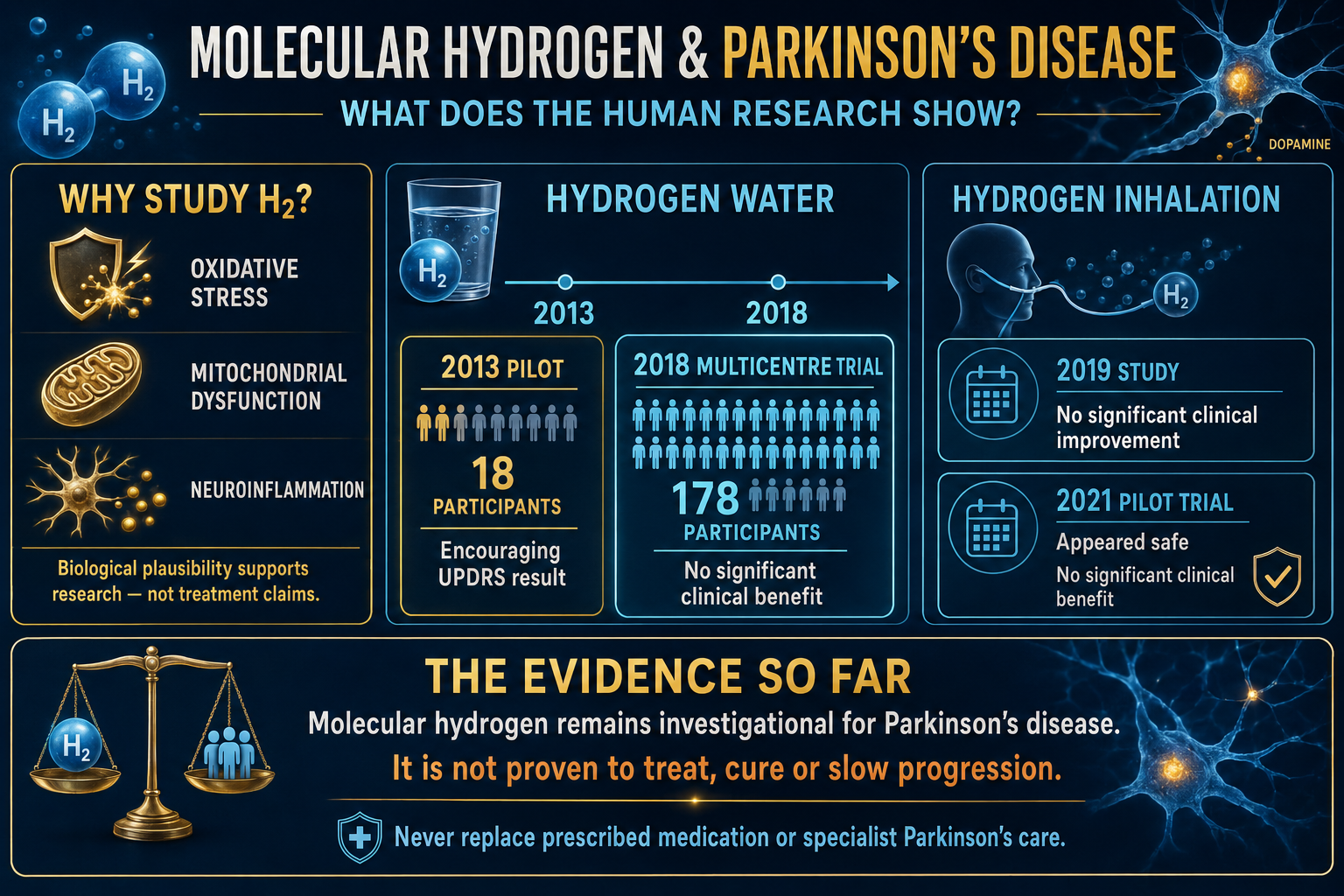
A randomised, double-blind pilot study included only 18 people with Parkinson’s who were taking levodopa. Participants drank either one litre of hydrogen-rich water or placebo water each day for 48 weeks.
The hydrogen-water group showed a more favourable change in total Unified Parkinson’s Disease Rating Scale (UPDRS) score than the placebo group. Hydrogen water was also reported to be safe and well tolerated during the study.
This result attracted considerable attention, but the sample was extremely small: only nine participants in each group. Small trials are more vulnerable to chance findings, baseline differences and exaggerated estimates of benefit. The correct conclusion was that a larger confirmatory trial was needed—not that hydrogen water had been proven effective.
2018 multicentre hydrogen-water trial: no demonstrated benefit
Researchers then conducted a substantially larger randomised, double-blind, placebo-controlled study across 14 Japanese hospitals. It enrolled 178 people with Parkinson’s, who drank one litre of hydrogen-rich water or placebo water daily for up to 72 weeks.
The trial found no significant advantage for hydrogen water on the total UPDRS score. It also found no significant between-group benefit in individual UPDRS sections, quality of life measured by the PDQ-39, or Hoehn and Yahr disease stage.
The larger trial supported safety under the study conditions, but it did not confirm the efficacy signal from the earlier pilot. Because it was much larger and multicentre, it carries more evidential weight.
Hydrogen inhalation studies: safe in trials, but no clinical benefit shown
A small 2019 study investigated low-dose hydrogen inhalation. It did not find a significant improvement in clinical Parkinson’s measures. An unexpected rise in urinary 8-hydroxy-2′-deoxyguanosine, a marker associated with oxidative DNA damage, also illustrated why hydrogen’s biology should not be reduced to a simple antioxidant narrative.
A later randomised, double-blind, placebo-controlled pilot trial assessed hydrogen inhalation in people with Parkinson’s. Published in 2021, it reported that the protocol appeared safe but did not produce significant beneficial effects on Parkinson’s outcomes.
Evidence at a glance
| Evidence | Intervention | Main finding | What it means |
|---|---|---|---|
| Cell and animal studies | H₂ water or gas | Neuroprotective and redox-related effects reported in experimental models | Supports further research, not clinical claims |
| 2013 pilot, 18 participants | 1 litre/day H₂ water for 48 weeks | More favourable UPDRS change than placebo | Interesting early signal; far too small to establish efficacy |
| 2018 multicentre trial, 178 participants | 1 litre/day H₂ water for up to 72 weeks | No significant clinical benefit versus placebo | The positive pilot result was not confirmed |
| 2019 inhalation study | Low-dose H₂ inhalation | No significant change in clinical measures | No demonstrated symptomatic benefit |
| 2021 inhalation pilot | H₂ inhalation versus placebo | Appeared safe; no significant beneficial effects | More research would be needed before clinical use |
Can hydrogen therapy slow the progression of Parkinson’s?
There is currently no reliable human evidence that molecular hydrogen slows, stops or reverses Parkinson’s disease.
This distinction matters. A therapy may influence a biomarker or produce an effect in an animal model without altering the course of a human neurodegenerative condition. To establish a disease-modifying effect, researchers would need adequately powered trials with rigorous blinding, consistent formulations, meaningful clinical outcomes and long follow-up periods.
Existing studies do not meet that evidential threshold.
Hydrogen water versus hydrogen inhalation for Parkinson’s
Both routes deliver H₂, but they are not interchangeable.
Hydrogen-rich water contains dissolved gas that begins escaping after production, especially when the container is opened or the water is agitated. The delivered amount depends on concentration, storage and how quickly it is consumed.
Hydrogen inhalation provides continuing respiratory exposure during a session, but the delivered concentration, flow, duration and gas composition all matter. Results from hydrogen-water research cannot automatically be applied to inhalation, and a higher gas output cannot be assumed to produce a better medical outcome.
Most importantly, the available Parkinson’s trials have not established clinical efficacy for either route. Our comparison of hydrogen inhalation versus hydrogen water explains the practical differences without treating them as proven disease therapies.
Is molecular hydrogen safe for people with Parkinson’s?
The published Parkinson’s trials generally reported that hydrogen water and the tested inhalation protocols were well tolerated. Nevertheless, “well tolerated in a research protocol” is not the same as universally safe in every person, device or setting.
Important points include:
-
H₂ should never be used as a substitute for prescribed Parkinson’s treatment.
-
Medication should not be reduced, delayed or stopped without specialist advice.
-
Hydrogen is flammable; inhalation equipment must be properly designed, maintained and used away from flames, smoking, sparks and heat sources.
-
Oxygen-containing gas mixtures require additional fire-safety care.
-
People with swallowing problems should ask their clinical team for advice about fluid intake.
-
New dizziness, falls, confusion, breathing difficulty or symptom changes require medical attention rather than self-adjusting complementary therapies.
Discussing complementary approaches with a neurologist or Parkinson’s nurse also creates an opportunity to review medication timing, “off” periods, falls risk and symptoms that may be more effectively addressed through established care.
What approaches are supported in Parkinson’s care?
For someone living with Parkinson’s, the priorities remain:
-
Specialist-led medication management. Levodopa and other Parkinson’s medicines can substantially improve symptoms, although the appropriate choice and timing vary.
-
Regular medication reviews. Wearing-off, involuntary movements, hallucinations and impulse-control changes should be discussed promptly.
-
Physical activity. Individualised aerobic, resistance, balance and mobility work can help manage symptoms and support wellbeing.
-
Physiotherapy. A physiotherapist with Parkinson’s expertise can address walking, freezing, posture, balance and falls.
-
Speech and language therapy. This may support voice, communication and swallowing.
-
Occupational therapy. Practical adaptations can make daily activities safer and easier.
-
Support for non-motor symptoms. Sleep, mood, pain, constipation, cognition and blood-pressure changes deserve active assessment and treatment.
These approaches have a stronger clinical foundation than molecular hydrogen for Parkinson’s disease. Complementary interests should sit around established care, never compete with it.
What research is still needed?
Future molecular-hydrogen studies would need to answer several questions:
-
Is there a reproducible benefit in a clearly defined group of patients?
-
Does disease stage influence response?
-
Which route, concentration and duration should be tested?
-
Are there credible biological markers showing target engagement?
-
Can any effect be distinguished from placebo and normal symptom fluctuation?
-
Does H₂ improve quality of life or daily function—not only laboratory measures?
-
Are benefits maintained over several years?
Researchers should publish negative as well as positive results. The contrast between the early pilot and later multicentre trial is precisely why replication matters.
The bottom line
Molecular hydrogen and Parkinson’s disease remains a legitimate area of scientific investigation. Oxidative stress, mitochondrial dysfunction and neuroinflammation provide plausible reasons to study H₂, and experimental models have generated encouraging findings.
Human evidence, however, is not currently positive overall. A small hydrogen-water pilot suggested improvement, but the larger multicentre trial found no benefit. Hydrogen-inhalation studies have likewise reported no significant clinical improvement.
The most accurate conclusion is therefore:
Molecular hydrogen appears investigational—not proven—for Parkinson’s disease. It should not be promoted as a treatment, cure or method of slowing progression.
People considering H₂ should first discuss it with their Parkinson’s specialist and continue all evidence-based treatment and support.
Frequently asked questions
Does molecular hydrogen help Parkinson’s disease?
It has not been proven to help. One very small hydrogen-water pilot reported a favourable result, but a larger multicentre trial did not find significant benefits. Trials of hydrogen inhalation have also failed to demonstrate clinical improvement.
Can hydrogen water cure Parkinson’s disease?
No. There is no cure for Parkinson’s disease at present, and no credible evidence shows that hydrogen water cures, reverses or stops it.
Is hydrogen inhalation better than hydrogen water for Parkinson’s?
There is no evidence that either route is clinically effective for Parkinson’s, and no robust head-to-head trial establishes that one is better. They deliver H₂ differently and should be evaluated separately.
Can molecular hydrogen protect dopamine-producing neurons?
Protection has been reported in some cell and animal models. It has not been established that H₂ protects dopamine-producing neurons or slows neuronal loss in people with Parkinson’s.
Can I use hydrogen therapy with levodopa?
Published studies included participants using levodopa, but that does not establish safety for every individual or device. Ask your neurologist, pharmacist or Parkinson’s nurse before combining a complementary intervention with your treatment plan. Never change levodopa without clinical guidance.
Why did the early and later hydrogen-water trials disagree?
The first study had only 18 participants, making it vulnerable to chance findings and an exaggerated treatment effect. The later trial included 178 people across multiple centres and did not reproduce the benefit. Larger confirmatory studies generally provide more dependable evidence.
Is molecular hydrogen approved as a Parkinson’s treatment?
No. Molecular hydrogen is not an approved treatment for Parkinson’s disease in the UK, and it is not included as a Parkinson’s therapy in NICE guidance.
Medical disclaimer
This article is for general information only and does not provide medical advice, diagnosis or treatment. Molecular hydrogen is an emerging research topic and is not an approved treatment for Parkinson’s disease. Speak with a qualified healthcare professional before changing treatment or using a complementary therapy. Never stop or alter Parkinson’s medication without advice from your specialist team.
Scientific references
-
Yoritaka A, et al. Pilot study of H₂ therapy in Parkinson’s disease: a randomized double-blind placebo-controlled trial. Movement Disorders. 2013. https://pubmed.ncbi.nlm.nih.gov/23400965/
-
Yoritaka A, et al. Randomized, double-blind, multicenter trial of hydrogen water for Parkinson’s disease. Movement Disorders. 2018. https://pubmed.ncbi.nlm.nih.gov/30207619/
-
Hirayama M, et al. Inhalation of hydrogen gas elevates urinary 8-hydroxy-2′-deoxyguanosine in Parkinson’s disease. Medical Gas Research. 2019. https://pubmed.ncbi.nlm.nih.gov/30713666/
-
Yoritaka A, et al. Randomized double-blind placebo-controlled trial of hydrogen inhalation for Parkinson’s disease: a pilot study. Neurological Sciences. 2021. https://pubmed.ncbi.nlm.nih.gov/34319514/
-
Wang F, et al. Role and mechanism of molecular hydrogen in the treatment of Parkinson’s disease. Frontiers in Neuroscience. 2025. https://pubmed.ncbi.nlm.nih.gov/40336538/
-
Henrich MT, et al. Mitochondrial dysfunction in Parkinson’s disease—a key disease hallmark with therapeutic potential. Molecular Neurodegeneration. 2023. https://pubmed.ncbi.nlm.nih.gov/37951933/
-
NICE. Parkinson’s disease in adults (NG71). https://www.nice.org.uk/guidance/ng71
-
Parkinson’s UK. Physical activity and exercise. https://www.parkinsons.org.uk/information/treatments/physical-activity-and-exercise