How to Recognise Quality Supplements
When people compare supplements, the first things they often notice are the number of capsules and the price on the bottle. A product offering twice as many tablets for half the price can appear to be the obvious bargain.
But with something we put into our bodies, quantity is not the same as value.
My personal approach is simple: if price were an issue, I would rather buy fewer, carefully selected, good-quality supplements than fill my cupboard with twice as many low-quality products. That does not mean that the most expensive supplement is automatically the best. It means I look beyond the front label and ask what I am actually paying for: the identity and amount of the active ingredient, its form, responsible manufacturing, suitable testing, traceability and honest claims.
Genuine quality supplements should offer transparent labels, traceable ingredients and responsible manufacturing.
A large bottle has little value if the active ingredient is present in an unsuitable form, in a lower amount than expected, or alongside ingredients that should never have been there.
Some of the most serious problems identified in products sold as supplements include:
-
Undeclared pharmaceutical ingredients. Regulators have found products marketed for weight loss, sexual enhancement, pain and bodybuilding that contained hidden drug ingredients or chemicals.
-
Contamination. Poor sourcing or manufacturing controls can introduce heavy metals, microorganisms, pesticides or residues.
-
Incorrect potency. A product may contain substantially more or less of an ingredient than its label states. Too little may provide no meaningful value; too much can increase risk.
-
Ingredient substitution or adulteration. A cheaper material may be used in place of the ingredient a customer believes they are buying.
-
Poor stability or formulation. Even a genuine ingredient may degrade or be delivered in a form that is difficult to use effectively.
-
Excessive fillers, colours, sweeteners or unnecessary additives. These are not automatically harmful, but they can matter to people with allergies, sensitivities or digestive conditions.
-
Unsupported health claims. A professional-looking label and enthusiastic testimonials are not substitutes for reliable evidence.
The US Food and Drug Administration says it has identified more than a thousand products marketed as supplements or foods containing hidden drugs and chemicals. It also makes clear that its online database covers only a fraction of the potentially hazardous products on the market. In the UK, the MHRA previously found dozens of unauthorised medicines being sold as sports supplements and warned consumers about products containing substances such as DMAA.
These are not reasons to fear every supplement. They are reasons to choose carefully.
When poor supplement practices reached the courts
The risks are not merely theoretical. There have been serious enforcement actions and court cases involving supplement businesses.
In the United States, USPlabs and SK Laboratories pleaded guilty in a case involving misbranded dietary supplements. The case related in part to OxyElite Pro, which had been recalled following an investigation into reports of liver injury. In 2020, the US Department of Justice announced sentences for two companies and two individuals connected with the scheme.
In another case, a US federal appeals court upheld an order requiring marketers of Supreme Greens and Coral Calcium supplements to pay $48.2 million after deceptive claims that the products could treat, cure or prevent serious diseases.
The US Federal Trade Commission also took action against Roca Labs over baseless weight-loss claims, undisclosed promotional relationships and efforts to suppress negative customer reviews. The FTC began distributing refunds to eligible customers in 2025 following the court order.
These cases involved different behaviours, and “low price” alone was not the issue. The common lesson is that persuasive marketing, popularity and confident claims do not prove identity, purity, safety or effectiveness.
I would rather choose fewer quality supplements than buy a larger collection of questionable products.
No single badge guarantees a perfect product, but several checks can reduce uncertainty:
-
A transparent label showing the precise ingredient, its form and the amount per serving.
-
A traceable manufacturer or responsible seller with accessible contact details.
-
Appropriate manufacturing standards, such as GMP controls relevant to the country of sale.
-
Independent testing or a batch-specific Certificate of Analysis, where appropriate, covering identity and potency and, when relevant, heavy metals and microbiological contamination.
-
Realistic, evidence-based language rather than promises to cure multiple unrelated conditions.
-
A formulation that suits the individual, including allergies, health conditions, medicines and digestive tolerance.
-
Professional advice when needed, especially during pregnancy, before surgery, or when someone has kidney, liver or heart disease or takes prescription medicines.
Price can reflect better raw materials, testing and manufacturing, but it can also reflect branding. That is why I do not buy on price alone—high or low. I buy on evidence, transparency and suitability.
And when my budget is limited, I would rather prioritise one or two genuinely useful, well-verified supplements than take a large collection of questionable products. I would not simply halve a clinically intended dose without checking the label or speaking to a qualified professional; instead, I would reduce the number of products I buy and focus on what is truly necessary.
The same principle guides our choice of hydrogen machines
This quality-first philosophy is also central to H2=E Hydrogen Therapy.
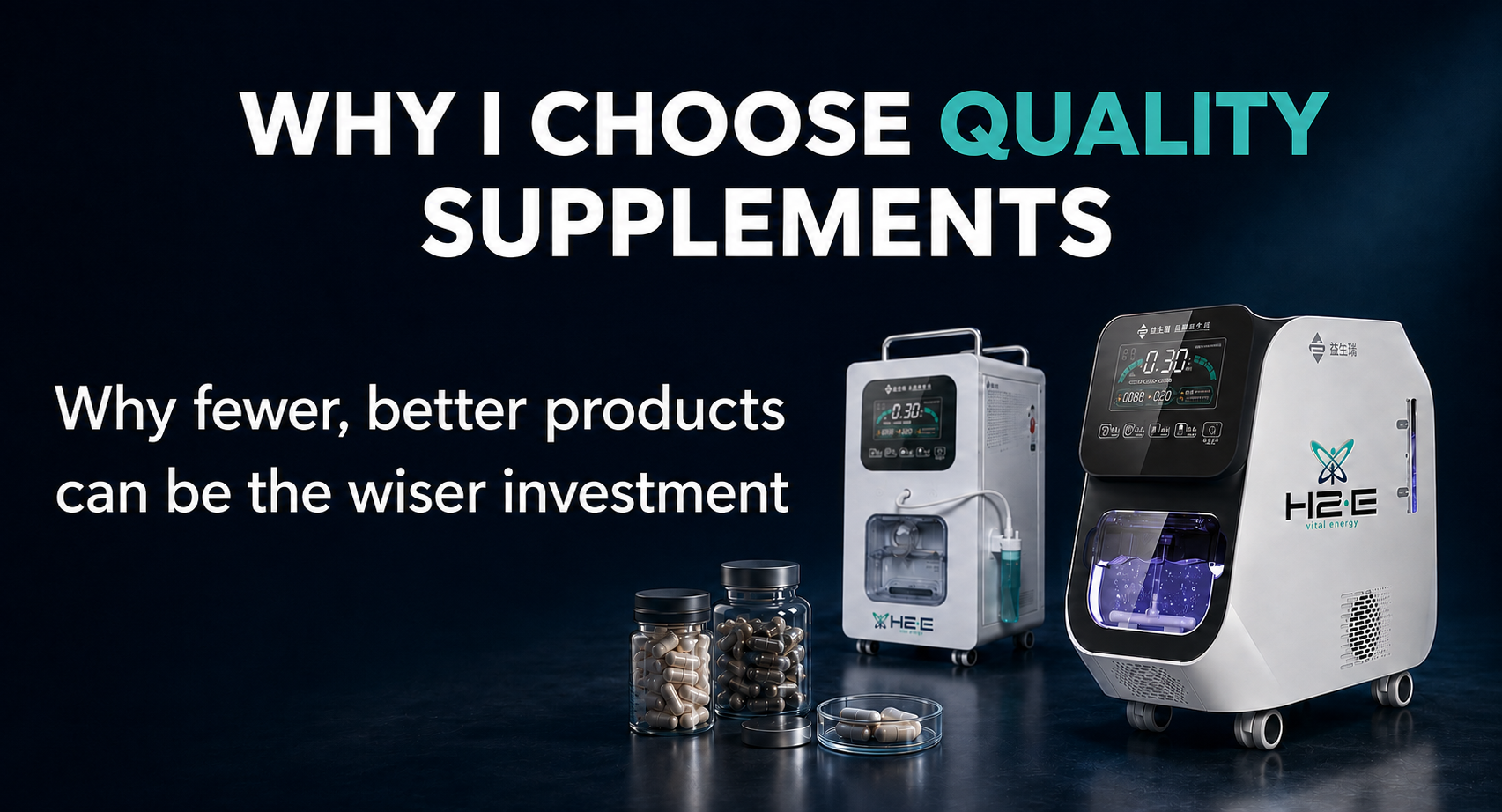
A hydrogen machine is not something we choose only by appearance, claimed output or the lowest possible price. The quality of its core components, engineering, safety features, manufacturing controls, documentation and after-sales support all matter.
Our Hydro Nova machines use a USA-made N117 proton-exchange membrane within the SPE electrolyser system. This is a critical part of the technology used to generate and separate the gas without adding a chemical catalyst.
The machines are documented as listed in China as medical devices for rehabilitation under reference CAAP2026006 and carry quality documentation identified as CE EED35Q814561. Our product information also specifies built-in gas mixing, intelligent sensor detection and triple protection incorporating flame-retardant and explosion-protection technology.
Our manufacturing partner has supplied hydrogen-generation technology used in hospital and clinical-research environments. Molecular hydrogen itself is also being investigated internationally: a 2023 review identified 81 registered clinical trials and 64 scientific publications involving human studies. This research is promising, but it does not mean that every hydrogen machine is equivalent, nor that hydrogen inhalation is approved to diagnose, treat or cure every condition.
For us, quality means being able to explain what is inside the machine, where its key technology comes from, what documentation supports it and what service customers receive after purchase. H2=E provides UK-based guidance and a two-year warranty because the relationship should not end when a machine is delivered.
Fewer—but better
Whether I am choosing a supplement or a hydrogen machine, my principle remains the same: more is not necessarily better, and cheaper is not necessarily better value.
I want to know what I am putting into my body, what technology I am bringing into my home and what evidence stands behind it. If that means choosing fewer products in order to choose better ones, that is a compromise I am willing to make.
Because when it comes to health, quality is not an attractive extra. It is part of the decision.
At H2=E, we apply the same quality-first philosophy to every hydrogen machine we offer. Explore our range of carefully selected molecular hydrogen machines for home and professional use.
[Explore Our Hydrogen Machines]
Sources
FDA: Tainted products marketed as dietary supplements and conventional foods
Molecular Hydrogen Therapy—A Review on Clinical Studies and Outcomes
Important: Food supplements are not a substitute for a varied diet or medical care. Speak with an appropriately qualified healthcare professional before starting a supplement if you have a medical condition, take medication, are pregnant or breastfeeding, or are preparing for surgery. H2=E hydrogen machines are not presented as a cure for disease. Device registration and permitted claims vary by country.